How To Start a Food Franchise Business: Step-by-Step Guide
How To Start a Food Franchise Business: Step-by-Step Guide
Opening a food franchise is one of the most accessible paths to restaurant ownership, but only if you know what you're getting into. From choosing the right brand to signing a franchise agreement and securing funding, every step carries real financial and operational weight. Understanding how to start a food franchise business before you commit your capital is the difference between building something lasting and learning expensive lessons the hard way.
At Russo's New York Pizzeria & Italian Kitchen, we've helped franchisees open 57 locations across the U.S. and internationally , so we know exactly what this process looks like from both sides of the table. Our franchise model is built on over 100 years of Italian family cooking tradition, strong unit economics, and a support system designed to set owners up for long-term success. We share that perspective throughout this guide, not to sell you, but because firsthand franchise experience matters when you're making a decision this big.
This step-by-step guide covers everything from evaluating your finances and picking the right franchise to navigating legal documents, securing your location, and opening your doors. Whether you're a first-time entrepreneur or an experienced operator looking to expand, you'll walk away with a clear, realistic picture of what it takes to launch a food franchise business.
Before you start: costs, time, and fit
Before you take a single step in learning how to start a food franchise business, you need a realistic baseline on three things: what it costs , how long it takes , and whether you're the right fit for franchise ownership. Most people underestimate at least one of these, and that gap between expectation and reality is where most franchise failures begin.
What it actually costs to open a food franchise
Food franchise costs vary widely depending on the brand, format, and location. A fast-food drive-through concept can require $500,000 to over $2 million in total startup investment, while a counter-service pizza or Italian concept like Russo's New York Pizzeria starts at around $250,000 , making it a more accessible entry point without sacrificing quality.
Your total startup investment is not just the franchise fee. It includes build-out, equipment, initial inventory, working capital, and pre-opening expenses.
Here's a breakdown of the typical cost categories you'll encounter:
| Cost Category | Typical Range |
|---|---|
| Franchise fee | $20,000 - $50,000 |
| Build-out and construction | $100,000 - $500,000+ |
| Equipment and fixtures | $50,000 - $200,000 |
| Initial inventory | $10,000 - $30,000 |
| Working capital (3-6 months) | $30,000 - $100,000 |
| Marketing and pre-opening | $10,000 - $30,000 |
You should also budget for ongoing royalty fees , which typically run 4% to 8% of gross sales, plus marketing fund contributions of 1% to 3%.
How long the process takes
Most franchisees underestimate the timeline from initial inquiry to opening day. The full process typically runs 6 to 18 months , depending on how quickly you secure financing, find a site, and complete build-out. Discovery calls, FDD review, and territory selection alone can take 30 to 90 days before you even sign an agreement.
Site permitting and construction often create the longest delays , especially in markets with slow municipal review processes. Build a buffer of at least two to three months beyond your initial opening estimate into your financial planning from day one.
Are you the right fit for franchise ownership?
Franchising is not the same as independent business ownership. You operate within a defined system , which is both its strength and its constraint. Successful franchisees follow the playbook, leverage established systems, and focus on execution rather than reinvention .
Ask yourself these questions before moving forward:
- Can you commit full-time attention to your location, especially in the first year?
- Do you have the liquid capital required without stretching your personal finances to the limit?
- Are you comfortable operating within guidelines set by a franchisor?
- Do you have strong local community ties and a network to drive early traffic?
Answering yes to all four puts you in a solid position to move forward with confidence.
Step 1. Set your budget and financing plan
When you learn how to start a food franchise business, the first concrete action is building a detailed budget before you talk to a single franchisor. Most brands require a minimum liquid capital (cash or easily convertible assets) of $100,000 to $250,000, plus a net worth requirement that can run two to three times that amount. Getting clear on your numbers upfront saves you from pursuing opportunities you can't actually qualify for.
Know your numbers before you apply
You need to calculate three figures before any serious conversation begins: your total available liquid capital , your current net worth , and a realistic estimate of how much you can borrow. Russo's New York Pizzeria, for example, requires a minimum of $250,000 in liquid capital and a net worth of at least $550,000, along with a credit score of 700 or higher . These benchmarks are typical across quality franchise systems and reflect what lenders and franchisors need to see before approving you.
Liquid capital is not the same as net worth. Your liquid capital covers startup costs and early operating losses, while net worth signals long-term financial stability to both franchisors and lenders.
Financing options to consider
Covering the full startup cost out of pocket is rarely necessary. Several financing paths exist specifically for franchise buyers , and combining more than one is common practice. Here are the most practical options:
- SBA 7(a) loans : The U.S. Small Business Administration's most common loan program covers franchise costs up to $5 million with competitive rates
- ROBS (Rollover for Business Startups) : Lets you use retirement funds without triggering early withdrawal penalties
- Franchisor financing : Some brands offer in-house financing or preferred lender referral programs
- Traditional bank loans : Regional banks familiar with franchise concepts often offer structured terms with predictable repayment schedules
Step 2. Choose the right franchise brand
Choosing the right brand is one of the most consequential decisions in figuring out how to start a food franchise business . A strong brand gives you a proven system, supplier relationships, and marketing infrastructure you couldn't build alone in years. A weak one saddles you with royalty payments and restrictions inside a concept that can't generate enough traffic to cover them. Evaluate multiple brands before you commit to any one of them.
What to look for in a food franchise
Your evaluation should go beyond looking at the menu or the name recognition. Focus on unit economics and franchisee satisfaction. Look for brands that publicly share average unit volumes (AUV) in their Franchise Disclosure Document. Russo's New York Pizzeria, for example, reports $1.164 million in average unit sales from its top 50% of locations, which gives you a concrete benchmark to stress-test against your local market and operating cost projections.
Strong unit economics on paper only hold if the brand's support system helps individual operators actually hit those numbers.
Key factors to compare across brands:
- AUV and franchisee profitability from the FDD Item 19
- Total startup cost relative to revenue potential
- Franchisee-to-franchisor ratio and how much direct support each owner gets
- Territory protection policies
- Length of franchise agreement and renewal terms
Questions to ask existing franchisees
Before you sign anything, speak directly with current and former franchisees . Franchisors must provide a contact list in the FDD, and calling those owners is one of the most reliable due diligence steps available to you. Ask them whether the franchisor delivers on its support promises, how long it took them to break even, and whether they would open a second location.
Ask these specific questions:
- Did the training prepare you for day one operations?
- How responsive is the corporate team when problems come up?
- What would you do differently if you started over?
Step 3. Validate demand and pick a territory
Opening a food franchise in the wrong location is one of the most avoidable mistakes in the entire process of learning how to start a food franchise business . Territory selection determines your customer pool, your competition, and your realistic revenue ceiling before you spend a dollar on build-out. Take the time to validate demand with real data, not gut instinct.
Research your target market
Your franchisor will have territory maps and population guidelines, but you should run your own independent analysis before accepting any boundaries. Look at population density, household income levels, and daytime traffic patterns in your target area. A pizza and Italian concept like Russo's New York Pizzeria performs best in markets with families, working professionals, and strong lunch or dinner traffic near commercial corridors.

The best territory on paper can still underperform if the local market already has more than enough competing options at your price point.
Use the U.S. Census Bureau's data tools to pull income and demographic breakdowns by zip code. Cross-reference those numbers against local competition density using Google Maps to count direct competitors within a two-mile radius of any site you're seriously considering.
Assess exclusivity and protection terms
Not all franchise agreements offer the same territory protection , and the difference matters significantly to your long-term profitability. Some franchisors reserve the right to open corporate units or allow additional franchisees near your boundaries if your population threshold is met. Before you accept a territory, confirm in writing exactly what geographic boundaries apply and under what conditions another unit can open nearby.
Ask your franchisor these specific questions before finalizing your territory:
- What is the minimum population radius required for an exclusive territory?
- Can corporate open a ghost kitchen or delivery-only unit within your territory?
- What happens to your territory rights if you miss a performance threshold ?
- Is there an option to expand to adjacent territories before they open to other buyers?
Step 4. Review the FDD and sign the franchise agreement
Every franchisor operating in the United States must provide you with a Franchise Disclosure Document (FDD) at least 14 days before you sign anything or pay any fees. This waiting period is not a formality. The FDD is a legally required document containing 23 standardized items that tell you everything from the franchisor's litigation history to franchisee turnover rates. Reading it carefully is one of the most important actions you take in figuring out how to start a food franchise business.
Hire a franchise attorney to review the FDD before you sign. This is not optional if you're serious about protecting your investment.
Key FDD items to scrutinize
The FDD has 23 items, but several carry more weight than others when evaluating risk and potential return. Focus your review on these:
| FDD Item | What It Covers |
|---|---|
| Item 3 | Litigation history against the franchisor |
| Item 5 & 6 | Fees, royalties, and ongoing costs |
| Item 12 | Territory rights and protections |
| Item 19 | Financial performance representations (AUV data) |
| Item 20 | Franchisee outlet openings and closures |
| Item 21 | Audited financial statements |
Item 20 is where you check whether franchisees are growing or exiting the system. A brand with high turnover signals problems that glossy marketing materials won't mention.
What to negotiate before signing
The franchise agreement is a long-term legal contract, often running 10 years, and most terms favor the franchisor by default. That does not mean every term is fixed. You can negotiate renewal fees, transfer rights, and construction timelines in many cases. Your franchise attorney should compare the agreement against the FDD to flag any inconsistencies before you put pen to paper.
Work through these checkpoints before signing:
- Confirm your exclusive territory boundaries match what you discussed verbally
- Verify the training schedule and pre-opening support commitments are written in, not just promised
- Understand the termination clauses and what triggers them on both sides
Step 5. Secure a site, permits, and build-out
Your location decision directly affects every revenue number you projected in your business plan. Finding and securing the right site is part real estate negotiation , part operational planning, and fully tied to your long-term profitability . Many franchisors provide site selection support, but the final call and the lease signature are yours.
Evaluating and selecting your site
When learning how to start a food franchise business, you'll find that site selection criteria vary by concept, but a few universal factors apply across formats. Look for high-visibility corners, anchor tenant proximity (near grocery stores, gyms, or schools), and parking ratios that support your projected covers per day. For a dine-in concept like Russo's New York Pizzeria, minimum square footage of 1,500 to 2,500 square feet with accessible parking is a standard baseline requirement.
Your franchisor's real estate team has data from dozens of existing locations, so use their site approval process as a filter before you commit to a lease.
Before signing, review the co-tenancy clauses and exclusivity provisions to confirm no competing food concept can open in the same shopping center without your knowledge. These lease terms carry long-term consequences and deserve the same attorney review as your franchise agreement.
Permits, inspections, and build-out timeline
Once you sign your lease, permit acquisition and construction become your primary focus. Most municipalities require a combination of building permits, health department approval, fire safety inspections, and a certificate of occupancy before you open. Start the permitting process the same week you execute your lease to avoid unnecessary delays.
Work through this checklist before your build-out begins:
- Submit building permit applications with architectural drawings
- Confirm ADA compliance requirements with your contractor
- Schedule a pre-construction meeting with your local health department
- Obtain signage permits separately from your general building permit
- Build a three-month construction buffer into your financial projections
Step 6. Hire, train, and launch strong
The final step in learning how to start a food franchise business is the one most people underestimate: building a team and opening with enough momentum to create lasting habits in your customer base . A weak launch creates operational chaos, negative first impressions, and a recovery period that eats into your working capital. Start hiring at least six to eight weeks before your target opening date so you have time to train, run practice services, and correct problems before real customers walk in.
Build your team before opening day
Your franchisor will define the minimum staffing requirements for your concept, but you should plan to hire slightly above that number for your first 90 days to account for turnover and the inevitable schedule gaps that hit every new location. For a pizza and Italian concept, prioritize finding an experienced kitchen lead who can own food quality consistency from day one, even if they need brand-specific training.
Use this pre-opening hiring timeline as your reference:
| Weeks Before Opening | Action |
|---|---|
| 8 weeks out | Post job listings, screen candidates |
| 6 weeks out | Complete all hires for key positions |
| 4 weeks out | Begin franchisor-led training program |
| 2 weeks out | Run full soft-open practice services |
| 1 week out | Address gaps identified during soft opens |
Execute a launch that builds momentum
Your opening week sets the tone for your reputation in the local market , so treat it as an operational stress test, not a celebration. Run at least two soft opens with friends, family, and invited community members before your public launch day to identify bottlenecks in your kitchen flow and front-of-house service.
A controlled soft open costs very little and protects you from the reputational damage a chaotic public launch can create.
Confirm these items are ready before your doors open to the public:
- All staff have completed certification requirements set by your franchisor
- Your POS system is fully tested with real transactions during soft opens
- Local marketing materials and social profiles are active before opening day
- You have a clear escalation path for equipment failures or staffing emergencies
Next steps
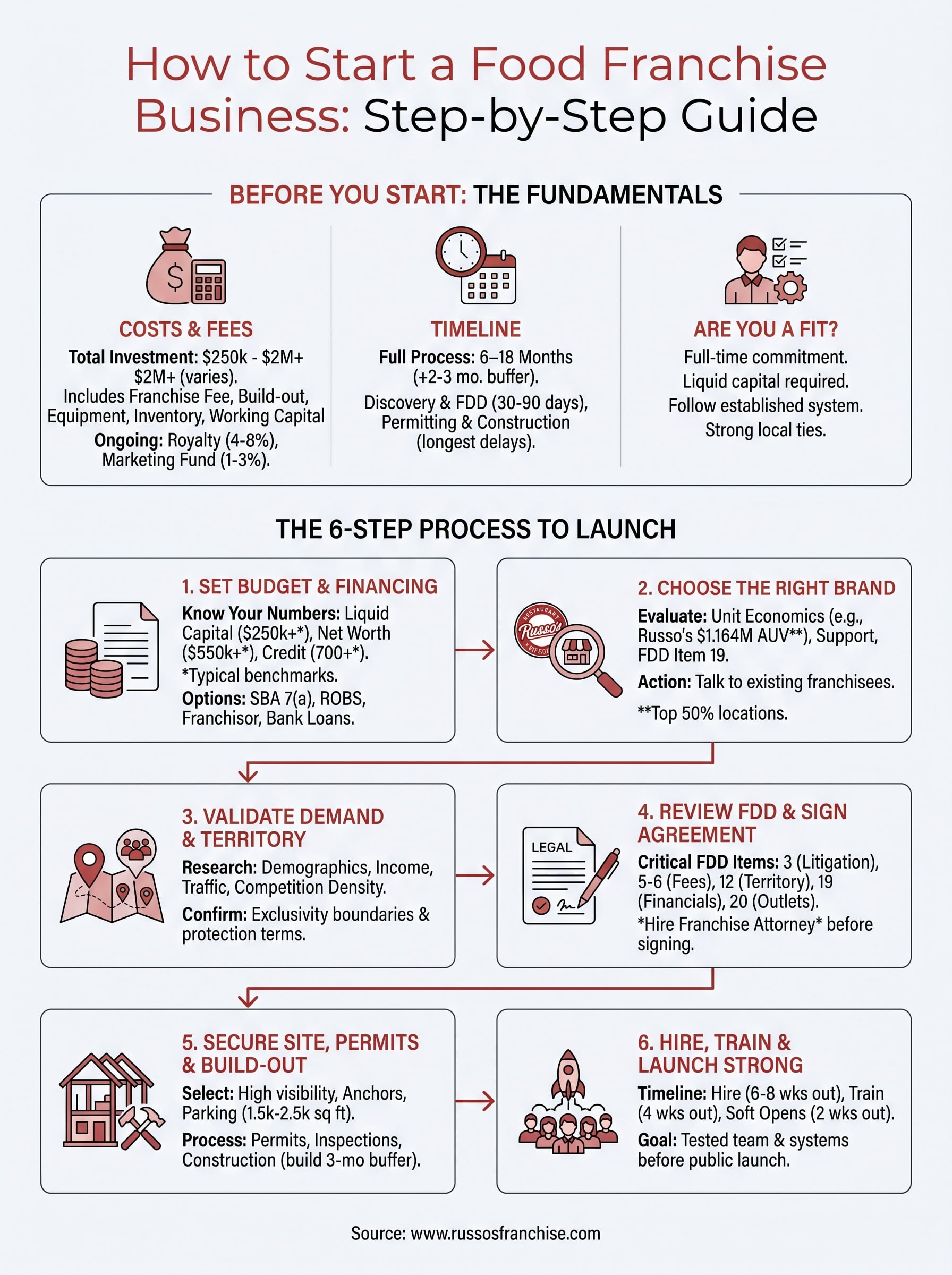
Now you have a complete picture of how to start a food franchise business , from setting your budget to opening your doors with a trained team and real momentum. Every step in this guide is actionable on its own, but the results compound when you work through them in order. Skipping steps or rushing the timeline is the fastest way to turn a solid opportunity into an expensive mistake.
Your next move is to pick one action from this guide and complete it this week. Whether that means pulling your liquid capital figures , calling three existing franchisees, or researching territory demographics in your target market, forward motion matters more than perfection. If you want to explore a franchise model with strong unit economics, over 57 proven locations, and a team built around franchisee success, request franchise information from Russo's New York Pizzeria and start a real conversation today.