Multi-Unit Franchise Ownership: Key Benefits Explained
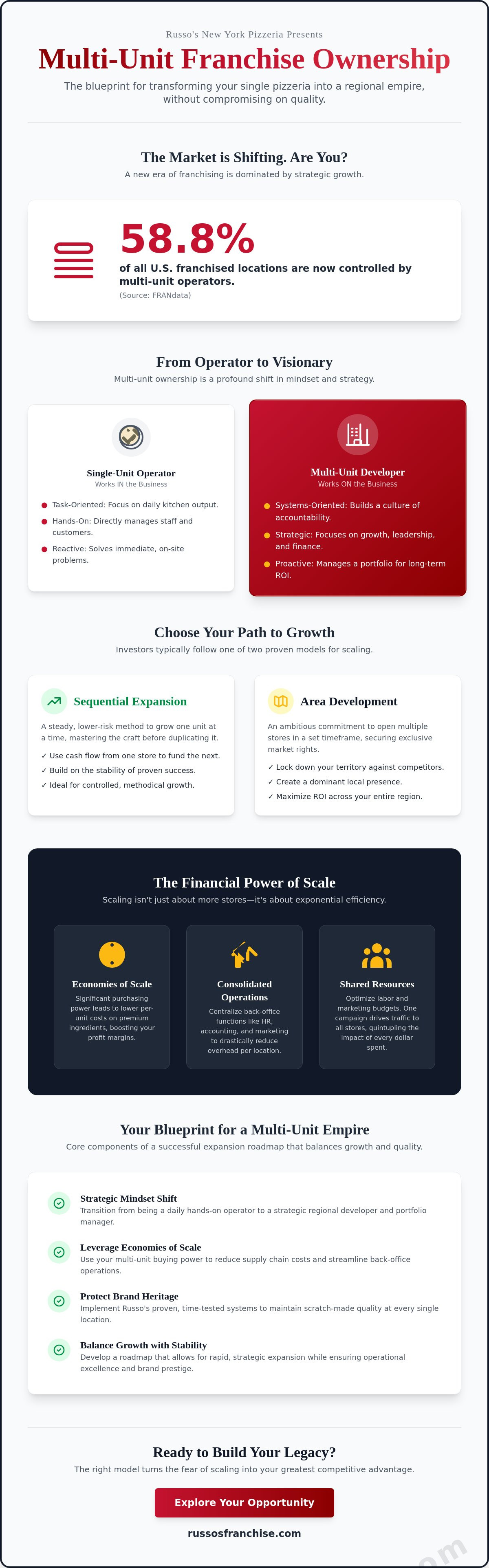
Did you know that multi-unit operators now control 58.8% of all franchised locations in the U.S., according to April 2026 data from FRANdata? This shift reflects a growing reality where savvy investors prioritize scalable systems over single-site management. Yet, for the dedicated entrepreneur, this growth often brings a quiet anxiety about losing operational control. You've built your reputation on the authentic quality of a premium Italian kitchen, and the thought of diluted standards can be a significant barrier to expansion. This is Multi Unit Franchise Ownership Explained for those who refuse to compromise on craftsmanship while they grow.
It's a common concern that scaling means losing the "soul" of the business, but the right model turns that fear into a competitive advantage. This guide shows you how to transition from a hands-on operator to a strategic developer with confidence. You'll discover the financial leverage inherent in multiple units and learn how a refined, time-tested system protects your brand heritage at every new location. We'll preview the roadmap to becoming a CEO of your own regional legacy, ensuring that your pursuit of growth remains rooted in the disciplined excellence of Italian tradition.
Key Takeaways
- Understand the strategic shift from daily operator to regional developer with Multi Unit Franchise Ownership Explained.
- Discover how to leverage economies of scale to reduce supply chain costs and streamline back-office operations across your entire portfolio.
- Learn how to implement proven systems that protect brand heritage and maintain scratch-made quality at every location.
- Evaluate the differences between regional multi-unit growth and international master franchise opportunities to determine your ideal investment scope.
- Identify the core components of a successful expansion roadmap that balances rapid growth with operational stability and prestige.
Table of Contents
What is Multi-Unit Franchise Ownership? Defining the Scalable Model
Success in the restaurant industry often starts with a single, passionate location. However, true wealth and regional influence often come through a different path. Multi-unit franchise ownership involves an investor who operates several locations within a defined geographical territory. It's a strategic expansion that moves beyond the "mom and pop" shop mentality. This is Multi Unit Franchise Ownership Explained : it's the evolution from managing a shift to managing a portfolio.
Professional management is the heartbeat of this model. Unlike a single-unit operator who might be found tossing dough or handling the register, a multi-unit owner focuses on high-level strategy and team development. They don't just work in the business; they work on it. To understand the foundation of this relationship, one can look at the general principles of What is Franchising, but the multi-unit approach adds layers of complexity and opportunity. It relies on an Area Development Agreement (ADA), a contract that secures your right to open a specific number of units in a set timeframe, effectively locking down your market share.
Multi-Unit vs. Single-Unit: The Operational Shift
The transition from operator to CEO is profound. Single-unit owners are often task-oriented, focusing on daily kitchen throughput or immediate customer service needs. In contrast, multi-unit developers are systems-oriented. They build a culture of accountability that functions whether they're on-site or not. This shift grants a different lifestyle, trading 60-hour weeks in a hot kitchen for a role focused on growth, leadership, and financial oversight. Your business becomes a machine that produces results, not a job that demands your constant physical presence.
Common Multi-Unit Investment Structures
Investors typically follow one of two paths when scaling their Italian kitchen franchise. The first is sequential expansion. You grow one unit at a time, using the cash flow from your first location to fund the second. This is a steady, lower-risk method that allows you to master the craft before duplicating it. Each new site builds on the stability of the last.
The second path is Area Development. This is a more ambitious commitment where you agree to open a specific number of stores over several years. This structure is highly prized because it includes territory rights. By securing a territory, you ensure that no other franchisee from the same brand can open a location within your designated area. This protection is vital for maintaining a dominant local presence and maximizing your return on investment across every neighborhood you serve.
The Economic Advantages of Scaling Your Pizza Franchise
Scaling a business isn't just about doubling your footprint; it's about exponential financial efficiency. When you look at the numbers, the advantages go far beyond simply collecting more receipts. It's about building a fortress around your investment through strategic growth. This is Multi Unit Franchise Ownership Explained : a system where your expansion actually lowers your relative costs while increasing your market dominance.
Economies of scale provide an immediate boost to your bottom line. Buying premium ingredients like extra virgin olive oil, aged cheeses, or high-grade flour for five locations gives you a seat at the table with vendors. You aren't just a customer; you're a partner with significant purchasing power. This leverage often leads to lower per-unit costs that a single-store owner simply can't access, allowing you to maintain high margins without sacrificing the authentic quality of your menu.
Consolidation is your next competitive weapon. Why pay for five separate bookkeepers or five distinct marketing agencies? By centralizing your back-office operations, you spread the cost of professional services across your entire portfolio. One skilled HR manager or a single accounting firm can service several units, drastically reducing your overhead percentage per location. This lean approach is a cornerstone of a successful pizza franchise strategy, turning administrative costs into a shared, manageable expense.
Maximizing ROI Through Shared Resources
Resource sharing is the engine of a multi-unit empire. Consider your marketing budget. A single, high-quality digital campaign can drive foot traffic to five locations simultaneously, effectively quintupling the impact of every dollar spent. Labor optimization works similarly. If one store is experiencing a quiet Tuesday while another is slammed, you can shift experienced management talent or staff between locations to ensure service remains impeccable. This flexibility reduces the need for redundant hiring and keeps your labor costs in check across the board.
Risk Mitigation in the Restaurant Industry
Operating multiple sites acts as a natural insurance policy. In the restaurant world, localized disruptions happen. A burst water main or long-term road construction can cripple a single location's revenue for months. However, with a multi-unit portfolio, your revenue is diversified across different neighborhoods and demographic zones. When one store faces a temporary hurdle, the others carry the weight. Understanding the logic of Single-Unit vs. Multi-Unit Ownership reveals that scaling actually makes your business more resilient. This stability is exactly what attracts institutional financing and private equity, leading to a much higher valuation when you eventually decide to exit the market.
Maintaining Quality and Heritage While Scaling
Scaling a premium brand often triggers a specific fear: the loss of the artisan touch. It's one thing to oversee a single kitchen where you can personally inspect every pizza. It's quite another to ensure that same excellence across five or ten locations. This is where Multi Unit Franchise Ownership Explained moves from financial theory into operational reality. Success depends on your ability to replicate a scratch-made experience without compromise. It requires a mindset that values precision as much as passion.
Meticulous standards are the only way to protect a family legacy. You aren't just selling food; you're stewarding a tradition. By utilizing a proven system, you ensure that every New York-style pizza maintains its signature crust and flavor profile, regardless of which unit serves it. Technology plays a vital role here. Modern platforms offer real-time quality monitoring and performance tracking. These tools keep your standards high even when you're not physically present. They provide the data needed to make informed decisions about training and operational adjustments.
The Systems-First Approach to Authenticity
Premium pizza franchise opportunities rely on standardized recipes to safeguard brand integrity. Founder-led guidance provides the philosophical foundation for every ingredient choice, while detailed operational manuals provide the practical execution steps. Consistency isn't a happy accident. It's the result of disciplined adherence to a time-tested blueprint that's been refined over decades of service. Centralized training ensures that every chef masters the specific crust and sauce profile that defines the brand.
Building Your Management Infrastructure
Growth requires a strategic shift in your leadership structure. You'll eventually need to hire a District Manager or a Director of Operations. This person bridges the gap between your vision and the daily execution at each site. This role is critical for maintaining executive oversight while empowering local store managers to lead their teams effectively. By creating a culture of excellence early on, you ensure that your standards survive the transition from one store to many. Your people become the guardians of the heritage you've worked so hard to build. Understanding Multi Unit Franchise Ownership Explained means recognizing that your most valuable asset isn't just the recipe; it's the management infrastructure that protects it.
Strategic Selection: Multi-Unit vs. International Master Franchise
Expansion is a journey that requires both a map and a clear destination. When you move beyond a single location, the fork in the road usually leads to two distinct destinations: regional multi-unit development or master franchise leadership. This is Multi Unit Franchise Ownership Explained for the investor who looks past the immediate horizon. One path allows you to refine a local empire through direct operational control, while the other empowers you to build a sub-franchise network that can define an entire country’s dining landscape. Your choice depends on whether you see yourself as a master of operations or a master of development.
The financial mechanics differ significantly between these two models. A multi-unit owner earns their return through the direct sales performance of their stores, benefiting from the lean overhead we discussed in previous sections. A master franchisee, however, operates on a higher plane of the value chain. They generate revenue through a combination of their own unit sales and a percentage of the royalties and franchise fees paid by sub-franchisees within their territory. This creates a diversified income stream that is less dependent on the performance of a single kitchen and more tied to the growth of the brand across a wide region.
The Master Franchise Model Explained
An international master franchise agreement effectively makes you the franchisor within your designated global region. You take on the responsibility of securing the supply chain, ensuring that every sub-franchisee has access to the same premium Italian ingredients that define the brand. Your role involves providing the sophisticated support and training that local operators need to thrive in their specific markets. In exchange for this high-level stewardship, you profit from the expansion of the network itself. It is a model built for institutional stability and massive scale, requiring a leader who excels at corporate strategy and relationship management.
Which Path Fits Your Investment Goals?
Choosing between these paths requires an honest assessment of your risk tolerance and management strengths. Multi-unit growth demands more capital for direct construction and labor but offers the full benefit of unit-level profits. It’s an ideal approach for those who want to ensure every New York-style pizza meets their personal standards through direct executive oversight. Territory scope is another major differentiator. A multi-unit developer might lock down a specific city or a cluster of affluent suburbs, focusing on market saturation to drive brand awareness. A master franchisee, however, might control an entire state or country, requiring a sophisticated infrastructure to manage disparate markets.
Consider your long-term vision for your business legacy. If your goal is regional dominance with deep operational roots and a focus on perfect execution, the multi-unit path is your blueprint. If you envision a national or global footprint where you lead other entrepreneurs and build a sprawling sub-franchise network, the master model is the superior vehicle. Matching your portfolio strategy to the brand’s global expansion plans ensures that your investment remains synchronized with the parent company’s long-term vision. Ready to define your territory? Discover our franchise opportunity today and see where your ambition can take you.
The Russo's Blueprint: Your Path to a Multi-Unit Empire
Building a regional legacy requires more than just capital; it demands a foundation of trust and a system that has already weathered the complexities of the market. Russo's offers a sophisticated partnership that prioritizes your growth as a developer through every phase of expansion. From initial site selection to the final training of your management team, our framework is designed to move you quickly from one unit to many. This is Multi Unit Franchise Ownership Explained as a collaborative journey where our family legacy becomes the engine for your entrepreneurial success.
A premium, heritage-driven menu acts as your primary advantage in a crowded industry. While competitors often prioritize convenience over quality, your commitment to authentic Italian recipes creates a destination, not just a dining option. This brand prestige is protected by a global supply chain that secures high-quality ingredients while maintaining your margins. You gain the stability of a founder-led brand that treats its developers as part of an extended family, providing a level of personalized support that corporate-heavy organizations often lack.
A Proven Model for Scalable Success
Scalability is built into the kitchen's design. By integrating traditional recipes with modern, high-efficiency kitchen technology, you can maintain the "scratch-made" standard without the need for excessive labor. The Halal pizza franchise model further strengthens this position, allowing you to reach untapped global markets and diverse demographics with ease. Your competitive moat is the quality of the product itself. Fresh, hand-tossed dough and authentic ingredients ensure that your customers remain loyal, providing a stable foundation for your growing empire.
Next Steps for Potential Multi-Unit Partners
Transitioning into a multi-unit role is a significant professional milestone. Your first step is a thorough assessment of your financial readiness to ensure you can support the development schedule of an Area Development Agreement. We encourage serious investors to request a Franchise Disclosure Document (FDD). This document provides a transparent look at unit economics and the structural health of our pizza franchise system. Once you've reviewed the data, the next phase is a direct conversation about your goals. Contact the Russo's development team to explore available territories and begin the process of securing your regional market today.
Architecting Your Regional Italian Legacy
Scaling your business is a profound commitment to excellence across a broader landscape. We've explored how the shift from a single kitchen to a regional portfolio transforms your role from a daily operator into a strategic developer. With Multi Unit Franchise Ownership Explained , the focus shifts to leveraging systems that protect your margins while honoring a deep-rooted culinary history. You don't have to choose between rapid growth and authentic quality when you utilize a blueprint that's been refined for over three decades.
Since 1992, Chef Anthony Russo has led this brand with a dedication to scratch-made Italian quality that scales seamlessly. Whether you're targeting local neighborhoods or exploring specialized Halal-certified models for a global presence, the infrastructure is already in place to support your ambition. It's time to take the next step in your entrepreneurial journey with a partner that values excellence as much as you do. Secure Your Territory and Start Building Your Multi-Unit Legacy with Russo's today. Your future as a regional leader starts with a single, strategic decision. We're ready to help you build a legacy that stands the test of time.
Frequently Asked Questions
What is the difference between a multi-unit franchisee and an area developer?
A multi-unit franchisee owns and operates several locations, while an area developer commits to opening a specific number of units within a defined territory over a set timeline. The developer often receives exclusive rights to that market. This distinction is vital when looking at Multi Unit Franchise Ownership Explained as a long-term investment strategy. It determines whether you're simply growing your footprint or securing an entire region for future expansion.
Can I start with a single unit and upgrade to a multi-unit agreement later?
You can certainly start with a single-unit pizza franchise and expand into a multi-unit agreement as your capital and operational confidence grow. Many successful partners choose sequential expansion to master the brand's heritage standards before duplicating them. This approach allows you to use the cash flow from your first location to fund subsequent sites, ensuring a stable and disciplined growth trajectory for your portfolio.
How many units do I need to own to see significant economies of scale?
Most operators begin to see significant economies of scale once they reach a threshold of three to five locations. At this stage, you can effectively consolidate back-office costs like accounting and marketing while gaining significant leverage with ingredient vendors. This volume allows you to distribute management talent across your units more efficiently, maximizing your return on investment and stabilizing your operational overhead.
Do multi-unit franchisees need to have previous restaurant experience?
Previous restaurant experience is beneficial but not strictly required if you possess strong business management and leadership skills. A proven system provides the technical training needed for scratch-made quality, allowing you to focus on high-level strategy. Successful multi-unit owners often come from corporate or entrepreneurial backgrounds where they've mastered the art of building teams and managing complex financial portfolios.
What are the common challenges of managing multiple pizza franchise locations?
The primary challenges involve maintaining consistent staffing and protecting quality standards across multiple physical sites. Managing a larger workforce requires a robust middle-management layer, such as a District Manager, to ensure daily excellence. Administrative complexity also increases; this is why utilizing centralized technology for real-time performance tracking is essential for modern multi-unit developers who can't be everywhere at once.
How does a master franchise agreement differ from a standard multi-unit deal?
A master franchise agreement grants you the right to act as the franchisor within a large region or country, whereas a standard multi-unit deal focuses on direct ownership of stores. Master franchisees recruit and support their own sub-franchisees, earning a portion of their royalties. This model is a higher-level investment typically suited for those looking to build a national or international network rather than just a regional cluster of stores.
Is it harder to maintain food quality with a multi-unit portfolio?
Maintaining quality is not harder if you adhere strictly to a systems-first approach and standardized operational manuals. Consistency is achieved through disciplined training and the use of identical, premium ingredients across every kitchen. By leveraging technology for quality audits, you can ensure that every New York-style pizza meets heritage standards, regardless of which location a customer visits.
What kind of support should I expect from a franchisor as a multi-unit owner?
Multi-unit owners should expect comprehensive support including supply chain management, regional marketing strategies, and ongoing operational audits. A founder-led brand often provides more personalized guidance to help you navigate the transition from operator to developer. This support ensures that your growth remains aligned with the brand's core values while providing the professional tools needed to manage a large-scale enterprise effectively.