Multi-Unit Franchise Opportunities: Scaling Your Portfolio in 2026
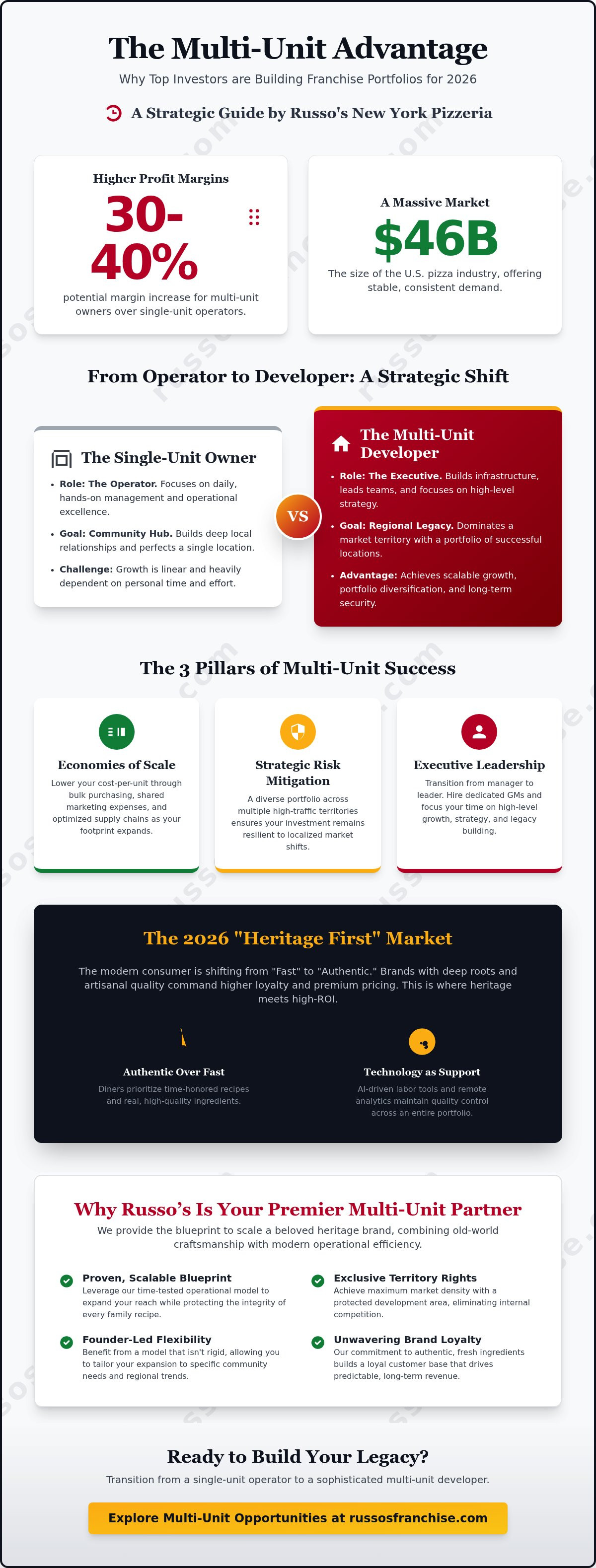
Did you know that multi-unit franchise ownership can generate 30-40% higher margins than operating a single location? While many investors begin with one storefront, the most successful entrepreneurs in 2026 are aggressively pursuing multi unit franchise opportunities to build regional legacies. You understand the challenge of maintaining artisan quality while managing the complexities of growth. It's a delicate balance between honoring a heritage of craftsmanship and achieving the hard-nosed efficiency required for a high-ROI portfolio.
Scaling doesn't have to mean sacrificing the soul of your business. We'll show you how to leverage a proven blueprint, like that offered by Own a Russo's New York Pizzeria & Italian Franchise - Pizza Franchise Opportunity , to build a dominant Italian dining empire while reducing your cost per unit through shared resources. You'll discover the strategic advantages of current SBA loan structures and the specific incentives available for rapid expansion in the $46 billion pizza industry. This guide provides a clear path to transition from a single-unit operator to a sophisticated multi-unit developer with a secure, scalable future.
Key Takeaways
- Understand why the 2026 economic landscape favors portfolio diversification and how a strategic development agreement builds long-term security.
- Compare the executive-level focus of multi unit franchise opportunities against the daily operational demands of single-unit ownership.
- Master the art of territory rights to achieve maximum market density without the risk of internal cannibalization.
- Implement a sophisticated operational blueprint that scales your reach while protecting the craftsmanship and integrity of every family recipe.
- Leverage the flexibility of founder-led models to tailor your expansion to specific community needs and regional trends.
Table of Contents
The Landscape of Multi-Unit Franchise Opportunities in 2026
Growth in 2026 isn't just a goal; it's a strategic necessity for those seeking to insulate their capital against market fluctuations. Multi-unit franchising represents a sophisticated commitment where an investor agrees to develop a specific number of locations within a defined territory over a set period. This approach has transformed the traditional franchising business model into a high-level portfolio play for entrepreneurs who prioritize long-term stability over short-term gains. By securing multi unit franchise opportunities , investors move beyond the role of a store manager and step into the position of a regional developer, overseeing an ecosystem of thriving businesses rather than a single storefront.
Sophisticated investors are moving away from the volatility of traditional equities in favor of tangible, cash-flowing assets that offer predictable growth. Distinguishing between an Area Development Agreement and an International Master Franchise is vital for this transition. An Area Development Agreement allows you to open and operate multiple units yourself within a protected zone, ensuring no internal competition. Conversely, an International Master Franchise grants the right to sub-franchise to others across an entire country. In the current economic climate, the pizza and Italian kitchen segment stands out as a premier choice for these models. Its reliance on core, high-quality ingredients and repeatable, artisan processes makes it uniquely suited for scaling without losing the soul of the brand.
Why Investors are Shifting to Multi-Unit Models
The move toward a multi-location strategy is driven by three core pillars of business efficiency:
- Economies of Scale: Managing five locations allows for massive leverage in supply chain negotiations and local marketing spend. Your cost per unit drops as your footprint expands.
- Strategic Risk Mitigation: Spreading your investment across multiple high-traffic territories ensures that your portfolio remains resilient. A single underperforming street corner won't compromise your entire operation.
- Executive Leadership: Pursuing multi unit franchise opportunities allows for a transition into true leadership. You can hire a dedicated regional manager to oversee daily operations, which frees your time to focus on high-level growth and community legacy.
The 2026 Market Outlook for Premium Dining
The 2026 consumer is defined by a "Heritage First" mindset. There is a palpable shift toward "Authentic Over Fast," where diners prioritize time-honored methods and real ingredients over processed convenience. This trend directly impacts multi-unit ROI, as brands with deep roots and artisanal standards command higher loyalty and premium pricing. Technology now plays a supportive role rather than a distracting one; AI-driven labor management and remote kitchen analytics allow owners to maintain meticulous standards across twenty kitchens as easily as one. Russo’s New York Pizzeria fits this 2026 profile perfectly as a resilient heritage brand, offering a proven blueprint that balances modern efficiency with the pride of a family kitchen.
Single-Unit vs. Multi-Unit: A Strategic Comparison for Investors
Choosing between a single storefront and an expansive portfolio is a decision that defines your daily lifestyle and your financial ceiling. A single-unit owner often thrives on the front lines, perfecting every hand-tossed crust and engaging directly with the community. It's an excellent entry point for those seeking a single unit pizza franchise to master the brand's heritage and operational rhythm. However, multi unit franchise opportunities cater to the executive mind. These partners aren't just running a kitchen; they're building an infrastructure. According to a standard industry overview of franchising, the shift from operator to developer requires a fundamental change in how you view labor, supply chains, and market presence.
The development schedule is the heartbeat of a multi-unit agreement. Unlike a single-unit purchase, which focuses on a single "grand opening," a multi-unit contract outlines a multi-year plan to open several locations in a specific territory. This requires a different level of support from the franchisor. While a single-unit owner needs intensive training in daily kitchen operations, a multi-unit developer needs sophisticated guidance on site selection, regional marketing, and managing a growing workforce across multiple postcodes. It's a journey from artisan mastery to regional dominance.
Risk vs. Reward: The Financial Reality
The financial commitment reflects the scale of the ambition. While a single location has its own entry requirements, developing a five-unit territory demands a higher tier of financial readiness, such as $800,000 in liquid capital and a $1,500,000 net worth. This investment isn't merely a cost; it's the foundation for a legacy. Multi-unit agreements often include incentives like temporary royalty relief for new openings to support your initial cash flow during the expansion phase. This structure favors the patient investor who understands that while the break-even timeline for a portfolio is longer than a single shop, the eventual cash flow scales with much greater velocity.
Operational Complexity and Management
Transitioning to a CEO mindset means moving away from the stove and toward the spreadsheet. You must build a "Hub and Spoke" infrastructure where a central management team or regional director maintains the standards you've set. Consistency is the primary challenge when you aren't in the kitchen every day. To protect the integrity of a family legacy, multi-unit owners rely on rigorous training systems and shared resources across their territory. This allows for a unified brand experience that feels just as authentic in your fifth location as it did in your first. If you're ready to explore how this model fits your goals, consider our available franchise opportunity as a blueprint for your regional expansion.
Evaluating Territory Rights and Market Density
Securing a territory is about more than geographic boundaries; it's about claiming a market's future. In a multi-unit agreement, territory protection acts as your primary safeguard, ensuring that your investment isn't diluted by internal competition. While a single-unit operator focuses on the success of one kitchen, a developer looks at the entire landscape to determine how multiple locations can coexist and thrive. When exploring pizza franchise opportunities, understanding the balance between market density and cannibalization is essential. You want your brand to be the dominant choice in a city, but each storefront must have enough breathing room to maintain high-ROI performance.
Market density creates a powerful psychological effect on consumers. When diners see your brand at the premier shopping center and near their residential neighborhood, it reinforces a sense of reliability and prestige. However, the risk of cannibalization occurs if trade areas overlap too aggressively. Sophisticated multi unit franchise opportunities provide data-driven blueprints to prevent this. For global developers, the International Master Franchise model offers an even broader scope, allowing for the stewardship of an entire country's expansion. This high-level responsibility requires a partner who values heritage as much as they value operational precision.
The Science of Site Selection for Multiple Units
Successful expansion relies on identifying the unique "Trade Area" for every location. We analyze demographic data to ensure each kitchen serves a distinct population, balancing high-foot-traffic retail spots with strategic residential delivery zones. This is particularly vital when developing a halal pizza franchise , as these models require specific demographic targeting to serve community needs effectively. By layering delivery heat maps over retail traffic reports, you can position your units to capture every possible dining occasion without ever competing against yourself.
Securing Your Regional Foothold
Negotiating your development timeline is a collaborative process that defines how many stores you'll open and how quickly you'll scale. In the 2026 market, having exclusive rights to a specific city or region provides a significant competitive edge. It allows you to move with confidence, knowing your expansion path is protected. A crucial element of these agreements is the "Right of First Refusal." This legal provision ensures that if new growth opportunities arise within your proximity, you have the first chance to claim them. It's a disciplined way to grow, ensuring that your regional legacy remains firmly in your hands as you build a stable, multi-generational business.
The Operational Blueprint: Managing Heritage at Scale
Scaling a premium brand requires a relentless commitment to the details that made the first location a success. When you pursue multi unit franchise opportunities , the greatest risk isn't financial; it's the potential dilution of the guest experience. Maintaining the integrity of a franchise with family recipes means ensuring that a sauce simmered in your fifth location tastes identical to the one prepared in your first. This consistency is achieved through a disciplined operational blueprint that treats heritage as a non-negotiable standard rather than a suggestion. It involves a sophisticated marriage of old-world craftsmanship and modern management systems.
Technology serves as the nervous system for a multi-unit portfolio. To manage five or ten locations effectively, you need a robust technology stack that provides real-time reporting on labor costs, inventory depletion, and guest satisfaction across your entire territory. These data points allow you to identify operational drift before it impacts your bottom line. We support this digital oversight with the Russo’s Training Academy, a centralized model designed to produce regional staff who are as passionate about the brand's legacy as the founder himself. This ensures that every team member, from the front-of-house host to the lead pizzaiolo, understands the weight of the heritage they represent.
Centralized Operations vs. Local Autonomy
Efficiency in a multi-unit model comes from knowing what to centralize and what to leave in the hands of local teams. Purchasing, regional marketing, and high-level accounting should be centralized to leverage economies of scale and reduce overhead. However, customer service and kitchen execution must remain local and personal. We recommend implementing a Regional Training Manager whose sole purpose is to move between locations, auditing kitchen standards and ensuring that Chef Russo’s meticulous requirements are met at every station. This "Hub and Spoke" management style protects your investment while fostering a sense of community pride in every neighborhood you enter.
Scaling the "Scratch-Made" Philosophy
Many brands fall into the "Corporate Taste" trap by switching to frozen or pre-processed ingredients as they grow. To avoid this, our model focuses on scaling the scratch-made philosophy through better logistics rather than compromised quality. Managing fresh dough and premium ingredients across multiple locations requires a disciplined supply chain, but the reward is a product that stands head and shoulders above the competition. The brick oven remains the heart of the operation, ensuring a consistent, authentic New York Style product that resonates with diners. If you are ready to lead a portfolio that values quality as much as growth, explore our franchise opportunity to begin your journey.
Why Russo’s New York Pizzeria is the Premier Multi-Unit Partner
Success in the premium dining sector requires more than just capital; it demands a partner who shares your dedication to excellence. By choosing Russo’s New York Pizzeria, you aren’t just signing a contract. You’re entering a mentorship with a founder-led organization that prioritizes your growth as much as the integrity of the menu. Anthony Russo brings decades of hands-on expertise directly to his partners, offering a level of accessibility that is virtually non-existent in larger, corporate-heavy systems. These multi unit franchise opportunities provide a rare chance to scale a business while maintaining a direct line to the visionary behind the brand.
The versatility of our business models is a cornerstone of our expansion strategy. Whether you are looking to open a fast-casual Pizzeria, a full-service Italian Kitchen, or a specialized halal pizza franchise , our systems are designed to adapt to your specific market needs. This flexibility allows you to diversify your portfolio within a single territory, capturing different dining segments and dayparts under one cohesive brand identity. You can tailor each location to the unique demographics of its neighborhood while relying on a singular, sophisticated operational engine.
The Russo’s Multi-Unit Support Ecosystem
We provide a comprehensive infrastructure designed to handle the heavy lifting of rapid expansion. Our dedicated area developers work closely with you to navigate the nuances of local zoning, site selection, and construction, ensuring that each new opening stays on schedule. Beyond the build-out, our supply chain logistics are finely tuned to deliver premium Italian ingredients to your doorstep, maintaining the "scratch-made" quality that defines our heritage. Our marketing support scales alongside you, moving from hyper-local neighborhood outreach for a single shop to sophisticated, region-wide campaigns that establish your dominant market share.
Building Your Legacy with a Proven Model
In the 2026 market, the prestige of owning an authentic Italian brand far outweighs the commodity-driven appeal of "Big Box" chains. High-level investors recognize the superior ROI potential in the premium pizza segment, where consumer loyalty is driven by quality rather than just price. By building a regional empire with Russo’s, you’re creating a stable, multi-generational asset that stands as a testament to your entrepreneurial vision. We invite sophisticated investors to join us for a discovery day or a private consultation to see the blueprint of our success firsthand. Now is the time to Join the Russo’s Family as a Multi-Unit Developer and secure your place in our growing global legacy.
Secure Your Future with Regional Dominance
Building a legacy in 2026 requires more than just owning a business; it requires a strategic vision for regional growth. You've seen how multi unit franchise opportunities allow you to transition from a hands-on operator to a sophisticated developer by leveraging shared resources and protected territories. By prioritizing market density and operational consistency, you can achieve a high-ROI portfolio that honors the craftsmanship of traditional Italian cuisine. The path to scaling an authentic brand is paved with disciplined systems and a commitment to quality that never wavers.
Russo’s New York Pizzeria provides the ultimate blueprint for this journey. With over 30 years of proven operational systems and the direct, founder-led support of Chef Anthony Russo, you have the tools to capture a high-average unit volume in the premium pizza segment. It's time to move beyond the single storefront and command a market that values heritage and excellence. Take the next step toward your entrepreneurial goals and Apply for a Russo’s Multi-Unit Development Opportunity today. We're ready to help you build a stable, prestigious future that your family can be proud of for generations.
Frequently Asked Questions
What is the difference between a multi-unit franchise and a master franchise?
A multi-unit franchise involves an agreement to open and operate several locations yourself within a specific territory. You maintain direct ownership and management of each storefront in your portfolio. An International Master Franchise grants you the right to sub-franchise the brand to third parties across an entire country or region, shifting your role toward recruitment and administrative support.
Do I need prior restaurant experience to qualify for a multi-unit agreement?
Prior restaurant experience is highly beneficial but not a strict requirement for those with a strong background in executive leadership or business management. We prioritize partners who understand how to lead teams and follow disciplined systems. Our training programs are designed to bridge any operational gaps, ensuring you can manage the craft as effectively as the commerce.
How many units do I typically need to commit to for a multi-unit franchise opportunity?
Most multi unit franchise opportunities involve a development schedule for three to five locations within a set timeframe. This range is ideal for achieving significant economies of scale while maintaining high standards of quality. Larger territories can be negotiated for investors who have the infrastructure and capital to support more aggressive regional growth.
What are the net worth and liquidity requirements for a multi-unit pizza franchise?
For a commitment of five or more units, we typically require a minimum of $800,000 in liquid capital and a total net worth of $1,500,000. These standards ensure you have the financial resilience to manage multiple construction phases and grand openings simultaneously. This capital provides the foundation for a stable, long-term legacy in the premium dining segment.
How does Russo’s protect my territory from other franchisees?
We provide a protected geographic area through your development agreement where no other Russo’s locations can be opened. This exclusivity ensures you can build market density without the risk of internal competition. By securing these rights, you gain the confidence to invest in regional marketing and community presence, knowing the trade area is yours to dominate.
Can I convert my existing independent restaurants into a Russo’s multi-unit portfolio?
Yes, we offer a conversion path for independent operators who want to leverage our 30 years of proven systems and brand recognition. If your current locations meet our site and quality standards, transitioning to our model can provide immediate operational stability. Converting often reduces the initial build-out timeline, allowing you to scale your portfolio with greater speed.
What kind of ongoing support does a multi-unit owner receive compared to a single-unit owner?
Multi-unit owners receive executive-level support focused on regional logistics, site selection for multiple territories, and advanced labor management. While a single-unit owner focuses on daily kitchen mastery, our support for developers shifts toward scaling those standards across a whole region. You'll have access to area developers who help you maintain consistency and efficiency across every kitchen you own.
Is the multi-unit model more profitable than owning multiple different franchise brands?
Managing multi unit franchise opportunities within a single brand is generally more profitable due to massive efficiencies in shared marketing, staffing, and supply chain costs. You don't have to learn multiple sets of rules or manage different franchisor relationships. This focus allows for 30-40% higher margins than single-unit operations, as your overhead costs are spread across a larger revenue base.