Pizza Franchise Costs: Investment & Financial Requirements
Choosing the cheapest entry point into the pizza industry is often the most expensive mistake an entrepreneur can make. While many investors start their journey by asking, "How Much Does It Cost to Open a Pizza Franchise?", the real question is what that investment actually buys for your future. It’s natural to feel a sense of hesitation when faced with potential construction overruns or the complexities of royalty and marketing fees. You want a path defined by stability and heritage, not just a low barrier to entry that leads to the high failure rates seen in budget brands.
This guide provides the clarity you need to move forward with confidence. You’ll discover the comprehensive financial breakdown and strategic value of investing in a premium pizza franchise, ensuring your capital is protected by a time-tested operational blueprint. We will explore a detailed line-item breakdown of startup costs, examine the ROI differences between standard quick-service models and premium Italian kitchens, and lay out a clear roadmap for your financial planning. Success in this industry isn’t about finding the lowest price; it’s about securing a legacy of quality and craftsmanship that yields long-term rewards.
Key Takeaways
- Master the distinction between your initial franchise fee and the total capital required to navigate the 2026 economic landscape with confidence.
- Get a definitive answer to "How Much Does It Cost to Open a Pizza Franchise?" through a granular breakdown of real estate, leasehold improvements, and specialized kitchen technology.
- Identify how ongoing royalty and marketing fees translate into a powerful corporate support system and national brand presence for your business.
- Compare the long-term ROI of premium pizzerias against discount competitors to see how authentic family heritage creates a recession-proof value ceiling.
- Explore the strategic advantages of the international master franchise model and how a founder-led vision ensures operational stability.
Table of Contents
Understanding the Total Investment for a Pizza Franchise
Entering the pizza industry requires a shift in perspective. Most prospective partners begin their research by asking, "How Much Does It Cost to Open a Pizza Franchise?", but the answer depends entirely on the depth and sophistication of the business model you choose. It's vital to distinguish between the franchise fee, which is the upfront price for joining the brand, and the total initial investment. In 2026, market conditions dictate a more robust capital cushion than in previous years. Rising real estate costs and supply chain fluctuations mean that having liquid reserves is no longer optional; it's a requirement for operational stability.
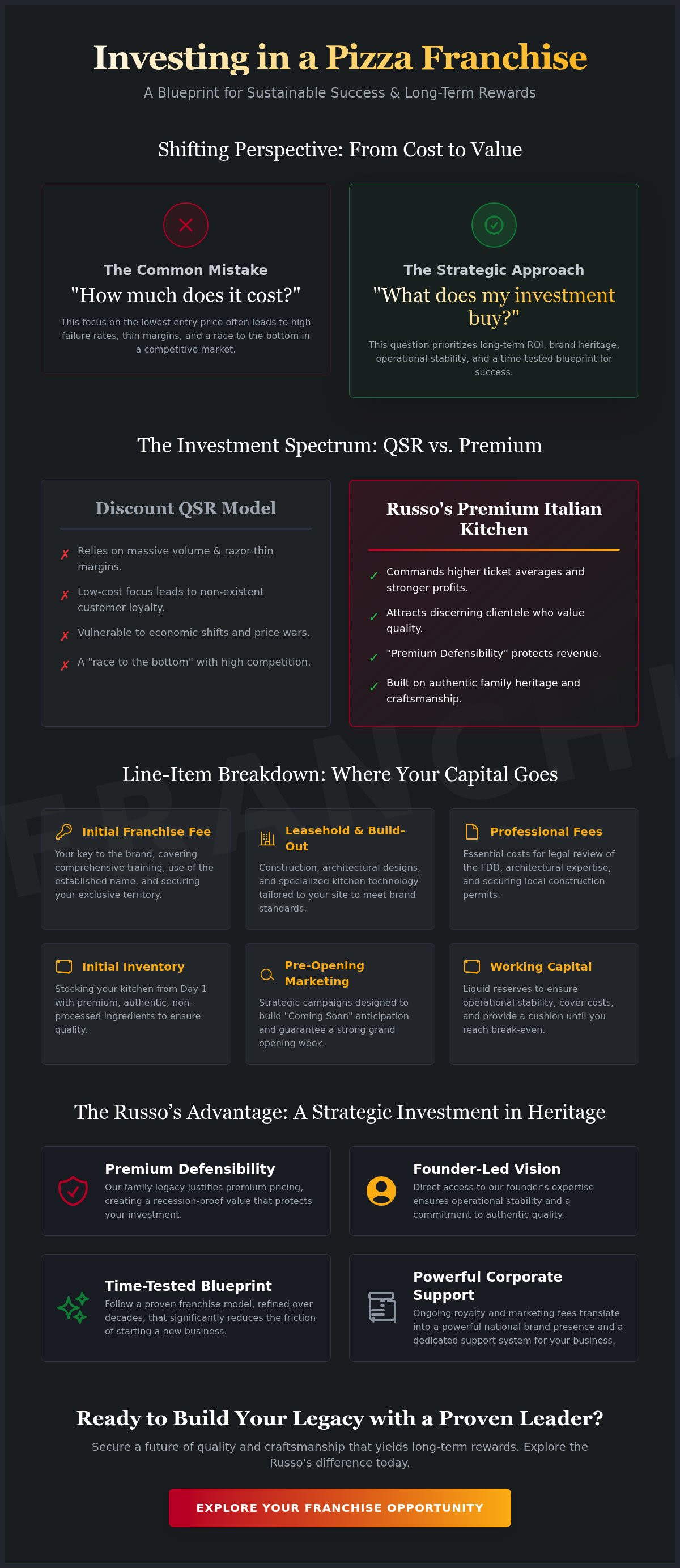
Heritage plays a decisive role in sustaining high average transaction values. When a brand is rooted in a deep family legacy, customers perceive a level of craftsmanship that justifies a premium price point. This creates what we call "Premium Defensibility." In a crowded market, being the low-cost option is a race to the bottom where margins are thin and loyalty is non-existent. A premium model protects your investment by attracting a discerning clientele who value quality over a bargain, ensuring your revenue remains resilient even when economic shifts occur.
The Spectrum of Costs: QSR vs. Premium Italian Kitchens
The pizza industry is divided into distinct tiers, each with its own financial profile. Discount Quick Service Restaurant (QSR) models often promise a lower entry price, but they rely on massive volume and razor-thin margins to survive. In contrast, the Russo’s premium kitchen approach focuses on high-quality ingredients and an elevated dining experience, which allows for higher ticket averages and stronger bottom-line potential. Total investment is the sum of all capital required to reach the break-even point. By investing in a premium model, you're choosing a path where quality ingredients and authentic recipes act as a safeguard for your capital.
Why Initial Fees are Only the Tip of the Iceberg
The initial franchise fee is essentially the key that unlocks the door to a partnership. It covers the cost of your comprehensive training, the right to use the brand’s established name, and the securing of your specific territory. This territory right is a critical asset, as it protects your local market share from being diluted by other units of the same brand. However, the true value lies in following a proven franchise model that significantly reduces the friction typically associated with starting a business from scratch.
Modern Franchising is a sophisticated relationship where the initial fee buys you a seat at the table of an expert mentor. While the fee is a one-time expense, it grants you access to ongoing research, development, and a blueprint for success that has already been refined over decades. It's the foundation upon which your kitchen is built, but the long-term success of your investment depends on how effectively you utilize the tools, technology, and heritage provided by the brand to serve your community.
Line-Item Breakdown: Where Your Capital Goes
Understanding the specific allocation of your capital is the only way to build a foundation for long-term success. To accurately answer the question, "How Much Does It Cost to Open a Pizza Franchise?", you must look beyond the initial fee and examine the tangible assets that drive your daily operations. Your investment is distributed across several critical categories, each requiring meticulous planning and professional oversight. These include professional fees for the legal review of your Franchise Disclosure Document (FDD), architectural designs tailored to your specific site, and the local permits necessary to begin construction. Additionally, sourcing authentic, scratch-made ingredients requires an initial inventory investment that reflects a commitment to quality over convenience.
- Site Selection and Professional Fees: Engaging legal and architectural experts ensures your space meets both brand standards and local regulations.
- Inventory and Supplies: Stocking your kitchen with premium, non-processed ingredients from Day 1.
- Pre-Opening Marketing: Strategic campaigns designed to build "Coming Soon" anticipation and secure a strong opening week.
Leasehold Improvements and Build-Out Costs
Site selection impacts your construction budget more than any other single factor. Transforming a raw space into a functioning kitchen involves significant leasehold improvements, including security deposits and interior finishes. In 2026, building codes have become increasingly stringent regarding HVAC systems and grease trap requirements, making it essential to account for these technical infrastructure costs early. Russo’s offers flexible footprints, ranging from streamlined Fast Casual models to expansive Full Service Italian Kitchens. This flexibility allows you to adapt the build-out to the specific needs of your local market while maintaining the sophisticated atmosphere that defines the brand.
Equipping a Premium Italian Kitchen
A premium New York-style pizza requires more than just a standard oven; it requires specialized technology designed for consistency and heat retention. Choosing premium brick oven technology over "off-the-shelf" conveyor models is a strategic decision that affects both the flavor profile and your bottom line. High-quality equipment, including high-capacity mixers and specialized prep stations, reduces long-term maintenance costs and improves labor efficiency. By investing in superior tools from the start, you minimize the risk of equipment failure during peak hours and ensure that every dish reflects the heritage of the Russo family recipes. If you're ready to see how these components fit into a successful business model, explore our pizza franchise opportunity for a deeper look at our operational standards.
Pre-opening marketing acts as the final bridge between your construction phase and your first sale. Investing in localized digital campaigns and community outreach ensures that your neighborhood is already hungry for your arrival. This proactive approach prevents a "slow start" and helps you reach your break-even point with greater speed and precision.
Ongoing Operational Costs and Hidden Fees
Launching your kitchen is only the first step in a much larger journey. Once the doors open, your focus shifts from construction to the sustainable rhythm of daily operations. Many new owners wonder, "How Much Does It Cost to Open a Pizza Franchise?" only to realize that the long-term success of their investment depends on managing recurring expenses with precision. These ongoing costs aren't just bills to be paid; they're investments in the infrastructure that keeps your brand relevant and your kitchen efficient. From the technology stack that manages your orders to the specialized labor required to toss authentic dough, every dollar spent should reinforce the premium nature of your business.
- Technology Stack: Modern POS systems, integrated third-party delivery platforms, and inventory software are essential for maintaining margins in 2026.
- Labor and Training: Budgeting for a team that can master and execute complex family recipes is a non-negotiable cost of doing business in the premium segment.
- Maintenance and Utilities: High-performance brick ovens and specialized kitchen gear require regular professional servicing to prevent costly downtime.
The Reality of Royalties and Marketing Fees
Royalties are often misunderstood as a simple tax on revenue, but in a sophisticated model, they're the engine of your growth. These fees fund a pizza franchise training program that constantly evolves to meet shifting market demands. Beyond training, your royalty contributions provide access to the collective bargaining power of a global network, which significantly reduces your food supply costs compared to independent pizzerias. Similarly, marketing fund contributions allow you to tap into national brand power. In 2026, the ROI of brand-level digital marketing far exceeds what a single location could achieve alone, placing your premium offerings in front of local customers with high-frequency precision.
Working Capital: The Six-Month Buffer
Financial stability during your first 180 days is the most critical factor in surviving the "startup phase." You must maintain a liquid capital reserve to cover payroll, utilities, and inventory while your local reputation grows. Working capital is the oxygen that allows a premium brand to find its local audience without the pressure of immediate, high-volume profitability. It's also your safeguard against "hidden" costs that often surprise unprepared owners. These can include everything from employee uniform replacements to local licensing renewals and health department certifications. By planning for these recurring expenses from the start, you ensure that your focus remains on the craft of Italian cooking rather than the stress of unexpected bills.
Reliability is built through consistency. By understanding the full scope of operational costs, you're not just running a restaurant; you're stewarding a legacy. A well-capitalized operation can afford to never compromise on the quality of its ingredients or the training of its staff, which is exactly what keeps customers coming back for generations.
Evaluating ROI: Why Premium Pizzerias Outperform Discount Models
When most investors begin their research, they focus heavily on the floor rather than the ceiling. It’s a common trap. While you may be asking, "How Much Does It Cost to Open a Pizza Franchise?", the more strategic question is what kind of return that capital will yield in a competitive market. Discount brands are trapped by a "Price Floor," where they must constantly slash prices to compete with the next budget option. In contrast, premium Italian kitchens enjoy a "Value Ceiling." This allows for significantly higher average ticket sizes because customers are willing to pay for authenticity, heritage, and a superior dining experience that a standard Quick Service Restaurant (QSR) simply cannot replicate.
A premium model also safeguards your investment through multiple revenue streams. You aren't just running a delivery hub; you're managing a destination for dine-in, a reliable source for takeout, and a sophisticated partner for high-ticket corporate catering. This diversified approach ensures your kitchen stays productive throughout the day, maximizing the utility of your specialized equipment and labor. Authentic family recipes create a level of customer loyalty that survives economic shifts, as quality becomes a non-negotiable for your local audience.
The Cost of Quality: Higher Margins Through Scratch-Made Dough
In the Russo’s model, quality isn't just a promise; it's a financial strategy. Many budget franchises rely on expensive, pre-frozen dough that adds significant overhead and diminishes the final product. By focusing on fresh, scratch-made dough prepared daily, you lower your ingredient costs while simultaneously elevating the perceived value of every pie. This "quality as a marketing strategy" approach reduces your reliance on margin-eroding discounts to drive traffic. Furthermore, the long-term profitability of a halal pizza franchise provides a unique opportunity to tap into high-growth, underserved markets where demand for premium, compliant options is surging.
Risk Mitigation in a 2026 Economy
Premium brands show remarkable resilience to inflation. As ingredient and labor costs rise, budget brands are forced to raise prices, which often alienates their core, price-sensitive customer base. Premium brands benefit from a "Flight to Quality" trend. In 2026, consumers are more selective with their spending, choosing to invest their dining budget in experiences that guarantee satisfaction. The real cost of failure in a low-cost franchise is often found in the churn rate; customers who come for a deal leave as soon as a cheaper deal appears. By investing in a brand with a deep-rooted legacy, you build a defensive moat that protects your margins and your future. Ready to build a business with a proven value ceiling? Explore our pizza franchise opportunity to begin your journey.
The Russo’s Advantage: A Strategic Investment in Heritage
Chef Anthony Russo’s founder-led vision provides a level of stability that few brands can match. In an industry where corporate leadership often shifts, having a chef at the helm ensures that the core product never loses its soul. This commitment to heritage is the bedrock of our business model. While the initial inquiry remains, "How Much Does It Cost to Open a Pizza Franchise?", the true value lies in the operational blueprint that protects your capital. You aren't just buying a brand; you're securing a partnership with a seasoned mentor who has navigated every complexity of the restaurant world.
The scalability of our international master franchise model allows for expansive growth while maintaining the integrity of our family recipes. This structure is designed for those who seek to build a legacy, moving beyond the day-to-day employee mindset to become a visionary owner. Our support system is comprehensive, covering every phase from site selection and architectural review to the grand opening and ongoing research and development. Success is a natural outcome of following a refined, time-tested path.
Flexible Models for Diverse Investors
We offer investment profiles that cater to different entrepreneurial goals. Whether you're interested in a single-unit local kitchen or a multi-unit regional development, our models are designed for maximum efficiency. A unique advantage is our Halal pizza franchise model, which opens doors to high-growth, underserved markets where demand for premium, compliant options is surging. To protect the prestige of our name, we explicitly exclude third-party ghost kitchen licensing. We believe our food deserves a dedicated, authentic space that reflects our high standards and provides a holistic experience for the guest.
Next Steps: Qualifying for a Russo’s Franchise
The journey toward ownership begins with a clear financial qualification process. We look for partners who share our passion for excellence and have the liquid capital necessary to sustain a premium operation. To get a detailed answer to "How Much Does It Cost to Open a Pizza Franchise?", we encourage you to schedule a discovery call. This is your opportunity to review our current Franchise Disclosure Document (FDD) and understand the line-item costs specific to your target market. It's time to transition from dreaming about ownership to building a business that honors tradition while driving innovation. Begin your journey with Russo’s New York Pizzeria today.
Secure Your Culinary Legacy with a Proven Blueprint
Investing in a premium pizza franchise is a significant decision that transcends simple financial calculations. It is a commitment to a specific standard of craftsmanship and a rejection of the high failure rates associated with discount brands. By understanding that your capital is an investment in specialized technology, high-quality ingredients, and a sophisticated support system, you position yourself for long-term stability. When you finally determine "How Much Does It Cost to Open a Pizza Franchise?", you are actually uncovering the price of a sustainable, high-margin asset that can thrive in any economic environment.
Russo’s New York Pizzeria offers a unique opportunity to join a brand with over 30 years of founder-led success. Our international presence in prime global markets is built on the foundation of authentic family recipes dating back to 1992. This is your moment to move beyond a standard business venture and begin building a lasting heritage for your family. Success is a natural outcome of following our refined, time-tested path. Download the Russo’s Franchise Investment Guide today and take the first step toward becoming a leader in the premium Italian kitchen space. We look forward to guiding you through every stage of this exciting opportunity.
Frequently Asked Questions
What is the minimum liquid capital required to open a pizza franchise?
Minimum liquid capital requirements vary by brand, but most established systems require between $75,000 and $200,000 in readily available funds. This liquidity ensures you can cover initial payroll and inventory before your kitchen reaches its break-even point. Premium models often sit at the higher end of this range to protect the integrity of the guest experience during the early months of operation.
How long does it typically take to see a return on investment (ROI)?
ROI timelines typically range from 24 to 60 months, depending on your market density and operational efficiency. While discount models focus on fast payback through volume, premium pizzerias aim for sustainable profitability through higher ticket averages. Your specific location and the strength of your local marketing efforts will be the primary drivers of how quickly you recoup your initial capital.
Are there specific financing options available for restaurant franchises in 2026?
Financing in 2026 remains accessible through SBA 7(a) loans and specialized equipment leasing programs designed for the hospitality sector. Many lenders favor franchise systems because of their historical success rates and structured business models. It's common for partners to secure 70% to 80% of their total project cost through these traditional financial instruments, provided they meet credit and experience requirements.
What is the difference between a royalty fee and a marketing fee?
A royalty fee is a recurring payment for the ongoing use of the brand's intellectual property and support systems, while a marketing fee is specifically earmarked for brand-level advertising. Royalties fund the continuous R&D and field support that keep your kitchen competitive. Marketing contributions pool resources from all partners to execute high-impact digital campaigns that a single location couldn't afford independently.
How does a premium pizza franchise compare to a fast-food pizza model in terms of cost?
Premium franchises generally require a larger upfront investment in specialized equipment, such as brick ovens, compared to the streamlined, conveyor-belt setups of fast-food models. When asking How Much Does It Cost to Open a Pizza Franchise? , investors must weigh these higher startup costs against the potential for superior margins. Premium brands attract a loyal clientele willing to pay for quality, which often leads to a more resilient business model.
Does the total investment include the cost of the real estate?
The total initial investment typically includes leasehold improvements and security deposits, but it rarely covers the purchase of the real estate itself. Most pizzerias operate out of leased spaces to maximize capital for kitchen technology and marketing. If you choose to purchase the land or building, your capital requirements will increase substantially, requiring a separate real estate loan and additional down payment.
Can I open a pizza franchise with no prior restaurant experience?
You can certainly open a franchise without prior culinary experience if you partner with a brand that offers a comprehensive training program. The "proven blueprint" of a franchise is designed to transfer decades of operational knowledge to new owners through structured onboarding. Success depends more on your leadership skills and commitment to the brand's standards than on your ability to hand-toss dough on day one.
What are the most common hidden costs in the first year of operation?
Hidden costs often include local licensing renewals, employee uniform replacements, and the "working capital gap" during slow seasonal periods. Many new owners overlook the cost of smallwares, like pizza cutters and serving trays, which require periodic replacement. Understanding How Much Does It Cost to Open a Pizza Franchise? means budgeting for these incremental expenses to ensure your cash flow remains healthy throughout your first year.