Restaurant Franchise Financing: A Comprehensive Guide for 2026
With SBA 7(a) variable rates currently climbing as high as 11.5%, you might wonder if your dream of owning a restaurant is still within reach. Lenders in 2026 are increasingly selective, often viewing independent ventures as high-risk gambles in a volatile market. You recognize that the financial barriers are higher than ever, and the confusion between SBA options and conventional bank loans only adds to the weight of the decision. Securing restaurant franchise financing in this climate requires more than just a solid credit score; it demands a strategic alignment with a legacy of success.
We promise to demystify this journey, offering you an expert roadmap to master the capital requirements of your next venture. You'll gain a clear understanding of current loan types, a disciplined step-by-step application plan, and the vital knowledge of how brand equity simplifies the approval process. This guide moves from the practicalities of interest rates to the emotional rewards of ownership, ensuring you have the tools to build something that lasts. By the end, you'll see how a time-tested business model transforms a financial hurdle into a sustainable path toward growth and heritage.
Key Takeaways
- Understand why the 2026 lending market favors established heritage over unproven, experimental concepts.
- Master the nuances of SBA 7(a) and conventional loans to optimize your restaurant franchise financing strategy.
- Learn to tailor your capital approach for either a single-unit pizza franchise or a sophisticated multi-unit territory expansion.
- Follow a disciplined five-step roadmap to ensure your financial profile and brand choice are ready for rigorous lender scrutiny.
- Discover how a brand’s thirty-year legacy of consistency translates into lower financial risk and greater stability for your investment.
Table of Contents
Navigating the Restaurant Franchise Financing Landscape in 2026
Successfully securing restaurant franchise financing requires a sophisticated understanding of how lenders perceive risk in a high-interest environment. This strategic acquisition of capital is more than just a loan; it's the fuel for your initial franchise fees, the architectural build-out of your kitchen, and the procurement of premium equipment. In 2026, the market sentiment has shifted decisively toward stability. Lenders no longer have the appetite for experimental "ghost kitchens" or unproven concepts that flooded the market in recent years. They're looking for what we call the "Risk-to-Recipe" ratio. This means a 30-year track record of scratch-made consistency effectively mitigates the high-risk label often attached to the food industry. When you present a business model built on heritage, you aren't just asking for money; you're offering a proven blueprint for success.
Liquid capital requirements are often viewed as a hurdle, but they're actually a vital safeguard for your long-term ROI. In a landscape where labor and food costs remain volatile, having a disciplined capital reserve ensures you have the runway to maintain the high standards of a premium pizza & Italian kitchen franchise. It's about protecting the brand's prestige and your personal wealth simultaneously. A well-capitalized start allows you to focus on the artistry of the craft rather than the stress of the balance sheet.
The 2026 Economic Outlook for Premium Pizzerias
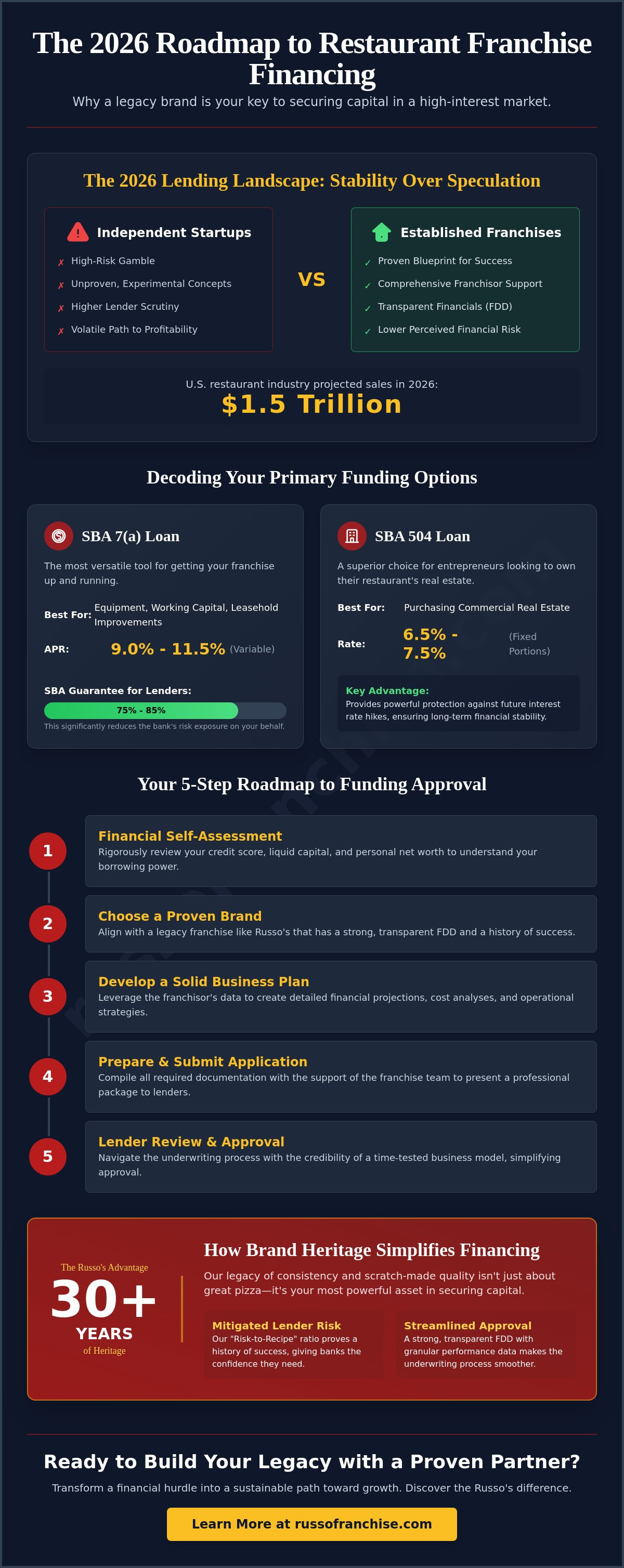
The U.S. restaurant industry is projected to reach $1.5 trillion in sales in 2026, yet this growth comes with specific financial complexities. With the Wall Street Journal Prime Rate holding at 6.75%, meticulous debt service planning is paramount for every entrepreneur. Italian cuisine remains uniquely resilient because it balances premium guest perceptions with manageable operational costs. New York Style pizzerias offer a stable investment for both domestic and international lenders because the product is a global cultural staple. Investors who account for SBA 7(a) variable rates, currently ranging from 9.0% to 11.5%, will find that traditional models with high-volume potential offer the most reliable path to profitability.
Why Lenders Prefer Franchises Over Independent Startups
Banks often view independent startups as high-risk gambles, but they perceive franchises as professional partnerships. A core part of understanding the franchise model is recognizing that you're adopting a refined system of operations. Franchisor support systems, such as comprehensive training and national marketing, act as a form of insurance for the bank's capital. Additionally, the Franchise Disclosure Document (FDD) provides the transparency lenders crave during underwriting. Under the 2026 FTC Rule changes, franchisors must provide more granular financial performance data. This makes the process for restaurant franchise financing much smoother for brands that can demonstrate strong median results and a disciplined history of growth.
Primary Funding Vehicles for Food Service Entrepreneurs
Capital is the lifeblood of your operation. Selecting the right vehicle determines whether you're building a legacy or merely managing debt. For most entrepreneurs, the search for restaurant franchise financing begins with federal support programs designed to bolster small business growth. These programs offer lower down payments and longer terms than traditional options, making them ideal for the initial build-out of a premium kitchen. You aren't just looking for money; you're looking for a sustainable foundation that respects your cash flow and your long-term vision.
SBA Loans: The Franchisee's Best Friend
The SBA 7(a) loan is the most versatile tool for leasehold improvements, equipment, and working capital. As of May 2026, variable rates for these loans typically range from 9.0% to 11.5% APR, depending on the lender spread and loan size. If your goal includes purchasing the real estate for your restaurant, the SBA 504 loan is a superior choice. It offers fixed-rate portions between 6.5% and 7.5%, providing protection against future interest rate hikes. The SBA guarantee serves as a 75% to 85% safety net for the lender, significantly reducing their risk exposure on your behalf. Researching various franchise financing options will show that these government-backed loans provide the stability needed to weather early-stage operational costs.
Conventional Financing and Portfolio Loans
Conventional commercial loans are often the preferred route for seasoned multi-unit developers with significant existing assets. Banks typically look for credit scores above 700 and a clear history of successful business management. Don't underestimate the power of a local bank relationship. These institutions value community-focused restaurants and may offer more flexible terms if they see your venture as a neighborhood anchor. They want to invest in something they can visit and experience. Some partners also utilize 401(k) rollovers, known as ROBS, to fund their down payment without incurring early withdrawal penalties or taxes, keeping their personal debt low.
Specialized equipment financing is another sophisticated strategy to consider. High-end assets, such as authentic Italian brick ovens, can be financed separately to preserve your primary credit line for other operational needs. When you choose a pizza & Italian kitchen franchise with a proven model, lenders often view these equipment investments with greater confidence. Whether you're leveraging personal equity or exploring private partners, your choice of funding should reflect the same commitment to quality that you bring to your kitchen. It's a disciplined approach to growth that ensures your business remains as stable as the heritage it represents.
Tailoring Your Capital Strategy to Your Franchise Model
Your capital strategy must mirror the scale of your ambition. Whether you're launching a single local pizza & Italian kitchen franchise or a sprawling multi-unit empire, the structure of your restaurant franchise financing changes significantly based on your operational footprint. A single-unit owner often relies on the strength of personal assets and government-backed programs to build a community anchor. Conversely, a master developer looks toward sophisticated credit facilities and regional partnerships to export a culinary legacy across borders. Matching your funding to your specific business model ensures you aren't just opening doors, but building a sustainable future.
For those starting with their first location, SBA 7(a) Loans remain the most accessible path to covering build-out costs and initial inventory. This model rewards the individual's dedication and local market knowledge. Financing a halal pizza franchise presents unique opportunities in global niche markets. Lenders in 2026 often look for specialized market research that demonstrates the strong demand for certified authentic cuisine, especially in high-growth urban centers. This specialized focus can make your application stand out by highlighting a clear, underserved demographic.
Financing the Multi-Unit Expansion
Scaling from one unit to many requires a shift from personal debt to corporate credit strategies. Successful developers often use the cash flow from their initial high-performing unit to service the debt of a second and third location. This disciplined approach demonstrates to lenders that your management team can replicate the brand's quality at scale. Securing a formal Development Agreement is essential here. It signals to banks a long-term commitment, often allowing you to lock in territory rights and more favorable terms before the first brick is laid. Managing your debt-to-income ratios during this phase is critical to maintaining the professional momentum required for rapid territory expansion.
International and Master Developer Capital
An international master franchise requires a high-level capital strategy that accounts for cross-border regulations and regional investment nuances. Exporting a premier Italian kitchen model involves navigating currency fluctuations and international banking standards. Most master developers seek local investment partners to share the capital burden and provide regional expertise. This collaborative approach stabilizes the venture against local market shifts and ensures the brand's heritage translates perfectly into new cultures. Lenders in these markets prioritize stability and a proven track record. This is where a 30-year legacy becomes your most valuable asset during restaurant franchise financing negotiations, proving that the recipe for success is truly universal.
How to Secure Funding: A 5-Step Roadmap for Franchisees
Securing restaurant franchise financing is a methodical process that rewards the disciplined entrepreneur. It begins with a rigorous self-assessment. Conduct a personal financial audit of your credit score, liquid capital, and total net worth. Banks in 2026 prioritize candidates with high liquidity to handle potential operational fluctuations. Once your house is in order, select a "lender-ready" brand. A franchisor with a transparent Franchise Disclosure Document (FDD), specifically a robust Item 19, provides the historical performance data lenders need to validate your projections. This transparency is the cornerstone of trust between you and your financial partners.
Structure your loan package as a professional portfolio. It should contain three years of personal and business tax returns, a detailed professional resume highlighting your leadership experience, and the franchisor’s operational support documents. After submission, don't simply accept the first term sheet you receive. Compare multiple offers to optimize your interest rates and repayment schedules. This ensures your monthly debt service supports, rather than hinders, your long-term growth. A strategic comparison can save you thousands in interest over the life of your loan.
Crafting a Winning Business Plan
Your business plan is the narrative of your future success. It must highlight the "Traditional Family Recipe" as a distinct competitive advantage in a market often saturated with generic options. Use data from pizza franchise opportunities to project a realistic ROI that reflects 2026 market conditions. If you're targeting specific global demographics, include a detailed "Halal Market Analysis" to show lenders you've identified a high-growth, underserved niche. A well-researched plan proves you're an expert in your local territory and a serious candidate for investment.
The Interview: Pitching to the Bank
When you sit across from a loan officer, present yourself as a disciplined operator and a seasoned mentor. Lenders often ask the difficult question: "What if the local market is saturated?" Answer this by pointing to the brand’s 30-year resilience and the superior quality of a scratch-made menu. Highlighting the franchisor’s comprehensive training program acts as a critical risk mitigation tool. This demonstrates that your restaurant franchise financing is backed by a proven blueprint for excellence, making the bank's investment feel secure. Ready to present your vision? Explore a pizza & Italian kitchen franchise opportunity today and start building your legacy.
The Russo’s Advantage: How Brand Heritage Simplifies Financing
Heritage serves as the ultimate collateral in a competitive lending environment. When you apply for restaurant franchise financing , you aren't just presenting a balance sheet; you're presenting the stability of Chef Anthony Russo’s founder-led vision. Lenders recognize that a brand with over 30 years of "scratch-made" consistency is far less likely to falter than an unproven startup. This time-honored commitment to quality transforms the perceived risk of the food industry into a calculated opportunity for growth. Our transparent Item 19 provides the rigorous financial performance representations that banks demand, creating a foundation of trust before the first interview even begins.
Russo’s global presence acts as a powerful validator for local financial institutions. Whether you're seeking an international master franchise or a domestic pizza & Italian kitchen franchise, our worldwide success proves that the business model is both scalable and resilient. This established prestige simplifies the conversation with loan officers, allowing you to focus on the operational excellence that defines our family legacy. Banks appreciate the discipline required to maintain such high standards across diverse markets, making them more likely to offer favorable terms to our partners.
A Legacy of Success Since 1992
A long-standing brand history since 1992 significantly accelerates the loan underwriting process. Banks often move faster when they can review decades of successful operations and a disciplined growth strategy. Our specialized halal pizza franchise model also opens doors to niche funding sources and community-focused lenders who value inclusive, high-quality dining options. By leveraging a professional and polished brand image, you build immediate confidence with investors who see you as a serious, disciplined partner rather than a speculative dreamer. This historical depth provides a level of security that newly formed concepts simply cannot replicate.
Next Steps: From Capital to Grand Opening
Securing your capital is only the beginning of the journey. Russo’s assists you throughout the site selection process, providing the demographic data and location analysis that lenders require to finalize your funding. This data-driven approach ensures your restaurant is positioned for maximum visibility and long-term ROI. We integrate your financial strategy with our comprehensive, step-by-step franchise onboarding guide to move you seamlessly from approval to your grand opening. This methodical transition ensures that your capital is deployed efficiently and your kitchen is ready to deliver excellence from day one. Ready to invest in a legacy? Contact Russo's to discuss your franchise future and take the first step toward a refined, successful partnership.
Building Your Legacy with Confident Capital
The path to ownership in 2026 is defined by a return to authenticity and disciplined planning. You've learned that navigating restaurant franchise financing is as much about the brand's history as it is about your own financial preparation. By selecting a lender-ready partner and following a structured roadmap, you transform the complexity of capital acquisition into a clear, manageable journey. Success in this industry requires a foundation built on time-honored methods and the unwavering stability of a proven business model.
Founded in 1992 by Chef Anthony Russo, our brand offers the security of a global presence and the unique advantage of Halal-certified options. Our transparent Item 19 financial reporting provides the professional clarity that lenders respect and entrepreneurs require. You aren't just launching a pizza franchise; you're joining a family that has perfected the craft of the Italian kitchen over three decades of growth. Your vision deserves a partner that values excellence as much as you do.
Your transition from aspiring entrepreneur to established restaurateur is within reach. We're ready to provide the blueprint for your success and welcome you into a heritage of culinary prestige.
Frequently Asked Questions
How much liquid capital do I need for a restaurant franchise loan?
Lenders typically require you to possess liquid assets equal to 20% to 30% of the total project cost. This ensures you have sufficient "skin in the game" to satisfy underwriting standards for a premium investment. Beyond the initial down payment, maintaining a cash reserve is a disciplined way to manage operational costs during your first year of growth.
Can I get a franchise loan with no prior restaurant experience?
Yes, you can secure funding without direct culinary experience if you partner with a brand that provides a comprehensive blueprint for operations. Lenders often view the franchisor’s training and support systems as a professional substitute for your individual industry background. Your history of leadership and management becomes the primary evidence of your ability to lead a successful team.
What is the difference between SBA 7(a) and SBA 504 loans for pizzerias?
The SBA 7(a) loan is a versatile tool for working capital and equipment, while the 504 program is specifically designed for long-term real estate and fixed assets. For a pizza & Italian kitchen franchise, 7(a) loans offer variable rates currently between 9.0% and 11.5%. The 504 program provides lower fixed rates for the CDC portion, making it the ideal choice for entrepreneurs purchasing their own building.
How long does the restaurant franchise financing process typically take?
The timeline generally ranges from 45 to 90 days depending on the complexity of your loan package and the lender's current volume. SBA loans often require a longer lead time due to federal oversight and the meticulous documentation required for approval. Preparing a "lender-ready" package with a transparent Franchise Disclosure Document can significantly expedite this professional review process.
Do franchisors like Russo's offer direct in-house financing?
Russo's does not provide direct in-house financing but offers expert guidance in connecting you with reputable third-party lenders. We provide the transparent financial performance data and Item 19 reports that banks require to validate your business plan. Our team acts as a seasoned mentor, ensuring your application reflects the professional polish and heritage that lenders find attractive.
What are the common interest rates for restaurant loans in 2026?
In 2026, restaurant franchise financing rates vary by loan type, with SBA 7(a) variable rates starting at 9.0% and reaching 11.5%. Conventional bank loans for high-credit borrowers currently average between 8% and 17.25% APR. These figures are influenced by the Wall Street Journal Prime Rate of 6.75% plus a lender spread based on your credit profile and experience.
How does a Halal-certified model affect my financing options?
A halal pizza franchise can broaden your financing options by appealing to niche community lenders and private investment groups interested in specialized markets. These institutions value the stability of an underserved demographic and the brand's commitment to authentic, inclusive dining. Highlighting this market in your business plan demonstrates a sophisticated understanding of local growth potential and competitive advantage.
Will the bank require collateral beyond the restaurant equipment?
Lenders usually require additional collateral to secure a significant loan, which may include personal real estate or a general lien on all business assets. The SBA 7(a) program specifically requires a personal guarantee from anyone owning 20% or more of the franchise. This commitment ensures that your personal interests are fully aligned with the long-term success and stability of the business venture.