Pizza Franchise vs Independent: Choosing the Best Model
A secret family recipe is a beautiful foundation, but it isn't enough to shield a new business from the complexities of a 46 billion dollar industry. You're likely torn between the allure of total creative independence and the proven security of an established system. It's a common crossroads for any ambitious entrepreneur asking: Pizza Franchise vs Independent Pizzeria: Which Business Model Is Right for You? You want to build a legacy that reflects your passion for craftsmanship while ensuring your investment yields a stable, professional return.
We know that the anxiety surrounding high failure rates or the hidden costs of supply chain management can be daunting. This article provides a clear ROI comparison between both models and a framework for evaluating your personal fit. You'll discover how to maintain "New York" quality at scale and why the right infrastructure is the ultimate competitive advantage. From navigating 2026 regulations like the "Skip the Stuff" laws to mastering food traceability, we'll help you choose the path that transforms your culinary ambition into a thriving, disciplined enterprise.
Key Takeaways
- Analyze the 2026 market demand for authentic, heritage-driven experiences and how this landscape dictates your long-term growth strategy.
- Contrast the total creative autonomy of an independent start-up with the logistical hurdles of maintaining scratch-made quality without a proprietary supply chain.
- Examine the protective advantages of a proven system, specifically regarding site selection and lease negotiation support that reduces initial investment risk.
- Use our operational framework to answer the pivotal question: Pizza Franchise vs Independent Pizzeria: Which Business Model Is Right for You?
- Explore the hybrid approach of a founder-led franchise that merges independent soul and family traditions with professional operational excellence.
Table of Contents
- The Pizza Business Landscape in 2026: Choosing Your Path
- Starting an Independent Pizzeria: The Price of Creative Freedom
- Investing in a Pizza Franchise: Buying a Proven System for Growth
- Operational Comparison: Supply Chains, Marketing, and Menu Development
- The Russo’s Advantage: Merging Independent Authenticity with Franchise Stability
The Pizza Business Landscape in 2026: Choosing Your Path
The 2026 culinary market is witnessing a profound shift. Consumers are increasingly rejecting mass-produced, generic options in favor of authentic, heritage-driven dining experiences. They seek the warmth of a family legacy and the precision of time-honored methods. This evolution presents a critical question for aspiring owners: Pizza Franchise vs Independent Pizzeria: Which Business Model Is Right for You? It's a choice that defines not just your menu, but the very foundation of your professional future.
Every entrepreneur faces a fundamental dilemma. Do you prioritize the absolute creative freedom of an independent brand, or do you seek the refined stability of a proven system? While the independent path offers a unique sense of personal legacy, it often lacks the operational armor needed to survive a competitive market. Premium pizzeria models have emerged as the most resilient sector in current economics because they bridge the gap between artisanal quality and professional structure. They offer the soul of a neighborhood shop with the backbone of a global brand.
Success requires moving beyond a hobbyist mindset. A hobbyist focuses solely on the recipe; a professional franchise developer focuses on the machine that delivers that recipe consistently. Understanding the franchising business model is the first step in recognizing how intellectual property can protect your capital. It's about choosing between a solo venture and a sophisticated partnership that values excellence and meticulous standards.
Why Pizza Remains a Recession-Resistant Investment
High-quality Italian cuisine maintains consistent demand across all economic cycles. In 2026, we've seen a surge in "at-home gourmet" dining. Customers expect restaurant-quality meals delivered to their door, yet they still crave the sensory experience of a brick-and-mortar location. It's a sobering reality that a high percentage of independent restaurants fail within their first three years. Without a proven blueprint, even the best recipes can't always overcome the weight of rising operational costs and supply chain complexities.
Defining Your Goals: Lifestyle Business vs. Scalable Empire
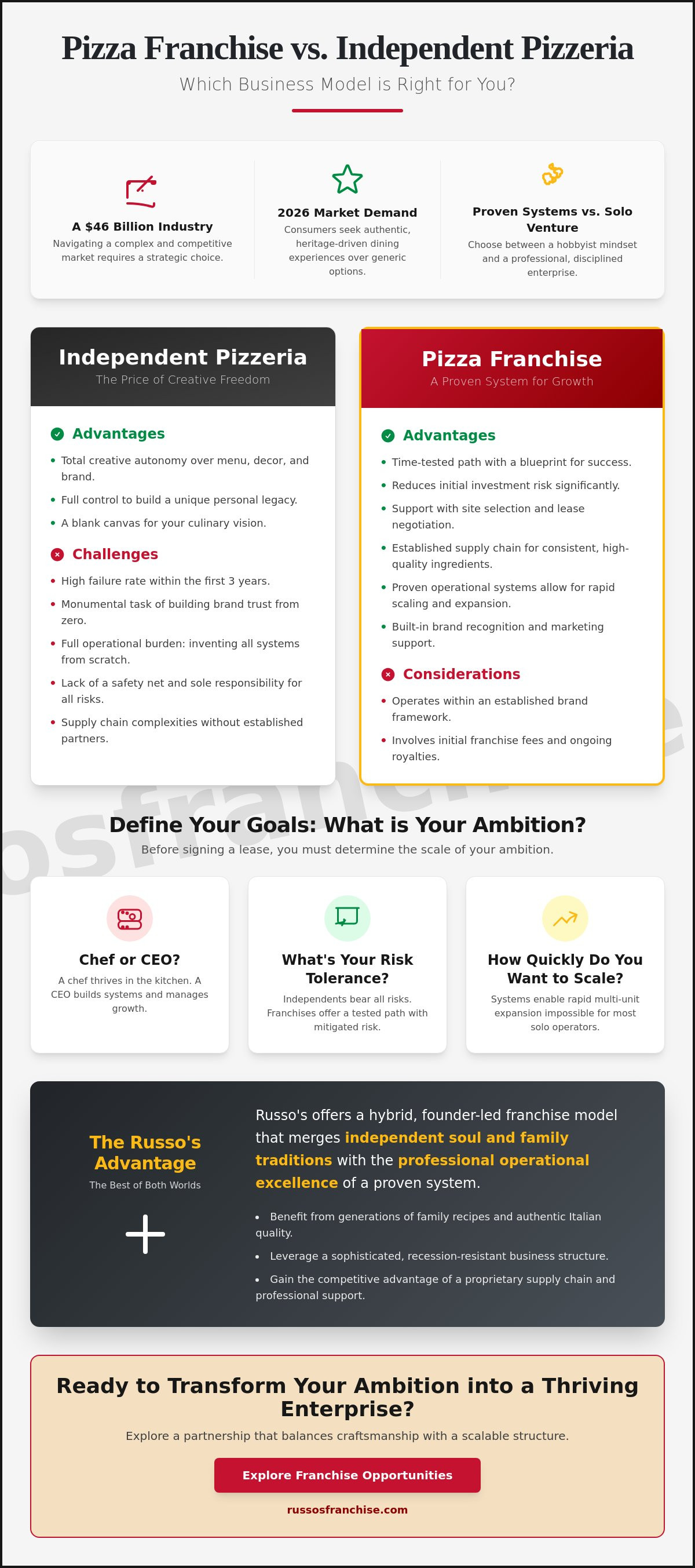
Before you sign a lease, you must determine the scale of your ambition. Are you looking to own a single neighborhood shop, or is your goal to build a multi-unit territory? Consider these questions:
- Are you a chef or a CEO? A chef thrives in the heat of the kitchen; a CEO thrives on building systems and managing growth.
- What is your risk tolerance? Independents carry the full weight of trial and error, while franchises offer a time-tested path.
- How quickly do you want to scale? Systems allow for rapid expansion that is often impossible for solo operators.
If you're looking for a path that balances craftsmanship with a scalable structure, exploring Pizza Franchise Opportunities serves as a benchmark for premium Italian investments in the current market.
Starting an Independent Pizzeria: The Price of Creative Freedom
For many, the dream of owning a pizzeria starts with a blank canvas. You have total autonomy over the signature sauce, the rustic decor, and the story behind your brand. This creative freedom is intoxicating. However, it often comes with a steep price tag that isn't always visible on the initial balance sheet. When you start from scratch, you're essentially inventing the wheel while trying to keep it turning. It's a high-stakes environment where every decision rests solely on your shoulders.
Building brand trust from zero in a crowded 2026 market is a monumental task. Without an established name, you are fighting for every single customer through a "marketing vacuum." You must convince a skeptical audience that your quality matches their expectations before they've even tasted a slice. Furthermore, the operational burden of creating systems for dough fermentation, sauce consistency, and staff training from scratch can be overwhelming. These are the foundational elements that determine if you can maintain quality as you grow, yet they require hundreds of hours of research and development that a solo owner rarely has.
When asking, Pizza Franchise vs Independent Pizzeria: Which Business Model Is Right for You? , you must weigh this autonomy against the lack of a safety net. An independent path requires you to be a master of all trades, often at the expense of your personal life and long-term strategy.
The Reality of Independent Profit Margins
The financial reality for single-unit owners is often harsher than expected. Without the bulk purchasing power of a larger network, independent operators frequently pay 20-30% more for premium ingredients like high-protein flour and whole-milk mozzarella. These costs eat into margins already stretched thin by the "Founder Trap." This is a scenario where the owner must simultaneously serve as the head chef, the janitor, and the accountant. While scratch-made dough matters for your bottom line by providing a superior product, executing it solo requires relentless discipline and leaves little room for strategic business development.
The Risks of Going Solo in 2026
Modern operations demand more than just a good oven. You must navigate complex POS systems, delivery app integrations, and digital loyalty programs. For an independent, this is a process of expensive trial and error. One bad location choice or a flawed recipe adjustment can end the business before it matures. This is why many entrepreneurs consult an SBA guide to buying a business to weigh these risks against more structured paths. In contrast, proven franchise models eliminate this guesswork by providing a pre-built operational engine. If you're ready to see how a structured system can support your culinary goals, consider exploring a professional franchise opportunity that balances tradition with modern efficiency.
Investing in a Pizza Franchise: Buying a Proven System for Growth
While the independent path celebrates absolute autonomy, the franchise model celebrates the power of partnership. It is a strategic alliance between your capital and a brand's proven intellectual property. If you're weighing the choice of Pizza Franchise vs Independent Pizzeria: Which Business Model Is Right for You? , consider the value of speed to market. A franchise provides an operational engine that has already been tuned through years of trial, error, and refinement. This is why the SBA guide on buying a business highlights the reduced risk profile and structured guidance inherent in this model. You aren't just buying a name. You're buying a disciplined blueprint for success.
Expert franchisors provide critical support in site selection and lease negotiation. This isn't merely about finding a vacant building; it's about using sophisticated analytics to identify high-traffic demographics that match your brand's profile. Once the site is secured, the proprietary supply chain takes over. Unlike the independent owner who often pays a 20-30% premium for single-unit orders, a franchise leverages the collective power of the network to secure authentic Italian ingredients at scale. This ensures your margins remain healthy while your quality remains uncompromising.
The "Playbook" is perhaps your most valuable asset. It contains the precise training programs that transform an inspired entrepreneur into a polished operator. It covers every meticulous standard, from dough hydration levels to the nuances of hospitality, ensuring that the "New York" experience is replicated perfectly with every order. This structure allows you to focus on growth rather than reinventing operational systems from scratch.
The Sophisticated Support System
A major advantage of this model is the ability to tap into national and regional marketing campaigns that drive traffic from the moment your doors open. For those with larger ambitions, the "Master Developer" concept offers a path to owning entire territories and building a scalable empire. If your vision extends beyond borders, exploring International Master Franchise opportunities allows you to scale authentic heritage on a global stage, backed by a world-class support infrastructure.
The Trade-Off: Royalties and Operational Consistency
New investors often question royalty fees, but it's more accurate to view them as an insurance policy for your investment. These fees fund the continuous research, development, and marketing that keep your business competitive. Brand consistency is the foundation of customer trust. When a guest sees your sign, they expect a specific, high-quality experience. A founder-led franchisor acts as an authoritative mentor, providing a level of dedication and heritage-driven pride that corporate conglomerates simply cannot replicate.
Operational Comparison: Supply Chains, Marketing, and Menu Development
Running a professional kitchen requires more than just passion; it requires a disciplined operational engine. When you evaluate Pizza Franchise vs Independent Pizzeria: Which Business Model Is Right for You? , the daily mechanics of supply chain and marketing often become the deciding factors. An independent owner typically relies on local vendors. While this feels community-oriented, it leaves you vulnerable to price fluctuations and inconsistent ingredient quality. A proprietary franchise supply chain secures the same high-protein flour and extra virgin olive oil for every location. This ensures the heritage of the brand is never diluted by logistical compromises.
The technological gap in 2026 is wider than ever. Independent shops often piece together expensive third-party POS systems and delivery apps that eat into profits through high commission fees. Franchises typically deploy a custom-built tech stack. This includes integrated ordering and loyalty apps designed specifically for the brand's workflow. This provides a seamless experience for the customer and a clearer data set for the owner, allowing for more precise inventory management and labor scheduling.
Many entrepreneurs overlook specialized markets that require rigorous standards. A Halal pizza franchise provides a certified system that is incredibly difficult for an independent to verify and maintain alone. This includes meticulous vetting of every supplier in the chain to ensure compliance with dietary standards. For a solo operator, this level of oversight is a massive administrative burden that can distract from the craft of cooking. If you are ready to leverage a professional operational engine, explore our franchise opportunity to see how we support our partners.
The Economics of Quality: Flour, Cheese, and Sauce
Proprietary recipes, such as family-owned dough formulas, create a competitive moat that rivals cannot easily cross. In 2026, franchises help stabilize ingredient costs against inflation by negotiating long-term contracts for premium Italian staples. This contrasts sharply with the "cheap" frozen products often used by lower-tier competitors. Authentic heritage relies on fresh, premium ingredients. The franchise model makes these items financially viable at scale, protecting your margins without sacrificing the culinary experience.
Marketing and Brand Equity in the Digital Age
Consider the cost of growth. Hiring a private marketing agency can cost thousands monthly with no guarantee of return on investment. A franchise marketing fee buys you into a machine that has already perfected customer acquisition. Brand recognition in the first 90 days is a powerful catalyst for success. It acts as a speed-to-market investment that brings guests through the door while an independent is still struggling to establish basic trust in a crowded digital landscape.
The Russo’s Advantage: Merging Independent Authenticity with Franchise Stability
Russo’s New York Pizzeria represents a sophisticated hybrid for entrepreneurs who refuse to compromise on quality. It offers the soul and artisanal craftsmanship of an independent shop with the operational stability of a global network. When deciding between a Pizza Franchise vs Independent Pizzeria: Which Business Model Is Right for You? , you don't have to choose between heritage and growth. Our model is founder-led. Anthony Russo’s direct involvement and original family recipes are at the core of every location, providing a level of authenticity that corporate conglomerates cannot replicate. Whether you're interested in a single-unit shop or a multi-unit territory, the system is designed to scale without losing its essence.
Specialized markets offer a unique path to global expansion. The Halal pizza franchise model is a significant growth driver, providing a certified, meticulous system that allows partners to serve a diverse and loyal customer base. This specialized focus, combined with our New York roots, creates a formidable presence in both domestic and international markets. Partners can leverage the International Master Franchise structure to secure entire regions, backed by a world-class support infrastructure that has been refined since our inception.
Authentic New York Pizzeria Review: Why Heritage Wins
Authentic Italian excellence is the foundation of our longevity. Founded in 1992, the brand has navigated decades of economic shifts by remaining disciplined in its approach. We focus on a traditional brick-and-mortar experience, rejecting the trend of ghost kitchens and frozen retail products. This commitment to a premium dining atmosphere drives higher average checks and fosters deep customer loyalty. When guests enter a Russo’s, they aren't just buying a meal; they are participating in a family legacy that prioritizes fresh ingredients and time-honored methods over mere convenience.
Next Steps: Evaluating Your Pizzeria Investment
Choosing the right path requires an honest assessment of your professional goals and financial readiness. Consider this checklist to determine if our model aligns with your culinary ambition:
- Quality Alignment: Do you prioritize authentic Italian excellence over mass-market, generic convenience?
- Scale Ambition: Is your goal to build a scalable empire with professional operational armor?
- Legacy Focus: Are you seeking a partnership with a founder-led brand that has a 30-plus year history of stability?
For those looking to dominate global markets, the International Master Developer role provides the authority to grow the brand across entire countries. If you're ready to bridge the gap between artisanal passion and professional success, it is time to Explore Russo's Pizza Franchise Opportunities and discover the most profitable path for your future.
Secure Your Future in the Premium Pizza Market
Choosing your path requires balancing the raw passion of a chef with the disciplined vision of a CEO. We have explored the significant logistical hurdles of going solo, from marketing vacuums to inflated ingredient costs. We have also highlighted how a heritage-led system provides the operational armor needed to thrive in 2026. Ultimately, answering the question, Pizza Franchise vs Independent Pizzeria: Which Business Model Is Right for You? comes down to your desire for long-term stability versus the high risk of trial and error. Success in this industry belongs to those who pair artisanal quality with a professional, time-tested blueprint.
Russo’s New York Pizzeria offers a rare hybrid model for the ambitious investor. It's been founder-led by Chef Anthony Russo since 1992, ensuring that every location upholds proprietary family recipes with absolutely no frozen ingredients. Whether you seek a halal-certified opportunity or a global master franchise, our system is designed for those who demand excellence without compromise. You don't have to sacrifice authenticity to build a scalable empire. Start Your Journey with a Russo's New York Pizzeria Franchise and build a business that honors tradition while securing your professional legacy. We're ready to help you turn your culinary ambition into a masterpiece.
Frequently Asked Questions
Is it more profitable to own a pizza franchise or an independent shop?
Profitability depends on your ability to manage margins versus your ability to drive volume. A franchise typically achieves higher volume through established brand trust, while an independent owner retains every cent of the net profit. However, single-unit independents often pay 20% to 30% more for premium ingredients. This makes the question of Pizza Franchise vs Independent Pizzeria: Which Business Model Is Right for You? a matter of balancing lower procurement costs against royalty obligations.
How much does a pizza franchise cost compared to starting my own shop?
Initial investment varies significantly based on the scale of your culinary ambition. Industry data from 2026 suggests independent brick-and-mortar shops can start around $95,000, while full-service pizzerias in major cities can exceed $750,000. Franchises often require a higher upfront investment to cover proprietary systems and professional site selection support. You're paying for a refined path that replaces expensive trial and error with a disciplined operational engine.
Can I change the menu if I own a pizza franchise?
Menu changes are typically restricted in a franchise model to ensure unwavering consistency across all locations. This discipline is what builds customer trust; a guest expects the same "New York" quality whether they're in Houston or Dubai. While you lose the ability to experiment daily, you gain a market-tested menu that has already been perfected for profitability and consumer demand. It's a trade-off that favors stability over total creative autonomy.
What is the average failure rate for independent pizzerias vs. franchises?
Independent restaurants face a significantly higher failure rate within their first three years of operation. Without a proven blueprint or a sophisticated supply chain, solo operators often struggle to survive economic shifts or rising inflation. Knowing these risks helps you decide Pizza Franchise vs Independent Pizzeria: Which Business Model Is Right for You? because it highlights the value of a safety net. Franchises generally offer a more stable path by providing established brand equity.
How long does it take to open a pizza franchise from the first inquiry?
The timeline to open a franchise typically ranges from six to twelve months after the initial inquiry. This period is dedicated to meticulous site selection, lease negotiations, and comprehensive staff training. A professional franchisor guides you through every milestone to ensure your doors open with the momentum of a seasoned operator. This structured approach is designed to eliminate the uncertainty and delays that often plague independent startups.
What kind of training does a premium pizza franchisor provide?
A premium franchisor provides end-to-end training that covers both the craft and the commerce of the business. You'll master everything from dough hydration and sauce consistency to POS integration and labor management. This "Playbook" approach ensures that even if you don't have a culinary background, you can maintain the standards of a high-end Italian kitchen with confidence. It is a mentorship that transforms an entrepreneur into a disciplined restaurant professional.
Is a halal pizza franchise a viable investment for international markets?
A halal pizza franchise is an exceptionally viable investment for international markets and diverse domestic regions. It provides a certified system that verifies every supplier in the chain, a task that is nearly impossible for an independent to manage alone. This specialized model acts as a unique global growth driver. It meets the rigorous dietary standards of a loyal and expanding customer base while maintaining the brand's authentic Italian heritage.
How do franchise royalty fees work and what do they cover?
Royalty fees are ongoing payments that act as an insurance policy for your business investment. They typically cover continuous research and development, national marketing campaigns, and the maintenance of a proprietary supply chain. These fees ensure your brand remains competitive and modern in a crowded market. They allow you to focus on daily hospitality and operations while the franchisor manages the high-level strategy and technical innovations of the network.