Authentic Pizzeria Franchise: The Russo’s New York Pizzeria 2026 Review
What if the very "New York Style" label that once promised success is now the reason your profit margins are shrinking? In an industry saturated with frozen dough and excessive commissary markups, securing a truly authentic pizzeria franchise requires a partner who treats heritage as a competitive advantage rather than a marketing tagline. You understand that discerning guests can taste the difference between a genuine family recipe and a mass-produced corporate formula, yet the logistical hurdles of a scratch kitchen often seem daunting for a growing enterprise. Quality demands discipline.
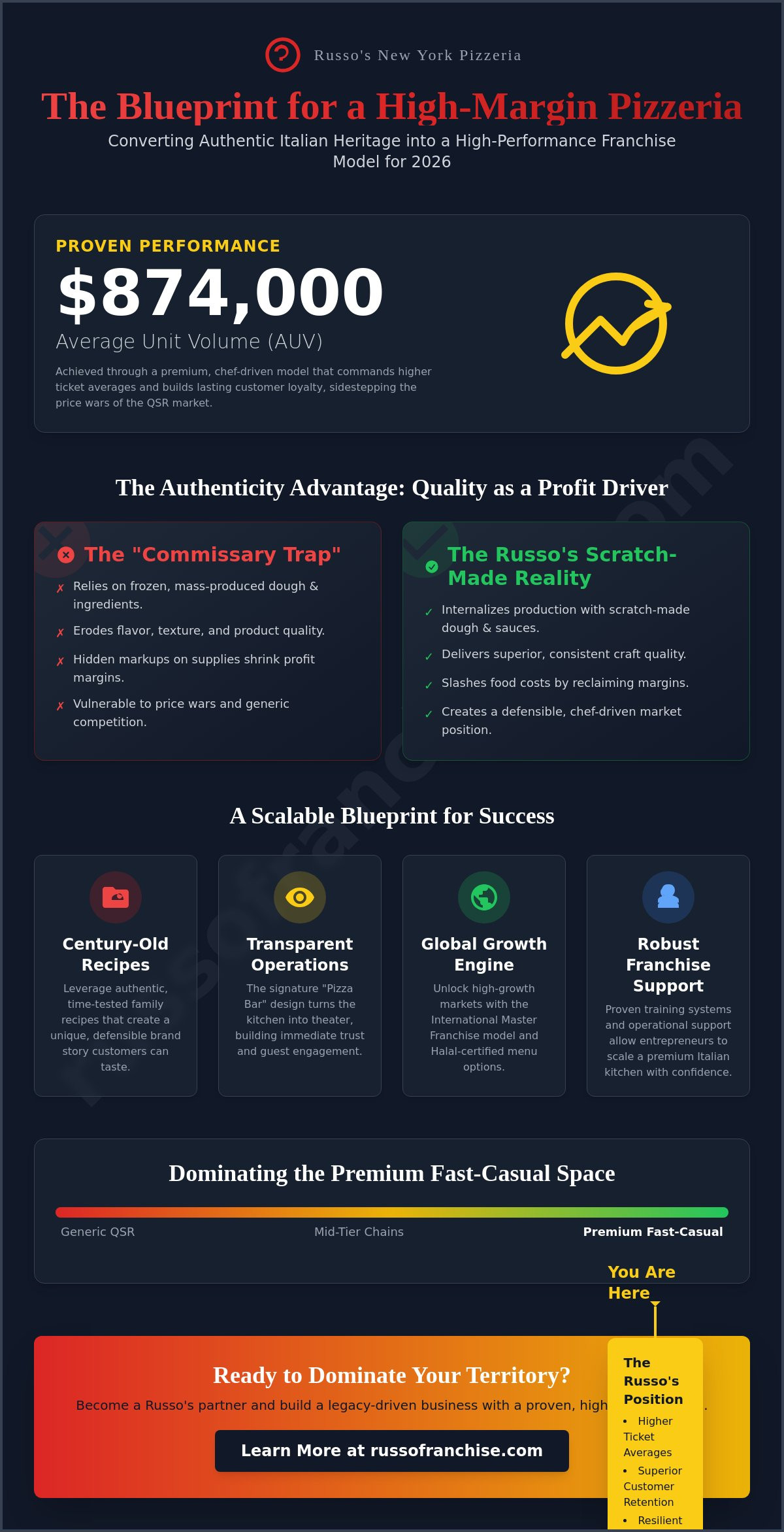
You likely believe that uncompromising quality is the only way to build lasting customer loyalty, and the data supports your intuition. This 2026 review reveals how Russo's New York Pizzeria converts traditional Italian craftsmanship into a high-performance business model that doesn't compromise on margins. We will analyze the brand's impressive $874,000 average unit volume, its expansion as a Halal pizza franchise, and its robust support for International Master Franchise partners. Discover how a disciplined approach to fresh ingredients and a proven operational blueprint can help you dominate your territory with a sophisticated, legacy-driven brand.
Key Takeaways
- Learn how internalizing production through scratch-made dough and sauces slashes food costs compared to commissary-dependent models.
- Explore the competitive edge of an authentic pizzeria franchise that leverages century-old family recipes to create a defensible, chef-driven market position.
- Understand how the International Master Franchise model and Halal-certified options unlock high-growth segments in the global marketplace.
- Identify the specific operational support and training systems that allow entrepreneurs to scale a premium Italian kitchen with confidence.
- Discover why the shift toward high-margin, heritage-driven dining makes this business model a resilient investment for the 2026 landscape.
Table of Contents
The Authenticity Gap: Why "NY-Style" Isn’t Always Authentic
The marketplace is currently flooded with brands claiming to offer a genuine New York experience, yet few can define what that actually means beyond a thin crust and a folding technique. For the sophisticated investor, identifying a truly authentic pizzeria franchise requires looking past the window decals and into the supply chain. True authenticity isn't a marketing veneer; it's a rigorous operational standard that dictates how every ingredient enters the kitchen. While competitors often prioritize the convenience of industrial logistics, a heritage-driven model understands that the soul of New York-style pizza lives in the chemistry of fresh dough and the vibrancy of hand-crushed tomatoes.
Consumer expectations have reached a tipping point in 2026. Diners are increasingly skeptical of "cookie-cutter" systems that rely on frozen components and pre-made sauces. They're seeking transparency and "clean label" dining experiences where ingredients are recognizable and preparation is visible—a standard upheld by family-led businesses like Firenze Pizzéria, which focus on home-style quality. This shift has turned heritage into a powerful shield. In an era where third-party ghost kitchens dilute brand identities with generic, assembly-line products, a brand rooted in a specific culinary legacy offers a unique, defensible asset that cannot be easily replicated by an algorithm or a shared kitchen space.
The "Commissary Trap" vs. Scratch-Made Reality
Many franchise systems hide their true costs within pre-packaged supplies, forcing operators into a "commissary trap" where profit margins are sacrificed for the sake of perceived simplicity. When dough is frozen and shipped across state lines, the yeast loses its vitality, resulting in a final product that lacks the characteristic airy, crisp texture of a proper slice. Relying on these "frozen-to-oven" logistics doesn't just erode the flavor profile; it adds significant markups to basic commodities like flour and water. Authenticity is the marriage of 1992 recipes with 2026 tech. By internalizing production and making dough fresh on-site, a franchise empowers its partners to reclaim their margins while delivering a product that consistently outperforms industrial alternatives.
The 2026 Pizza Market Landscape
The divide between traditional Quick Service Restaurants (QSR) and premium fast-casual dining has never been wider. Data suggests that premium brands are capturing a larger share of the market as customers trade frequency for quality. An authentic pizzeria franchise occupies a distinct, high-growth asset class that commands higher ticket averages and superior customer retention. Because these brands offer a narrative and a craft, they're less susceptible to the price wars that plague the lower end of the market. Investors who prioritize a "chef-driven" foundation find themselves positioned to meet the growing demand for stable, upscale dining options that feel like a neighborhood fixture rather than a corporate outpost.
The Russo’s Blueprint: 100-Year-Old Recipes in a 2026 Marketplace
Success in the food industry often hinges on the delicate tension between tradition and technology. While many competitors prioritize "fast-fired" assembly lines that sacrifice flavor for a three-minute wait time, Russo's New York Pizzeria has built its reputation on the deliberate, slow-fermentation methods that define a truly authentic pizzeria franchise . This blueprint was established by Chef Anthony Russo in 1992, drawing from family recipes that have crossed generations to find a home in the modern market. It's a system where heritage isn't just a story; it's the operational foundation that ensures a flagship experience in every unit.
The centerpiece of this model is the "Pizza Bar," a design element that transforms the kitchen into a transparent theater. Guests don't just order food; they witness the craft of hand-tossed dough and fresh ingredient preparation. This visibility builds immediate trust and differentiates the brand from the sterile, hidden kitchens of typical fast-food outlets. By standardizing these century-old techniques into a repeatable global system, the brand ensures that the aromatic profile and crust texture remain consistent, whether the restaurant is in Houston or a new international territory.
Founder-Led vs. Private Equity-Owned
Choosing a partner is as much about the leadership as it is the product. Unlike many brands managed by private equity firms that may prioritize short-term dividends over culinary integrity, Russo’s remains a privately held, founder-led organization. This structure provides a level of stability and mentorship that is rare in the 2026 marketplace. Anthony Russo’s personal involvement in the training program means new owners learn the "why" behind every sauce and sear. When reviewing the Consumer's Guide to Buying a Franchise, you'll find that the strength of the franchisor’s vision is a primary indicator of long-term success. Russo's focus remains firmly on brick-and-mortar excellence rather than diluting the brand through third-party ghost kitchen experiments.
The Menu: Beyond the Slice
A sophisticated authentic pizzeria franchise must capture more than just the quick-lunch crowd. The Russo's menu is engineered as a full Pizza & Italian Kitchen, integrating hearty pastas, fresh calzones, and crisp salads to drive higher ticket averages across multiple dayparts. This "Gourmet Advantage" allows operators to serve as both a premium lunch spot and a destination for family dinners. The signature scratch-made sauces, prepared daily without preservatives, serve as the culinary anchor that keeps customers returning. If you are ready to bring this level of craftsmanship to your market, explore the available franchise opportunity and see how heritage drives performance.
The Business Case for Scratch-Made: Quality as a Profit Driver
Efficiency is often confused with shortcuts. In the high-volume world of Italian dining, many operators assume that scratch-made preparation is a luxury they can't afford. The reality is quite the opposite. An authentic pizzeria franchise built on the Russo’s model uses on-site preparation to reclaim the margins that other brands lose to industrial middle-men. When you stop paying for the logistics of shipping frozen dough balls and pre-packaged sauces, you shift that capital back into your own bottom line. The economics of flour and water are remarkably simple: making dough in-house slashes your Cost of Goods Sold (COGS) while delivering a product that commands a premium price.
Labor efficiency doesn't require a kitchen full of five-star chefs. It requires a disciplined, repeatable system. Russo’s has engineered a training pipeline that allows staff to execute complex, heritage recipes with absolute precision. By standardizing the "Chef-Driven" process into clear, manageable steps, the model ensures high-volume throughput without a drop-off in quality. This operational discipline supports multiple revenue streams, from the high-energy "Pizza Bar" dine-in experience to robust delivery and catering departments, ensuring the kitchen remains productive throughout every daypart.
Analyzing the Pizzeria Profit Margin
While typical industry food costs often spiral out of control due to commissary markups, this model targets a highly competitive range of 21% to 26%. This lean operational profile is sustainable because the quality of the ingredients does the heavy lifting for your marketing department. When guests experience the difference of fresh, preservative-free sauces and hand-tossed crusts, organic word-of-mouth replaces the need for aggressive, margin-eroding discount cycles. This creates a longer customer lifecycle and a higher frequency of visits. By positioning yourself within the most resilient restaurant industry market segments, you build a business that relies on loyalty rather than gimmicks.
Flexible Footprints for Maximum Yield
Profitability is also a function of how effectively you use your square footage. The Russo’s model offers flexible footprints to match the specific demographic needs of your territory. Whether it's a 1,200 square foot delivery-focused hub or a 3,500 square foot full-service authentic pizzeria franchise , the kitchen layout is optimized for maximum yield. This adaptability allows owners to secure prime real estate that fits their capital requirements while maintaining the high-volume capacity needed to drive a strong Average Unit Volume (AUV). It's about matching the store model to the market, ensuring every inch of the restaurant contributes to the overall ROI.
Scalability Without Compromise: Global Master Development
Scaling is the ultimate test of a brand's foundation. While many systems lose their culinary identity as they cross borders, Russo’s has engineered a Global Master Development program that treats regional expansion as a partnership of shared values. This model allows an authentic pizzeria franchise to maintain its "NY soul" while adapting to the logistical and cultural nuances of diverse international markets. By empowering a single entity to oversee an entire region, the brand ensures that the standards of Chef Anthony Russo are upheld with the same rigor in Dubai or Riyadh as they are in Houston.
Resilience in global expansion depends on a robust, adaptable supply chain. Russo’s works closely with partners to source premium ingredients that meet strict quality specifications, ensuring that the signature crunch of the crust and the sweetness of the sauce remain unchanged. It's a disciplined approach to growth. Instead of diluting the menu with localized gimmicks, the focus remains on the core Italian recipes that have already proven their universal appeal. This stability makes the brand a preferred choice for investors looking to dominate a territory with a proven, high-performance asset.
Mastering the International Market
The International Master Franchise model is designed for the sophisticated developer who seeks to own a region rather than just a single store. These partners act as the primary brand ambassadors, taking on the responsibility of site selection, sub-franchising, and regional training. Russo’s provides extensive support during this process, offering a blueprint for success based on established growth in the Middle East. This region has served as a powerful template, demonstrating how a premium Italian concept can thrive in competitive, high-traffic international environments when backed by a structured development pipeline.
The Halal Opportunity
One of the most significant growth drivers for the brand is its position as a leading Halal pizza franchise. This is a massive, underserved global niche that demands both culinary excellence and strict adherence to dietary standards. Russo’s has successfully operationalized Halal requirements without altering its core flavor profile, making it a uniquely inclusive dining destination. By capturing this fast-growing segment, partners can tap into a loyal demographic that values transparency and authenticity. If you are ready to lead the expansion of a heritage brand in your region, apply for an International Master Franchise opportunity today and secure your territory.
Becoming a Russo’s Partner: The Path to Ownership
The transition from admirer to owner is a significant milestone. Joining the Russo’s network isn't just a financial transaction; it's an entry into a legacy that values meticulous standards and entrepreneurial ambition. The ideal partner brings a sophisticated blend of business acumen, liquid capital, and a genuine passion for the culinary arts. While previous restaurant experience is beneficial, the brand prioritizes leaders who understand the importance of discipline and are committed to maintaining the integrity of a 100-year-old family history. Success here is a natural outcome of following a refined, time-tested path.
The journey begins with an intensive eight-week training program at the corporate academy in Houston. Here, up to four members of your leadership team will master everything from the chemistry of the dough to the nuances of high-volume kitchen management. This isn't a surface-level orientation. It's a deep immersion into the operational "how" that ensures your location mirrors the excellence of the original flagship. You'll leave with the heart of a family-oriented guide and the skills of a seasoned operator.
The Support Ecosystem
Securing the right location is the first hurdle in building a successful authentic pizzeria franchise . Russo’s provides professional guidance throughout the site selection and lease negotiation phases, ensuring your restaurant is positioned for maximum visibility and traffic. Once the doors open, you're backed by a global marketing engine designed to drive local dominance. This support includes:
- Comprehensive build-out and construction management guidance to streamline your opening.
- National and regional marketing campaigns to build immediate brand awareness.
- Continuous R&D that introduces new menu items and tech updates to keep your kitchen ahead of market trends.
Investment and Discovery
Transparency is the bedrock of a healthy partnership. The discovery process involves a series of purposeful interactions, including a Discovery Day where you'll meet the corporate team and Chef Anthony Russo himself. This is the time to review the Franchise Disclosure Document (FDD), which provides a clear, detailed look at performance expectations and the structural requirements of the business. You'll gain a thorough understanding of the royalty structures and the marketing fund that fuels the brand's global presence. It's a disciplined approach that builds trust and security for every new partner.
Securing a territory in this growing network is a strategic move for those who value stability and prestige. The brand's methodical growth ensures that each partner receives the attention and resources necessary to thrive in their specific market. If you're ready to move beyond the generic and invest in a brand with a defensible heritage, the path is clear. Start your journey toward owning an authentic pizzeria franchise today.
Securing Your Legacy in the Global Italian Market
Building a sustainable future in the restaurant industry requires more than just a recognizable name. It demands an authentic pizzeria franchise that balances century-old traditions with modern operational precision. Since 1992, Chef Anthony Russo has demonstrated that a founder-led, scratch-made model isn't just a culinary preference; it's a superior business strategy. By internalizing production, partners can achieve a proven food cost model of 21-26%, reclaiming margins that competitors lose to industrial suppliers. This efficiency, combined with specialized Halal and International Master Franchise opportunities, ensures your investment is positioned for long-term stability and global growth.
The path to ownership is structured to provide security while fostering your entrepreneurial ambition. You aren't just opening a restaurant; you're joining a refined ecosystem dedicated to craftsmanship and high-volume success. If you're ready to dominate your territory with a brand that refuses to compromise on quality, the next step is waiting. Download the Russo’s Franchise Opportunity Guide to explore how our heritage can drive your performance. We look forward to helping you build a legacy that your community will taste in every slice.
Frequently Asked Questions
What defines an authentic pizzeria franchise in the 2026 market?
Authenticity is defined by a commitment to scratch-made preparation, on-site dough fermentation, and the use of preservative-free ingredients. In the 2026 market, it also includes transparency in the kitchen through design elements like a Pizza Bar. This approach ensures a premium product that differentiates an authentic pizzeria franchise from industrial, commissary-dependent models that rely on frozen components.
How much does it cost to open a Russo’s New York Pizzeria?
Total investment costs vary based on the specific store model, location size, and regional real estate conditions. Prospective partners should review the Franchise Disclosure Document (FDD) for a comprehensive breakdown of initial fees, construction costs, and equipment requirements. These figures are designed to reflect the quality and structural standards necessary for a high-performance Italian kitchen and full-service dining environment.
Is a halal pizza franchise model available for international markets?
Yes, Russo's offers a specialized Halal pizza franchise model specifically designed to capture underserved global demographics. This operational blueprint adheres to strict dietary certifications while maintaining the original flavor profiles established by Chef Anthony Russo. It allows international developers to serve a diverse customer base without compromising on the brand's culinary heritage or its New York soul.
Does Russo’s provide training for owners with no restaurant experience?
Russo's provides an extensive eight-week training program at its Houston academy for up to four people per franchise unit. While a background in business or hospitality is beneficial, the curriculum is designed to teach the operational techniques to owners regardless of their previous kitchen experience. This ensures every partner can execute the brand's recipes with the heart of a professional chef and the discipline of a seasoned operator.
What is the difference between a single-unit and a master franchise agreement?
A single-unit agreement focuses on the operation of one restaurant, while an International Master Franchise agreement grants a developer the rights to an entire territory or region. Master developers take on a leadership role, overseeing sub-franchising and regional training. This structure is ideal for sophisticated investors looking to build a large-scale presence and dominate a specific geographic area with a proven brand.
How does Russo’s maintain food quality across different global territories?
Quality is maintained through a disciplined global supply chain and the standardization of scratch-made preparation techniques. Every authentic pizzeria franchise location follows the same rigorous fermentation and ingredient sourcing protocols established at the flagship level. Regular corporate audits and ongoing R&D support ensure that the product remains consistent regardless of whether the restaurant is located in the United States or an international territory.
Are there specific net worth requirements to become a Russo’s franchisee?
Prospective franchisees must meet specific liquid capital and net worth requirements to ensure the long-term stability and growth of their location. These financial benchmarks vary depending on whether you are pursuing a single unit or a multi-unit development agreement. Detailed financial qualifications are discussed during the initial discovery process and are clearly outlined in the current Franchise Disclosure Document.
How long does the process take from signing to grand opening?
The timeline from signing a franchise agreement to the grand opening typically depends on variables such as site selection, permitting, and construction phases. While each project is unique, the corporate team provides a structured roadmap to help navigate lease negotiations and build-out requirements efficiently. Partners can expect a methodical process that prioritizes operational readiness and staff training to ensure a successful and polished launch.