Can a financial spreadsheet actually capture the aroma of a wood-fired oven or the weight of a thirty-year family legacy? Most entrepreneurs realize that a generic restaurant franchise business plan template often fails to translate the intangible value of premium Italian dining into a language that banks and investors understand. You know that high-end hospitality requires more than just standard projections. It demands a strategy that respects time-honored tradition while ruthlessly targeting a high-ROI reality. It's frustrating to feel that your passion for quality is being lost in a sea of sterile, one-size-fits-all documents.
We'll show you how to master the art of franchise planning with a template designed to turn your heritage-driven vision into a professional, bank-ready roadmap. This guide provides the clarity you need to scale from a single unit to a multi-state presence without losing your brand's soul. We'll explore the essential components of a scalable model, including how to value premium ingredients in your financials and the best ways to adapt a global brand to your local market. By the end, you'll have the validation and the tools to prove your chosen franchise model is both authentic and exceptionally profitable.
Key Takeaways
- Distinguish your brand from commodity fast food by understanding why 2026 lenders prioritize proven, heritage-driven blueprints over speculative independent startups.
- Utilize a specialized restaurant franchise business plan template to identify local market gaps and craft an executive summary that commands entrepreneurial attention.
- Learn how to transform scratch-made dough and traditional family recipes into tangible financial assets that drive community engagement and brand loyalty.
- Master the nuances of financial modeling for premium price points, including the unique logistics involved in scaling an international master franchise.
- Transition seamlessly from the strategic planning phase to site selection using a disciplined operational framework that ensures long-term consistency and prestige.
Why a Generic Restaurant Franchise Business Plan Template Fails Premium Brands
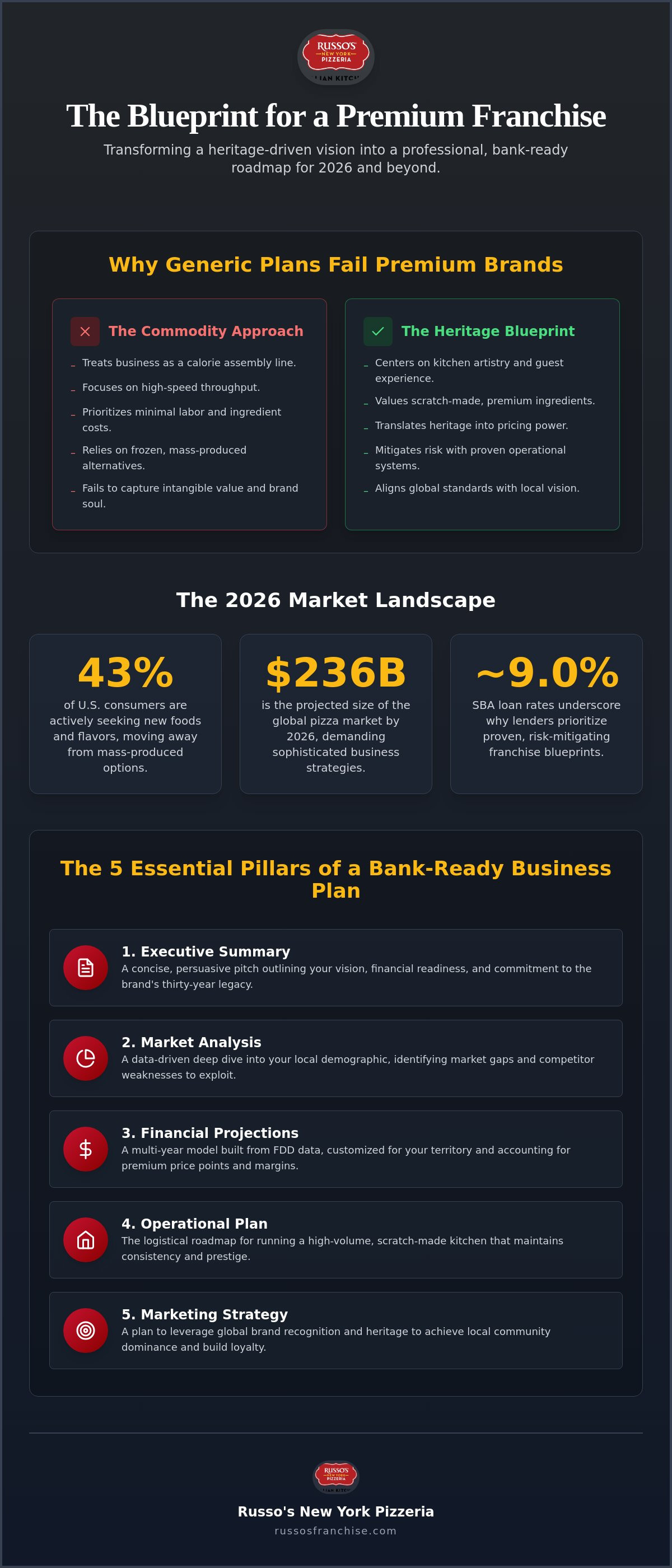
A standard restaurant franchise business plan template often treats a pizzeria as a mere assembly line of calories. For a premium Italian kitchen, this approach is fundamentally flawed. A commodity fast-food plan focuses on high-speed throughput and minimal labor costs. In contrast, a premium strategy centers on the artistry of the kitchen and the elevated guest experience. By definition, a restaurant franchise business plan is a strategic document that adapts a proven model to a specific local demographic. It ensures the brand's core values resonate within a new community while maintaining the operational rigor required for scale.
The financial landscape in 2026 has become increasingly discerning. With SBA 7(a) loan interest rates for amounts over $250,000 currently hovering around 9.00%, lenders aren't interested in speculative independent startups. They prioritize proven blueprints that mitigate risk through established operational systems and historical performance. Gaining a deep understanding the franchise model allows you to present a plan that combines the safety of a corporate structure with the entrepreneurial drive of a local owner. This alignment between your local vision and the franchisor's global standards is what transforms a simple document into a powerful funding tool.
The 2026 Shift: Quality as a Financial Metric
Consumer expectations have evolved rapidly. Research indicates that 43% of U.S. consumers are actively seeking out new foods and flavors, moving away from mass-produced, one-size-fits-all options. This shift means that scratch-made ingredients aren't just culinary choices; they're vital components of your projected margins. High-quality flour, hand-stretched dough, and authentic sauces create a significant barrier to entry for competitors who rely on frozen alternatives. Your business plan must demonstrate how this heritage translates into pricing power. It should reflect how you'll sustain a premium position even as the average price of a large cheese pizza in the U.S. reaches $16.92. Sustainable growth in 2026 depends on this commitment to craftsmanship rather than mere convenience.
Bridging the FDD and Your Local Reality
A professional restaurant franchise business plan template requires more than just copying the Franchise Disclosure Document (FDD). You must extract critical data from Item 1 and Item 19 to build a realistic financial model. Item 19 provides the historical performance data of existing units, yet your plan must interpret these figures through the lens of your specific territory. Customizing the Business Description section is where you blend the franchisor's global standards with your local vision. It's about showing how a brand with deep historical roots can thrive in a modern, specialized market. This sophisticated blend of professional investment and family legacy is exactly what attracts high-level partners and secures the necessary capital for growth.
The 5 Essential Pillars of Your 2026 Franchise Business Plan
Constructing a robust restaurant franchise business plan template requires more than just filling in blanks. It's a disciplined architectural exercise. You must harmonize the rigid requirements of institutional lenders with the fluid, sensory nature of premium Italian dining. Your plan should function as a high-impact declaration of entrepreneurial intent, proving that you have the operational stamina to uphold a thirty-year legacy. To secure a piece of the $236.21 billion global pizza market projected for 2026, your strategy must rest on five non-negotiable pillars:
- Executive Summary: A concise, persuasive pitch that outlines your vision and financial readiness.
- Market Analysis: A data-driven deep dive into local demand and competitor weaknesses.
- Operational Plan: The logistical roadmap for running a high-volume, scratch-made kitchen.
- Marketing Strategy: A plan to leverage global brand recognition for local community dominance.
- Financial Projections: A multi-year model that accounts for current interest rates and premium margins.
When detailing your operational plan, it's vital to reference established benchmarks for success. Many entrepreneurs find that consulting an SBA guide to writing a business plan helps ensure their financial and operational sections meet the rigorous standards of federal lending programs. This level of detail is especially critical when planning for a pizza franchise opportunity where quality and consistency are the primary drivers of ROI.
Executive Summary: The Founder-Led Narrative
Investors don't just back businesses; they back leadership and proven systems. Your summary should highlight the strategic advantage of partnering with a brand led by a seasoned mentor like Chef Anthony Russo. This section is where you state your specific goals for either single-unit stability or aggressive multi-unit expansion. It must clearly articulate the "why" behind your investment, focusing on the stability of an established Italian kitchen model rather than the volatility of an unproven startup. Your narrative should project confidence, discipline, and a deep commitment to the craft.
Market Analysis: Beyond Basic Demographics
While there were over 75,000 pizzerias in the U.S. by 2025, the market for truly authentic, New York-style pizza remains underserved in many regions. Your analysis must identify the "pizza deserts" in your territory where quality is currently lacking. Don't just look at population counts. Map out local competitors and pinpoint exactly where they fail in terms of authenticity or ingredient quality. With consumer trends in 2026 favoring experiential, heritage-driven kitchens, your plan should project a shift in local dining habits toward premium offerings. This section proves there's a hungry market waiting for what you provide.
Marketing Authenticity: Turning Heritage into Competitive Advantage
Heritage serves as a powerful shield in an increasingly crowded marketplace. While competitors often chase fleeting trends, your restaurant franchise business plan template should articulate how your brand's history creates a distinct financial advantage. Family recipes and scratch-made dough are more than just culinary choices; they're tangible assets that build immediate trust with a discerning public. In an era where ghost kitchens and mass-produced meals are becoming the norm, a premium brick-and-mortar establishment offers a "safe haven" for guests who value transparency and craftsmanship. You aren't just selling food. You're offering an invitation into a legacy that spans generations.
Balancing digital convenience with the high-margin experience of on-site dining is essential for modern success. While 84% of pizzeria operators report significant revenue from online ordering, the true soul of a premium brand resides in the hospitable atmosphere of a physical kitchen. Your plan must detail how you'll use digital platforms to capture market share while funneling customers toward the superior, full-service experience that only an authentic brand can provide. When researching how to write a business plan, you'll find that articulating this unique value proposition is the key to differentiating your venture from low-cost, commodity competitors.
The ROI of Traditional Methods
Premium ingredients reduce long-term customer acquisition costs by fostering organic word-of-mouth and high repeat-visit rates. Choosing brick-oven technology over conventional conveyor belts requires more initial training, but it results in a superior product that justifies a higher price point. This commitment to quality directly correlates with larger average check sizes and stronger brand loyalty. Investing in an authentic Italian food franchise means prioritizing these time-honored methods to ensure long-term stability and prestige in your local market.
Local Store Marketing (LSM) for Premium Brands
Your marketing efforts should reflect the warm, hospitable personality of the brand. Develop a structured calendar of community tastings and heritage-themed events that allow locals to experience the "Chef-driven" quality firsthand. Social media campaigns should highlight the presence of a mentor-chef, showcasing the meticulous standards and passion behind every dish. By integrating the Russo's story into your local community outreach, you transform a global brand into a local treasure. This approach ensures your marketing is never just a transaction; it's a professional and polished extension of the brand's core values.
Financial Modeling for Global and Specialized Markets
Financial precision is the bedrock of any successful expansion. When you're utilizing a restaurant franchise business plan template , it's easy to fall into the trap of using generic figures that don't reflect the reality of a premium market. You need a model that accounts for the nuances of high-quality sourcing and the specific operational requirements of specialized niches. Calculating a realistic pizza franchise ROI requires a deep dive into premium price points and the stability that comes from a thirty-year brand history. It's about proving that your margins can withstand the pressures of a sophisticated economy while delivering exceptional value to your guests.
Your projections must also factor in the structural costs of growth. In 2026, ongoing royalty fees for premium pizzerias typically range from 4% to 5.5% of net sales. While these are standard, your plan should justify them by demonstrating the operational ease and marketing power they provide. Additionally, your model must account for initial franchise fees, which generally fall between $25,000 and $35,000 for top-tier brands. Mapping out these expenses alongside regional supply chain costs ensures your financial narrative is both transparent and bank-ready. This level of detail transforms a simple restaurant franchise business plan template into a professional investment prospectus.
The Master Developer Projections
For those looking beyond a single location, the logistics of an international master franchise present unique financial opportunities and challenges. Your plan should detail the structure of regional territory rights and the potential for sub-franchising revenue. Scaling an authentic heritage globally requires a robust overhead strategy to support multiple units across diverse markets. You must justify the capital requirements for this large-scale expansion by highlighting the long-term stability and prestige of the brand. This isn't just about growth; it's about building a legacy that spans continents.
Halal Market Integration
The halal pizza franchise model is a high-growth sector that requires specific financial planning. You need to document the certification process within your operational budget and address the supply chain requirements for Islamic compliant operations. Analyzing the market size and halal franchise investment potential allows you to tap into a loyal and expanding demographic. This specialized focus demonstrates a sophisticated understanding of modern dining trends and a commitment to inclusive, high-quality hospitality. It shows you're prepared to serve a diverse global community with excellence.
Ready to translate these projections into a reality? Explore our franchise opportunity to see how our proven blueprint can secure your financial future.
Executing Your Vision with the Russo’s Proven Blueprint
A document is only as strong as the system behind it. While a restaurant franchise business plan template provides the necessary structure, the Russo’s blueprint provides the soul and the substance. Moving from the theoretical stage to active development requires a partner who has already mastered the complexities of the industry. We provide the historical depth and operational ease that turn a static plan into a living, breathing business. This transition marks the moment your entrepreneurial vision begins its journey toward a physical reality, backed by a legacy of excellence that lenders and landlords respect.
Finalizing your document for stakeholders is about projecting a poised and established presence. Banks want to see that you aren't just an enthusiast; they want to see that you are an operator supported by a world-class organization. Ongoing franchisor support is the silent partner in your financial success, ensuring you maintain the high standards of a premium Italian kitchen franchise. From the initial site selection phase to the day you open your doors, this partnership ensures that every detail aligns with a proven path to profitability.
The Mentor Advantage
Success in the premium dining sector isn't accidental. It is the result of a meticulously crafted strategy that marries your local ambition with our thirty years of operational refinement. By utilizing Russo’s extensive experience, you can validate your operational assumptions with real-world data. You gain access to intensive training programs that translate the words in your business plan into disciplined kitchen habits and superior guest service. Founder-led brands offer a more secure path because the standards are personal. Chef Anthony Russo’s dedication to quality serves as your professional compass, guiding you through the challenges of growth with confidence and pride.
Your Next Steps to Ownership
The path forward is clear and methodical. Once your plan is polished, the next phase involves a series of structured milestones designed to ensure a perfect fit for both parties. You'll move through these steps with the support of our development team:
- Review your completed plan against the Russo’s Selection Criteria to ensure alignment with our core values.
- Prepare for your first discovery day by refining your heritage-focused strategy.
- Collaborate on site selection using our data-driven approach to local market demographics.
- Finalize your investment and begin the transformation of your chosen space into an authentic Italian kitchen.
Your future in premium hospitality starts with a single, decisive action. Start your journey by exploring our premium franchise models today.
Transform Your Vision into a Premium Reality
Success in the 2026 hospitality market requires a sophisticated strategy that bridges the gap between traditional craftsmanship and modern financial rigor. By moving beyond a generic restaurant franchise business plan template , you've gained the tools to articulate the true value of heritage and quality to potential stakeholders. You now understand how to model ROI for specialized markets and how to leverage a global brand's equity to dominate your local territory. It's time to stop planning and start building a legacy that reflects your dedication to excellence.
Russo’s New York Pizzeria offers the stability of over 30 years of proven success. As a founder-led brand guided by Chef Anthony Russo, we provide the disciplined operational blueprint needed to scale our Halal and Master Franchise models across the globe. You don't have to navigate this journey alone. Our team is ready to help you translate your professional goals into a thriving, heritage-driven business reality. Download the Russo's Franchise Opportunity Guide to take the first step toward premium ownership. We look forward to helping you bring authentic Italian traditions to your community.
Frequently Asked Questions
Why do I need a business plan if the franchisor provides a proven model?
You need a business plan to secure institutional funding and to adapt the franchisor's global strategy to your specific local market. While the model is proven, lenders require a document that proves your personal financial readiness and local territory knowledge. It serves as your personal roadmap for execution within the franchisor's framework, ensuring you're prepared for the unique challenges of your region.
What are the most important financial metrics for a pizza franchise in 2026?
Prime cost, average check size, and digital sales percentages are the critical metrics for 2026. With the average price of a large cheese pizza reaching $16.92 in the U.S., maintaining a strong gross margin while managing labor costs is essential. You should also track online ordering trends, as digital sales now account for an average of 26.9% of total revenue for modern pizzeria operators.
How do I include 'heritage' as a competitive advantage in my plan?
Define heritage as a barrier to entry that competitors cannot easily replicate. In your restaurant franchise business plan template , explain how traditional family recipes and scratch-made dough reduce long-term marketing costs by fostering organic customer loyalty. Heritage isn't just a story; it's a financial asset that justifies premium pricing and differentiates your kitchen from mass-produced commodity brands that rely on frozen ingredients.
Can I use a standard restaurant template for a Halal pizza franchise?
No, a standard template lacks the specific operational and supply chain requirements necessary for Halal certification. You must include a section for Islamic compliant sourcing and specialized training protocols in your plan. A tailored restaurant franchise business plan template ensures that the unique costs and high-growth potential of the Halal market are accurately projected for your investors and stakeholders.
How does a Master Franchise business plan differ from a single-unit plan?
A Master Franchise plan focuses on regional territory rights, sub-franchising revenue, and the infrastructure needed to support multiple units across a broad area. It requires a more complex financial model that accounts for large-scale logistics and regional management overhead. Unlike a single-unit plan, it emphasizes your ability to act as a regional developer and mentor to other operators within the brand's network.
What role does the FDD play in my business plan financial projections?
The Franchise Disclosure Document (FDD), specifically Items 7 and 19, provides the raw data needed to build realistic projections. Item 7 outlines the initial investment range, while Item 19 offers historical performance data from existing units. You must use these figures to validate your assumptions and prove to stakeholders that your financial goals are grounded in historical reality rather than speculation.
How should I account for delivery vs. dine-in revenue in my 2026 plan?
Your plan should project separate margins for delivery and dine-in to account for varying costs like packaging and third-party platform fees. With 84% of operators reporting sales from online ordering, your model must reflect the shift toward digital convenience. However, you should also emphasize the high-margin potential of the on-site dining experience, which drives beverage sales and strengthens brand loyalty through hospitality.
What is the #1 mistake entrepreneurs make in their franchise business plans?
The most common mistake is failing to customize the plan for their specific local territory. Lenders see through generic templates that don't address local competitors or regional demographics. A successful plan must bridge the gap between the franchisor's proven global blueprint and the unique realities of your chosen market. This demonstrates true operational readiness and a sophisticated understanding of your local guest's expectations.