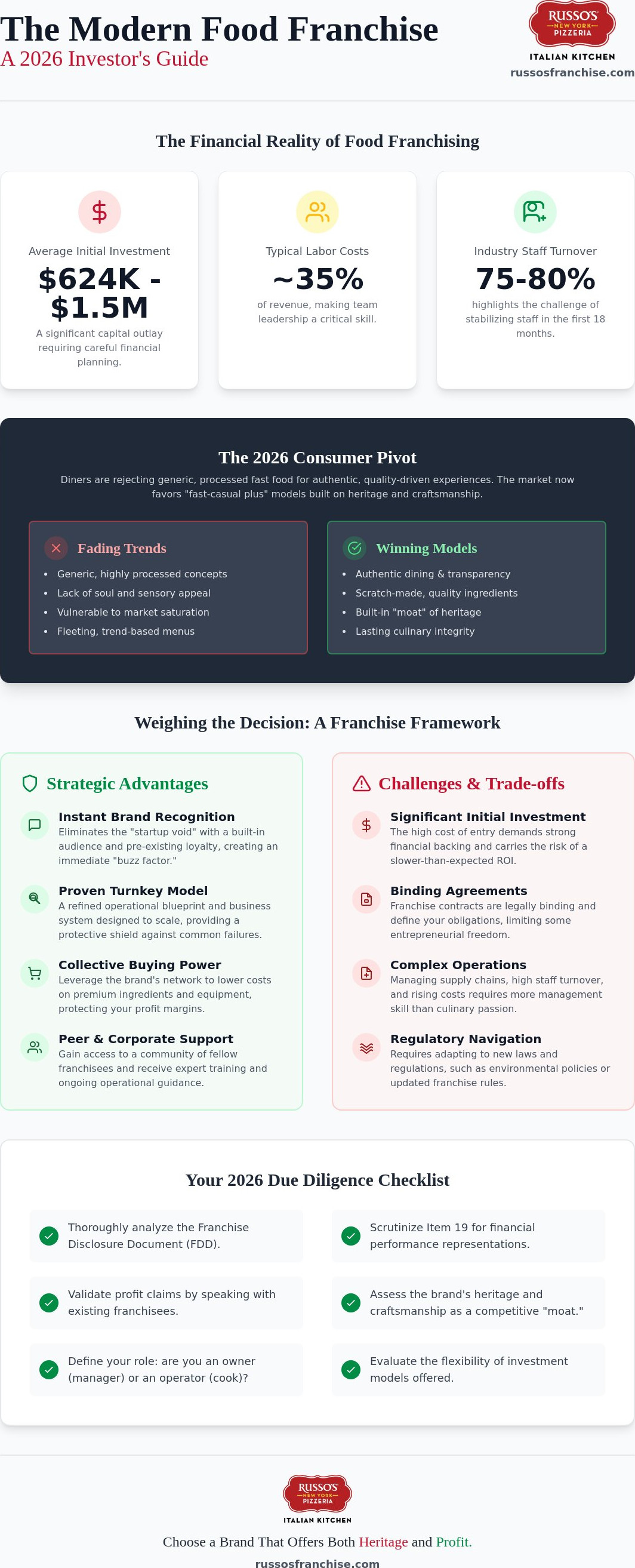
The true value of a food franchise isn't found in a logo; it's found in the legacy of a perfected craft. While the promise of a turnkey business is alluring, the reality of 2026 demands a deeper look at the pros and cons of buying a food franchise before you sign a binding agreement. You've likely felt the weight of high interest rates or the fear that a massive initial investment, which industry data shows averages between $624,000 and $1.5 million for many food brands, might not yield the immediate ROI you expect. It's natural to feel protective of your capital when the margin for error is slim.
We understand that the complexity of modern operations and rising labor costs, now often representing 35% of revenue, can feel overwhelming to even the most ambitious investor. This guide will help you discover the critical advantages and hidden challenges of food franchising to determine if a proven business model aligns with your unique entrepreneurial goals. We provide a clear decision-making framework, an explanation of hidden costs like new environmental regulations, and the confidence to choose a brand that offers both heritage and profit.
Key Takeaways
- Understand why the 2026 market favors authentic, heritage-driven dining experiences over generic fast food concepts.
- Discover how established operational systems and immediate brand recognition provide a protective shield against common business failures.
- Evaluate the pros and cons of buying a food franchise by weighing initial fees against the long-term security of a proven, turnkey model.
- Master the due diligence process by analyzing Item 19 financial disclosures and validating profit claims with existing operators.
- Learn how flexible investment models, from single units to international master franchise agreements, can help you scale a family-rooted legacy.
The Reality of Food Franchising in 2026: An Industry Overview
A food franchise is more than a commercial agreement; it's a partnership rooted in established intellectual property and a refined operational blueprint. Understanding what is franchising begins with recognizing it as a turnkey business system designed to scale a proven concept through local ownership. Before diving into the pros and cons of buying a food franchise, it's vital to grasp the legal framework that protects your investment. The Franchise Disclosure Document (FDD) serves as your primary tool for due diligence, offering a transparent look at the brand's financial health, litigation history, and the specific obligations you'll hold as a partner. In 2026, the food sector remains the most resilient segment of the industry because it fulfills a fundamental human need for connection and quality nutrition that digital-only models simply cannot replicate.
The Shift Toward Premium Italian Kitchen Models
The 2026 landscape reveals a distinct pivot in consumer behavior. Diners are increasingly moving away from generic, highly processed fast food in favor of "fast-casual plus" models that emphasize authentic dining and transparency. Scratch-made quality has become a significant competitive advantage. While ghost kitchens and automated kiosks offer convenience, they lack the soul and sensory appeal of a traditional kitchen. Evaluating the pros and cons of buying a food franchise in this environment means looking for brands with a built-in "moat" of heritage and craftsmanship. Authentic Italian concepts, for example, provide a level of culinary integrity that protects against market saturation and the fleeting nature of food trends.
Understanding Your Role: Owner vs. Operator
Success in this industry requires a clear-eyed understanding of your daily responsibilities. Many new partners enter the space expecting to spend their time in the kitchen, but the most profitable franchisees focus on working "on" the business rather than "in" it. Management experience is often more valuable than culinary skill, especially when facing current industry challenges. With restaurant turnover rates hovering around 75-80% and labor costs frequently reaching 35% of revenue, your ability to lead a team and maintain operational discipline is paramount. Setting realistic expectations for the first 18 months is crucial. This initial period is dedicated to stabilizing your staff, mastering the supply chain, and navigating local regulations, such as the New Jersey "Skip the Stuff" law effective August 1, 2026, or the updated Virginia franchise laws that took effect on July 1, 2026. A disciplined approach during this phase sets the foundation for long-term stability and growth.
The Strategic Advantages: Why Entrepreneurs Choose Food Franchises
Momentum defines the early stages of a successful investment. When weighing the pros and cons of buying a food franchise, the most immediate benefit is the elimination of the "startup void"—that perilous period where independent owners struggle to define their brand identity. A franchise offers instant recognition. It brings a built-in audience that recognizes the logo, trusts the quality, and anticipates the "Grand Opening" with genuine excitement. This pre-existing loyalty creates an immediate "buzz factor" that can take independent restaurants years to cultivate. A recent analysis of the pros and cons of franchising highlights that the structured nature of these agreements often serves as a critical safety net for capital, providing a level of security that is rare in the volatile hospitality industry.
Collective buying power provides a significant edge in 2026. By joining an established network, you leverage the total volume of the entire brand to lower the costs of premium ingredients and specialized kitchen equipment. This isn't just about saving money; it's about ensuring that your kitchen is stocked with the finest authentic products—from hand-crushed tomatoes to cold-pressed oils—at a price point that protects your margins. You also gain access to a community of fellow franchisees. This peer-to-peer support network allows you to share insights, solve operational hurdles, and celebrate successes with others who understand the specific nuances of your business model.
Training and Ongoing Operational Support
Expert guidance transforms an ambitious investor into a disciplined operator. From the initial site selection to the final kitchen layout, you receive a blueprint for success that has been refined over decades. Standardized training programs ensure that your staff delivers a consistent experience, maintaining the high standards of the brand from day one. You don't have to worry about menu innovation or designing marketing collateral; the franchisor provides a continuous stream of fresh culinary concepts and professional advertising materials. This support allows you to focus on the hospitality and growth of your location while the brand's architects handle the long-term strategy.
Financing and Real Estate Leverage
Lenders and landlords alike value stability and proven results. Financial institutions often look more favorably upon pizza franchise opportunities because they are backed by extensive ROI data and predictable cash flow models. This history of performance makes it significantly easier to secure business loans compared to unproven concepts. Additionally, a prestigious brand name gives you leverage in the real estate market. Landlords are more likely to offer prime locations and favorable lease terms to a tenant with a global reputation and a history of driving foot traffic. In 2026, forward-thinking brands are also capturing untapped markets by offering specialized options, such as a Halal pizza franchise, which meets a surging global demand for inclusive, high-quality dining experiences.
Navigating the Disadvantages: Understanding the Franchise Trade-off
Every strategic investment involves a calculated trade-off. When exploring the pros and cons of buying a food franchise, you must recognize that you're trading absolute creative autonomy for the reliability of a battle-tested blueprint. While an independent owner can change their menu on a whim, a franchisee is bound by a commitment to consistency. This lack of "creative meddling" is often viewed as a restriction, but it's the primary mechanism that protects the brand's integrity and your long-term equity. Before committing your capital, it's essential to review a due diligence checklist for buying a franchise to ensure your personal goals align with the franchisor’s rigid operational standards.
Financial transparency is the cornerstone of a healthy partnership. Total investment requirements often extend far beyond the initial entry fee. While the initial franchise fee for most food brands falls between $20,000 and $50,000, the total capital required to open a location can range from $624,000 to over $1.5 million. This figure encompasses everything from high-end kitchen equipment and leasehold improvements to initial inventory and working capital. Territory restrictions also play a critical role in your future growth. These clauses define your exclusive operating area, which can protect you from internal competition but may also limit your ability to expand into adjacent neighborhoods if another partner has already secured those rights.
The Cost of Consistency: Royalties and Marketing Fees
Royalty structures are the fuel for the franchisor's ongoing support and innovation. In the food sector, ongoing royalty fees typically range from 4% to 8% of gross sales. These payments fund the continuous development of the business model, including supply chain management and technical support. Marketing fund contributions, usually between 1% and 4%, are often viewed as a collective benefit. These funds drive the brand’s national presence and digital advertising, creating a level of visibility that a single-unit operator could never achieve alone. Calculating your break-even point must include these fixed percentages to ensure your margins remain healthy as you scale.
Operational Boundaries and Contractual Obligations
Discipline is the price of excellence. You're required to follow standardized recipes, use approved vendors, and adhere to specific service protocols. These operational boundaries prevent the brand dilution that occurs when individual owners deviate from the core concept. It's a long-term commitment, often spanning ten to twenty years, making it vital to choose a brand whose values and heritage you truly respect. Understanding these contractual obligations is not about accepting defeat; it's about embracing a proven path to success that has already been paved by those who came before you.
How to Evaluate a Food Franchise: A 2026 Due Diligence Checklist
Evaluation is the bridge between a dream and a disciplined reality. While we have already explored the general pros and cons of buying a food franchise, your specific success depends entirely on the depth of your due diligence. You must look beyond glossy brochures and scrutinize the Item 19 financial performance representations in the Franchise Disclosure Document. This section provides the only verified glimpse into the actual revenue and profit potential of existing locations. It's your responsibility to validate these figures by interviewing current partners. Ask them about the quality of ongoing support and whether the franchisor's promises align with their daily experience in the kitchen.
Scalability is the hallmark of a truly sophisticated business model. You shouldn't just be looking for a single-unit venture; you're looking for a system that allows you to transition into a multi-unit operator or area developer. In 2026, this requires a stable, cost-effective supply chain that can withstand global fluctuations. A brand that has spent decades perfecting its procurement process offers a level of security that newly formed concepts cannot match. If you're ready to see how a proven system can work for you, explore our franchise opportunity and discover the path to professional growth.
Analyzing the Pizzeria Market and ROI
A thorough pizza franchise comparison is essential for identifying high-margin models that prioritize quality over commodity. Pizza remains one of the few recession-proof menu items because it offers high perceived value and shares well, driving consistent foot traffic even during economic shifts. To find the true ROI, you must calculate the real cost of goods sold. This includes accounting for the premium ingredients that define a superior product. A model that balances these costs with efficient labor practices, which currently represent 30-35% of revenue across the industry, is the one that will provide long-term stability.
Testing for Authentic Heritage and Quality
True craftsmanship creates a competitive moat that private-equity-owned commodity brands simply can't replicate. You must ask: does the brand rely on frozen, pre-packaged products, or does it honor the tradition of scratch-made cooking? Founder-led leadership often ensures a commitment to these meticulous standards, whereas private equity may prioritize short-term margins over culinary integrity. Expanding your reach into new demographics is also a strategic necessity. For instance, a halal pizza franchise opens doors to a rapidly growing global market that values both premium Italian heritage and strict dietary adherence.
The Russo's Difference: Maximizing the Pros of Pizzeria Franchising
Russo’s New York Pizzeria represents the intersection of ambitious growth and culinary integrity. When analyzing the pros and cons of buying a food franchise, many investors fear the loss of soul that often accompanies large corporate systems. We solve this by leveraging over 30 years of authentic family history and perfected New York recipes. Our model isn't built on processed shortcuts; it's built on a foundation of hand-tossed dough, premium ingredients, and time-honored methods. This commitment to craftsmanship ensures that your investment remains a prestigious asset rather than a mere transaction. We provide the stability of a global brand, the warmth of a family kitchen, and the precision of a perfected craft.
Our 'Chef-to-Chef' support model distinguishes us from corporate-heavy systems that prioritize spreadsheets over flavor. We believe that an authoritative expert should also be a seasoned mentor. You receive direct guidance from professionals who understand the nuances of the kitchen, ensuring that operational ease is a reality, not just a promise. This practical mentorship is a significant advantage when weighing the pros and cons of buying a food franchise, as it reduces the learning curve and builds immediate operational confidence. Whether you're looking for a single unit or an International Master Franchise agreement, our flexible investment models are designed to align with your specific scale of ambition.
A Proven Blueprint for Premium Italian Dining
Traditional craft meets modern efficiency within our system. We've refined the complexities that often overwhelm new owners into a seamless, manageable blueprint. This focus on brick-and-mortar excellence drives long-term asset value by creating a destination that customers trust. Additionally, a halal franchise investment allows you to tap into a massive, underserved global demographic that seeks both quality and adherence to tradition. We help you bridge the gap between heritage-driven pride and a growth-oriented mindset, ensuring your location stands out in a crowded marketplace.
Your Path to Ownership with Russo's
Your transition into the world of premium Italian dining is guided by a methodical process. We provide step-by-step expertise from the initial inquiry to your Grand Opening, ensuring you never feel lost in the complexity of the industry. You gain access to our network of international master developers, opening doors to global expansion and shared success. It's time to move beyond the theoretical and take a bold step toward your future as a business leader. Start your journey with Russo's New York Pizzeria today and secure your place in a tradition of excellence and profit.
Building Your Legacy in the Future of Food
Choosing your path in the hospitality industry requires more than just capital; it requires a vision for quality that stands the test of time. We've explored how the pros and cons of buying a food franchise in 2026 hinge on the balance between rigid operational systems and the emotional resonance of authentic dining. Success comes to those who prioritize a disciplined due diligence process and recognize the shifting consumer demand for heritage over commodity fast food. By selecting a brand that offers a proven blueprint and a stable supply chain, you transform operational complexity into a manageable, scalable asset.
Russo’s New York Pizzeria has been founder-led by Chef Anthony Russo since 1992. We remain committed to authentic family recipes and never use frozen retail products in our kitchens. With a growing global footprint and specialized Halal-certified models, we offer a unique opportunity to join a legacy of excellence. If you're ready to align your entrepreneurial spirit with a brand that values craftsmanship as much as profit, it's time to take the next step. Explore Premium Pizza Franchise Opportunities with Russo's and start building a business you can be proud of. The path to professional growth is ready for you to follow.
Frequently Asked Questions
Is buying a food franchise more profitable than starting my own restaurant?
Buying a franchise is often more profitable because you're investing in a battle-tested system with immediate brand recognition. Data shows that franchised restaurants generate average sales 1.4 times larger than independent restaurants of the same type. While an independent owner keeps every cent of revenue, they also shoulder the full cost of supply chain inefficiencies and marketing trials. A franchise provides a refined blueprint that optimizes labor costs, which currently represent 30 to 35 percent of industry revenue.
What are the most common hidden costs in a food franchise agreement?
Beyond the initial fee and royalties, common hidden costs include technology fund contributions, mandatory equipment upgrades, and local marketing requirements. You might also encounter fees for specialized software subscriptions or site audits. Understanding these obligations is a vital part of weighing the pros and cons of buying a food franchise. Always scrutinize the FDD for "other fees" to ensure your capital reserves can handle these recurring operational expenses without straining your monthly cash flow.
How much experience do I need to open a pizza franchise?
Prior culinary experience is not a strict requirement because our standardized training programs teach you the craft from the ground up. However, strong management and leadership skills are essential for navigating the complexities of the modern kitchen. We look for partners with a disciplined mindset and the ability to lead a team toward excellence, especially given the current 75 to 80 percent turnover rate in the industry. Your role focuses on working on the business rather than just making dough.
Can I own a food franchise while keeping my full-time job?
Semi-absentee ownership is possible if you hire a highly capable general manager, but the first 18 months typically require your direct, daily involvement. Establishing a culture of discipline and quality is difficult to do from a distance. Most successful operators treat their investment as their primary focus until the systems are stabilized and the staff is fully trained. While some models allow for passive income eventually, the initial phase demands an owner's dedicated attention to detail and local community engagement.
What happens if the food franchise brand loses popularity?
Resilient heritage brands mitigate this risk through continuous menu innovation and a commitment to authentic quality that transcends fleeting food trends. If a brand relies on "commodity" fast food, it's more vulnerable to shifts in consumer taste. Choosing a concept rooted in craftsmanship and tradition provides a competitive moat. The franchisor's marketing fund is also dedicated to maintaining brand relevance and driving digital engagement to ensure your location stays top-of-mind for diners in your territory.
How long does it typically take to see a return on investment (ROI)?
The timeline for a return on investment typically ranges from two to five years, depending on your location, operational efficiency, and total initial capital. This period allows you to stabilize labor costs and build a loyal customer base. It's essential to maintain sufficient working capital during the ramp-up phase. Reviewing the Item 19 financial disclosures in the FDD provides the most accurate data for setting realistic expectations and understanding the potential revenue of a proven business model.
Why should I choose a heritage brand over a cheaper fast-food franchise?
Heritage brands offer a premium experience that commands higher margins and protects you from the price wars of the fast-food sector. A cheaper franchise often relies on frozen products and high-volume, low-quality sales, which are easily disrupted by competitors. When evaluating the pros and cons of buying a food franchise, consider the long-term asset value of a brand built on authentic recipes. Quality craftsmanship creates customer loyalty that commodity brands simply cannot replicate in a crowded market.
Are there international opportunities for food franchises in 2026?
International expansion is a major growth driver in 2026, particularly through Master Franchise agreements in emerging markets. Global demand for premium Italian dining remains high, and specialized models like a Halal pizza franchise allow you to capture diverse demographics. These international opportunities provide a path for experienced developers to scale a proven brand across entire regions. We offer the support and systems necessary to translate our New York heritage into a successful, high-performing global presence.