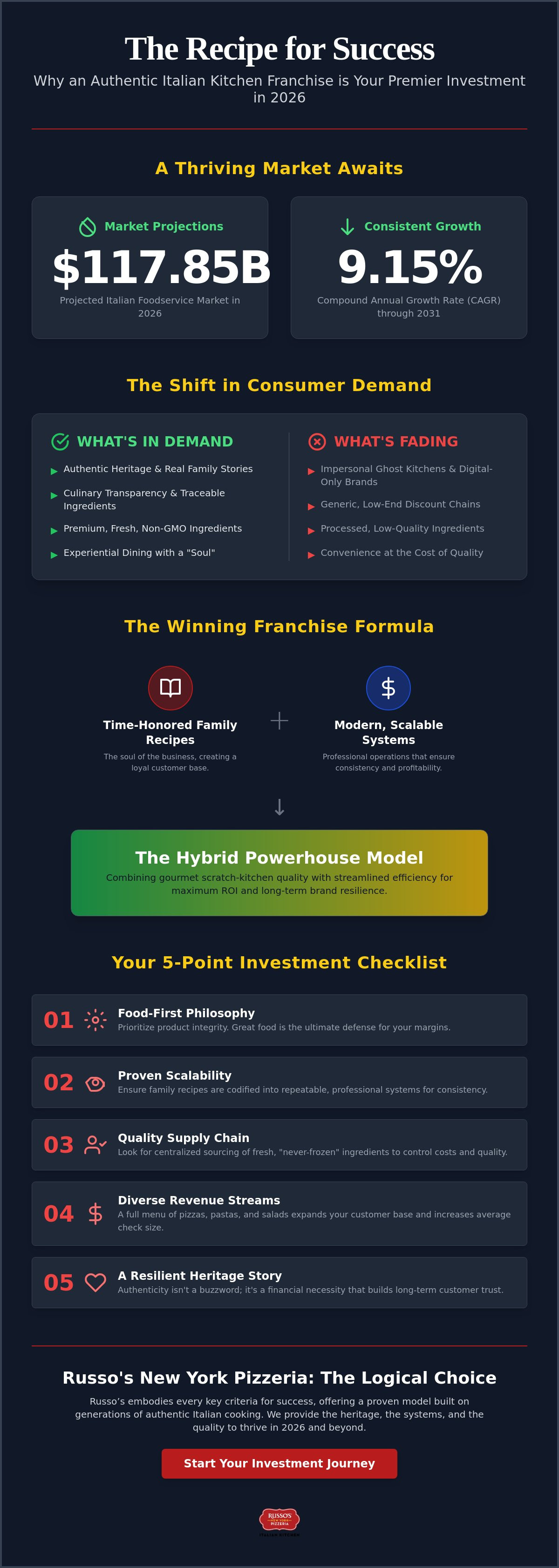
Authenticity is the highest-yielding asset in 2026. While the market is crowded with generic, low-end pizzerias, savvy investors are realizing that a story customers can taste is the ultimate competitive advantage. Choosing the right italian kitchen franchise means finding a balance between time-honored family recipes and the modern scalability required to thrive in a market projected to reach $117.85 billion this year. You shouldn't have to choose between the soul of a family kitchen and the professional support of a global brand.
It's frustrating to face the impersonal nature of corporate franchisors or the difficulty of scaling complex dishes without losing quality. You deserve a business model that respects tradition while maximizing your ROI through disciplined operations. This guide will walk you through evaluating premium opportunities, understanding the shift toward chain formats in the Italian sector, and selecting the investment structure that fits your ambitions. We'll explore how a heritage-driven brand captures both the gourmet and fast-casual markets to ensure your long-term success in an evolving industry.
Key Takeaways
- Learn why the 2026 market favors a hybrid model that blends fast-casual efficiency with the refined quality of an authentic italian kitchen franchise.
- Identify the essential "food-first" criteria that distinguish high-performing, scalable scratch kitchens from impersonal, low-quality operations.
- Explore how a diverse menu of pastas and salads can expand your revenue streams and increase average check sizes beyond the standard pizza box.
- Master the investment journey by learning how to conduct a thorough culture-fit assessment and navigate the complexities of the Franchise Disclosure Document.
- Discover why a commitment to traditional craftsmanship and a proven heritage story creates a more resilient business model in a crowded market.
Why the Italian Kitchen Franchise Market is Thriving in 2026
The landscape of the restaurant industry has shifted. The discount pizza segment is currently struggling under the weight of rising costs and waning consumer interest in low-quality ingredients. In contrast, the italian kitchen franchise has emerged as a powerhouse hybrid. It combines the rigorous standards of a gourmet scratch kitchen with the streamlined operational efficiency of a modern business model. This isn't just about selling food; it's about providing a premium experience that generic fast-food chains simply can't replicate. Success in 2026 belongs to brands that offer culinary transparency and operational stability.
Consumer behavior now favors "experiential dining" over mere convenience. People want to know where their food comes from and who created the recipe. Italian cuisine remains uniquely recession-resistant because it offers high-perceived value and deep emotional comfort. Whether the economy is booming or tightening, families still gather over pasta and pizza. By investing in a model that prioritizes quality over deep discounts, you position yourself in a market segment that values longevity and brand loyalty over fleeting price wars.
The Shift Toward Authentic Heritage
Modern diners are rejecting the sterile nature of "ghost kitchen" brands. They've grown tired of digital-only concepts that lack a physical soul or a verifiable history. Instead, they're seeking out brands rooted in real family history and Italian culinary traditions that have survived for generations. These traditional recipes aren't just menu items; they're assets that build long-term customer loyalty. Understanding the new york pizza franchise market trends for this year shows that investors are now prioritizing heritage stories as a primary driver for customer acquisition. Authenticity isn't a marketing buzzword anymore. It's a financial necessity.
Market Stability and Growth Projections
The data paints a clear picture of opportunity. The Italian foodservice market is projected to grow to $117.85 billion in 2026, with a compound annual growth rate of 9.15% through 2031. This growth is largely driven by the "premium fast-casual" segment, which is seeing rapid expansion in both suburban and urban markets. Investors are finding that high-quality Italian concepts offer better margins than low-end pizzerias because customers are willing to pay more for fresh, non-processed ingredients. The Italian kitchen market is a multi-billion dollar opportunity driven by culinary transparency and a growing consumer demand for quality they can trust.
Key Criteria for Evaluating an Italian Kitchen Franchise Opportunity
Financial spreadsheets are essential, but they shouldn't be the primary lens through which you view a culinary investment. A "food-first" philosophy is the bedrock of any successful italian kitchen franchise . If the product doesn't stand on its own, no amount of sophisticated marketing will protect your margins in the long run. You're looking for a partner that prioritizes the integrity of the plate as much as the health of the balance sheet. Quality is a financial strategy, not just a culinary preference.
Evaluating scalability is your next priority. It's one thing to make a perfect marinara in a single kitchen; it's another to replicate that excellence across twenty locations. You need a system where scratch-made dough and slow-simmered sauces can be produced consistently without requiring a five-star chef at every station. Look for brands that have codified their family secrets into repeatable, professional systems. These systems empower non-chefs to deliver gourmet results while maintaining the soul of a traditional kitchen.
Quality of Ingredients and Supply Chain
Modern diners in 2026 are more informed than ever. Non-GMO and fresh-never-frozen ingredients are no longer luxury upgrades; they're non-negotiable requirements for premium brands. A centralized supply chain is your best defense against food inflation, ensuring you get top-tier products at predictable prices. This commitment to quality is what defines authentic italian pizza franchise standards. For those looking at international expansion, checking for Halal-certified options or the availability of Master Franchise Agreements can open doors to massive, underserved global markets that generic brands often overlook.
Operational Support and Training
You don't need a culinary degree to succeed, but you do need a franchisor who acts as a seasoned mentor. Analyze the depth of the initial training program. Does it cover the nuances of dough hydration and oven temperatures, or is it just a surface-level overview? Founder-led brands typically provide better mentorship than private-equity-owned firms because their personal legacy is tied to your success. Before making your final decision, review the FTC's guide for potential franchisees to ensure you're fully aware of the legal and disclosure requirements involved in your purchase. Assessing the flexibility of the business model is also vital. A resilient kitchen should seamlessly balance high-margin delivery and takeout with the brand-building power of a welcoming dine-in experience. If you're ready to explore a model that balances these complexities, you can learn more about our partnership opportunities today.
Beyond the Pizza Box: The Full Italian Kitchen Advantage
Many entrepreneurs make the mistake of thinking too narrow when entering the Italian food sector. While pizza is a global staple, a limited menu often leads to limited revenue. Choosing a comprehensive italian kitchen franchise over a standard pizzeria fundamentally changes the financial profile of your business. By offering a diverse range of pastas, calzones, and fresh salads, you move beyond the "commodity pizza" price wars. This variety doesn't just satisfy different palates; it strategically increases your average check sizes by encouraging multi-course dining and group orders.
The "Daypart" advantage is where the full kitchen model truly shines. A standard pizza shop often sits idle during the early afternoon, but a kitchen equipped for authentic Italian dining captures lunch, dinner, and professional catering revenue. Brick-oven technology serves as the heart of this operation, delivering a superior product that generic conveyor belts cannot match. This traditional heat source creates a distinctive crust and a depth of flavor that justifies a premium price point. It's a visible sign of craftsmanship that differentiates your territory from every other "pizza-only" competitor on the block.
Menu Engineering for High ROI
Smart menu design is about more than just taste; it's about protecting your bottom line. Traditional pasta dishes offer some of the highest margins in the industry, often outperforming meat-heavy entrees in terms of profitability. Integrating these into a fast casual pizza franchise model allows you to offer gourmet appetizers and signature dishes that drive repeat visits. Catering services further boost your results by securing high-volume weekday revenue from local offices and events. This multi-stream approach ensures your kitchen stays busy and profitable throughout the entire week.
Halal and Specialized Menu Opportunities
One of the most significant "moats" you can build against local competitors is through specialized dietary certifications. Tapping into the underserved global market for Halal-certified Italian dining provides a massive competitive edge. A standardized Halal model simplifies international expansion and attracts a loyal, diverse customer base that often struggles to find high-quality, authentic options. These certifications aren't just labels. They represent a commitment to inclusivity and quality that resonates deeply with modern diners. By meeting these specific standards, your italian kitchen franchise becomes a destination of trust in a crowded and often impersonal marketplace.
Navigating the Investment: From Disclosure to Grand Opening
The transition from a prospective investor to a successful owner of an italian kitchen franchise is a journey of disciplined steps. It doesn't begin with a signature on a contract; it starts with a deep dive into the brand's soul. Your first interaction should be a culture-fit assessment, ideally with the founder or the executive team. This initial inquiry ensures that your entrepreneurial ambitions align with the brand's heritage and long-term vision. It's about finding a partner who values the craft as much as the capital.
Once the cultural alignment is confirmed, your focus must shift to the Franchise Disclosure Document (FDD). You'll want to pay close attention to Item 19, which provides the financial performance representations of existing locations. This transparency allows you to build a realistic business plan based on historical data rather than optimistic projections. Following the financial review, the corporate team assists with site selection. By utilizing sophisticated real estate data, you can identify high-traffic locations that match the brand's target demographic, ensuring your kitchen is positioned for maximum visibility from day one.
The final phases involve the physical transformation of your space and the mastery of operations. Construction and kitchen design are handled with meticulous detail, ensuring that specialized equipment like brick ovens are installed for peak performance and high-quality finishes from Richmond Stone are used to create an authentic atmosphere. This is followed by a comprehensive training period, often lasting eight weeks, where you and your management team learn the nuances of authentic preparation. A "Soft Opening" phase then allows you to refine your service before the official grand opening, ensuring a polished experience for your first customers.
Understanding Territory Rights
Selecting the right investment structure is vital for your long-term growth. You'll need to decide between a single-unit protected territory or a multi-unit development agreement. While a single unit allows for focused management, multi-unit deals provide a path to regional dominance. Evaluating the strategic value of authentic pizzeria franchise territory exclusivity is essential, as it protects your investment from internal competition and allows you to capture the full potential of your local market.
Master Franchise Agreements for Global Scale
For those looking to expand across borders, an international master franchise offers a unique opportunity to scale authentic heritage globally. As a Master Developer, you take on the responsibility of growing the brand within an entire country or region. This model includes a lucrative revenue-sharing structure, where you earn royalties from sub-franchisees that you recruit and support. It's a high-level partnership that requires a sophisticated understanding of both the brand and the local culture. If you're ready to begin this journey, you can request a franchise information kit to explore our available territories.
Why Russo’s New York Pizzeria is the Logical Choice for 2026
Russo’s New York Pizzeria represents the perfect intersection of Chef Anthony Russo’s deep family heritage and high-performance business systems. While many in the industry are pivoting toward faceless delivery models, we remain committed to our "No Ghost Kitchens" promise. This is a firm stand for real brick-and-mortar quality, ensuring that every location is a physical destination defined by the aroma of fresh basil and the warmth of a custom brick oven. This isn't just an italian kitchen franchise opportunity; it's a partnership with a brand that refuses to compromise on the sensory experience of traditional dining. We provide a stable, proven alternative to the volatile and impersonal trends currently saturating the fast-food market.
Flexibility is a cornerstone of our 2026 growth strategy. We offer a variety of footprints ranging from 1,200-square-foot delivery and carry-out hubs to expansive, full-service dining rooms. This adaptability allows you to tailor your investment to the specific needs of your local real estate market without sacrificing the core brand identity. For global master developers, our Halal-certified menu options provide a significant competitive advantage. We've successfully standardized these authentic recipes to meet the highest dietary standards, opening doors to massive, underserved markets across the Middle East, Asia, and beyond. This turnkey approach to international expansion ensures that your italian kitchen franchise can thrive in any cultural context.
A Founder-Led Vision
Chef Anthony Russo still personally oversees recipe development, ensuring that every sauce and dough recipe meets the standards set by his family generations ago. This hands-on leadership is rare in an era of private-equity-owned restaurant groups. Our "Family Table" philosophy translates directly into franchisee support, where you're treated as a partner in a shared legacy rather than just a unit number. Russo’s isn’t just a brand, it’s a 30-year legacy of New York excellence that provides a disciplined and prestigious foundation for your entrepreneurial future. You're joining a lineage of culinary craftsmanship that has been refined over decades of successful operation.
Next Steps for Qualified Investors
The path to ownership is methodical and transparent, designed to ensure that every partner is positioned for long-term stability. Your journey begins by requesting our 2026 Franchise Information Kit, which offers an in-depth look at our operational systems and the diverse revenue streams available to our partners. Qualified candidates will then be invited to a Discovery Day in Houston. This is a vital opportunity to meet Chef Russo, tour our corporate kitchens, and see firsthand how our traditional methods are supported by modern technology. If you're ready to invest in a brand that balances heritage with scalability, the time to act is now.
Explore Russo’s Italian Kitchen Franchise Opportunities and discover how our commitment to authenticity can drive your business success in 2026.
Secure Your Legacy in the 2026 Italian Market
Success in the modern restaurant landscape requires a rare combination of historical depth and operational precision. You've learned that a heritage-driven model outperforms generic fast food by capturing diners who value authenticity and transparency. By moving beyond the standard pizza box and embracing a full kitchen model, you unlock multiple revenue streams and a higher average check size. Choosing an italian kitchen franchise with a proven track record is the most reliable way to navigate this $117.85 billion industry.
Since 1992, Chef Anthony Russo has personally led this vision. He ensures every location serves authentic family recipes without the dilution of ghost-kitchen licensing. Whether you're interested in multi-unit development or an international master franchise, our systems provide the stability you need to scale confidently. Your future in the culinary world deserves a foundation built on excellence. We look forward to welcoming you to the family table.
Download Your 2026 Italian Kitchen Franchise Prospectus
Frequently Asked Questions
What is the average initial investment for an Italian kitchen franchise?
Initial investment costs depend heavily on the specific model and local real estate conditions. Factors like construction requirements, equipment needs, and location size influence the total capital required. It's best to review the current Franchise Disclosure Document for a detailed breakdown of the expected ranges for different footprint styles, as these can vary significantly between urban and suburban markets.
Do I need previous restaurant experience to open a Russo’s New York Pizzeria?
You don't necessarily need a background in professional cooking to succeed with our brand. We look for partners with strong business acumen, leadership skills, and a genuine passion for hospitality. Our comprehensive eight-week training program is designed to teach you every aspect of the operation, from dough preparation to back-office management, ensuring you're ready to lead your team.
How does an Italian kitchen franchise differ from a standard pizza franchise?
An italian kitchen franchise offers a much broader menu than a typical pizza shop. While a standard franchise might focus solely on high-volume pizza delivery, our kitchen model includes authentic pastas, calzones, and gourmet salads. This diversity increases your average check size and captures multiple dining dayparts, from corporate lunches to formal family dinners.
What kind of ongoing support can I expect from the franchisor?
Support is continuous and covers every critical area of your business. We provide assistance with site selection, kitchen design, and localized marketing strategies to build your brand presence. Our field support teams conduct regular visits to ensure your kitchen maintains the chef-driven standards that define our reputation, helping you stay efficient and profitable as you grow.
Are there master franchise opportunities available for international markets?
Yes, we offer international master franchise agreements for developers looking to scale across entire regions. This model allows you to act as a Master Developer, managing sub-franchisees and expanding the brand's footprint in a new country. It's a high-level partnership designed for experienced operators with significant growth ambitions and a deep understanding of their local market.
How long does it typically take from signing the agreement to the grand opening?
The timeline from signing to your grand opening usually spans several months, depending on the complexity of your site. Factors like real estate negotiations, local permitting, and the construction of your custom brick oven play a major role. We work closely with you during each phase to provide a structured blueprint, keeping the project moving toward a successful launch.
Does Russo’s offer Halal-certified franchise models?
We offer specialized Halal-certified models to meet the needs of diverse global markets. These standardized menus ensure that you can provide authentic Italian flavors while adhering to specific dietary requirements. This certification acts as a powerful competitive advantage in many international territories, allowing you to serve a broader and more inclusive customer base.
What is the ideal real estate footprint for a modern Italian kitchen?
The ideal footprint depends on your specific market and business goals. We offer flexible options starting around 1,200 square feet for delivery-focused locations, while full-service dining rooms require more space to accommodate guests. Our team helps you analyze local demographics and traffic patterns to determine which size will maximize your operational efficiency and long-term return.