What if the secret to a thriving pizzeria isn't found in a culinary degree, but in the precision of a proven operational blueprint? Many aspiring entrepreneurs hesitate because they fear that a lack of technical kitchen knowledge will lead to inconsistent quality or operational failure. It's natural to feel overwhelmed by the complexities of supply chain management and staffing, especially in a 2026 market where the National Restaurant Association projects industry sales to reach $1.55 trillion. You want to build a legacy, but you don't want to spend years mastering the art of the perfect dough.
We understand that desire for stability and professional excellence. This guide reveals exactly how to start a pizzeria with no experience by leveraging heritage-backed systems and sophisticated business models that bypass traditional learning curves. You can maintain premium standards and artisan quality without being a culinary expert. We will provide a clear roadmap from your initial investment to your grand opening. You will discover how to identify a partner who offers a complete business in a box, ensuring your venture is rooted in discipline, craftsmanship, and unwavering consistency from the very first slice.
Key Takeaways
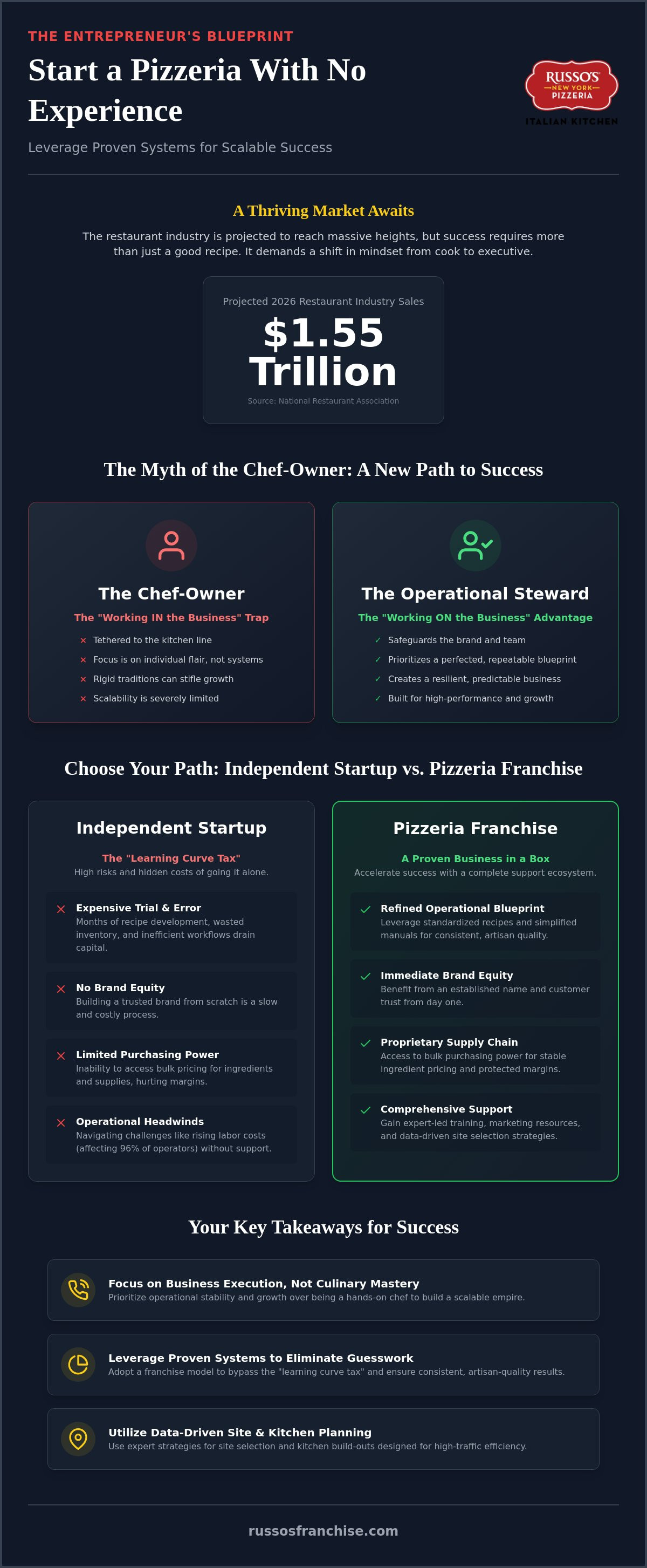
- Shift your focus from culinary mastery to disciplined business execution to ensure long-term operational stability and growth.
- Discover how to start a pizzeria with no experience by leveraging proven systems that eliminate the costly "learning curve tax" of independent startups.
- Implement standardized operational blueprints that maintain artisan quality and consistent product standards without requiring a professional chef on-site.
- Navigate the complexities of site selection and kitchen build-outs using data-driven strategies designed for high-traffic efficiency and premium presentation.
- Partner with a heritage-backed franchise to access a comprehensive support ecosystem, including expert-led training and sophisticated marketing resources.
The Myth of the Chef-Owner: Why Business Acumen Trumps Culinary Skill
The romanticized image of the flour-dusted chef-owner laboring over a wood-fired oven is a charming relic of the past; however, it is rarely the foundation of a scalable empire. In the modern landscape, the most successful pizzerias aren't led by master pizzaiolos, but by visionary entrepreneurs who understand the critical distinction between working in the business and working on the business. If you are researching how to start a pizzeria with no experience, you have already bypassed the greatest hurdle: the "ego-driven" kitchen mentality. Professional chefs often struggle with the transition to ownership because they are tethered to the line, unable to see the broader operational horizon. Your lack of technical experience is actually a strategic advantage. It allows you to approach the industry with fresh eyes, free from the bad habits and rigid traditions that often stifle growth and profitability.
Success in this industry requires you to be an operational steward rather than a line cook. Your role is to safeguard the brand, inspire your team, and ensure that every guest receives the same premium experience regardless of who is behind the counter. This "System-First" mindset is what separates a local hobby shop from a high-performing investment. By prioritizing a perfected blueprint over individual flair, you create a business that is resilient, predictable, and ultimately, far more valuable.
The Evolution of the Modern Pizzeria Owner
The restaurant market in 2026 rewards consistency above all else. With total industry sales projected to reach $1.55 trillion this year, consumers are looking for reliability in every bite. While the history of pizza is rooted in artisan craftsmanship, the modern owner must be an executive leader. Executive leadership skills, such as financial oversight and brand stewardship, are infinitely more scalable than the ability to hand-stretch dough. You don't need to be the artist; you need to be the one who provides the canvas and the tools for excellence to happen every single day.
Bridging the Knowledge Gap with Proven Systems
True operational mastery is built on three core pillars: Labor, Cost of Goods Sold (COGS), and the Customer Experience (CX). When you learn how to start a pizzeria with no experience, you rely on standardized recipes and simplified operational manuals to eliminate the need for an expensive, temperamental executive chef. These systems ensure that your "scratch-made" quality remains uncompromised while your margins remain protected. The blueprint model serves as the ultimate risk-mitigation tool by replacing human guesswork with data-driven protocols and time-honored methods.
Independent Startup vs. Pizzeria Franchise: Which Path is Right for You?
Deciding exactly how to start a pizzeria with no experience often leads to a fundamental crossroads: building an independent brand or investing in a franchise. While the allure of total creative freedom is strong, it often comes with a steep "Learning Curve Tax." This tax isn't a line item on a balance sheet. Instead, it's paid through expensive trial and error, wasted inventory, and inefficient kitchen workflows that can drain capital before the first anniversary. Statistics show that the restaurant industry is increasingly complex; in fact, 96% of operators reported higher labor costs in early 2026. For a novice, navigating these headwinds without a proven map is a high-risk gamble.
A franchise model offers a sophisticated alternative by accelerating your speed to market and providing immediate brand equity. You aren't just buying a name; you're securing a refined ecosystem. This includes access to proprietary supply chains and bulk purchasing power that independent shops simply cannot match. When you leverage an established network, you benefit from stable ingredient pricing and a vetted list of vendors, which is vital for maintaining margins in a competitive landscape.
The Hidden Costs of Going It Alone
Independent owners often underestimate the sheer volume of work required before the doors even open. Recipe development alone can take months of testing to achieve consistency. Menu engineering, nutritional labeling, and kitchen layout design are equally demanding. Before you register your business, you must account for these invisible expenses. Many find that Evaluating ROI and quality early in the process reveals that the support of a partner far outweighs the perceived "freedom" of going solo.
The Franchise Advantage for Inexperienced Owners
For those learning how to start a pizzeria with no experience, a franchise provides a "business in a box" that transforms a novice into a confident operator. Comprehensive training programs distill decades of culinary heritage into manageable systems. You receive marketing support that drives traffic from day one, rather than waiting years to build local recognition. If you are looking for pizza franchise opportunities that prioritize authentic Italian standards, the choice becomes clear. By following a time-tested path, you can focus on growth and community engagement rather than troubleshooting dough fermentation at 2:00 AM. If you value stability and prestige, exploring a premium franchise opportunity is the most logical step toward long-term success.
The Operational Blueprint: Mastering Consistency Without a Culinary Degree
Consistency is the silent engine of a successful restaurant. While independent operators often struggle with fluctuating product quality, those who understand how to start a pizzeria with no experience know that success lies in the system, not the individual. Mastering the science of dough is a perfect example. Instead of relying on a chef's "feel" for the mixture, a professional blueprint utilizes standardized fermentation protocols. These meticulous steps account for temperature, humidity, and time; ensuring a perfect, airy crust every single day without requiring a single hour of culinary school.
Managing a "scratch-made" kitchen requires more than just passion; it demands a disciplined approach to documentation. Simplified operational manuals and "Step-by-Step" station guides transform complex Italian recipes into repeatable actions. This shift allows you to hire for attitude and work ethic rather than just technical skill. In this model, the role of a "Kitchen Manager" becomes more vital than that of a traditional "Chef." A manager is a steward of the system, focused on execution, waste reduction, and maintaining the heritage standards that define your brand.
Standardized Excellence: The Secret to Scalable Flavor
True craftsmanship is often born from family recipes that have been refined over generations. However, translating a grandmother's kitchen secrets into a high-volume commercial setting requires precision. Leading Italian kitchen franchises succeed by combining these authentic flavors with meticulous ingredient sourcing. By following a station-by-station guide, every employee becomes a guardian of the brand's culinary legacy. This level of detail ensures that a pizza served in London tastes identical to one served in New York or Riyadh.
Training and Support: Your Continuous Education
When you learn how to start a pizzeria with no experience, you aren't left to navigate the complexities of the industry alone. A comprehensive franchise training university provides the foundational knowledge needed to run a premium operation. This education doesn't end at the grand opening. Ongoing field support and access to a dedicated franchise business consultant provide a safety net for your investment. The ability to engage in peer-to-peer learning within a global network of owners offers insights that no textbook can replicate. You are part of a community dedicated to the same high standards of excellence and ambitious growth.
Location, Logistics, and Launch: The Practical Steps to Opening
Once the operational systems are understood, your focus must shift from the theoretical to the physical footprint. Learning how to start a pizzeria with no experience requires a disciplined transition from a visionary mindset to a logistical one. You aren't merely searching for a storefront; you're looking for a strategic asset that will drive your return on investment. Successful owners utilize a data-driven approach to site selection, analyzing granular traffic patterns, local demographics, and competitor density. This analytical rigor ensures that your venture is positioned for maximum visibility and long-term viability from the moment you sign the lease.
Navigating the complexities of permits, health inspections, and local regulations can be daunting for the uninitiated. However, these steps are the necessary hurdles that safeguard your professional reputation. A well-organized launch strategy builds momentum long before the doors officially open, turning a simple grand opening into a significant community event. By following a structured path, you replace the anxiety of the unknown with the confidence of a seasoned professional.
Site Selection: The Foundation of Your ROI
High-traffic "A+" locations often command premium rents, yet they are frequently the most cost-effective choice for owners new to the industry. These prime spots provide a built-in audience, which significantly reduces your initial marketing burden. You should seek the "Halo Effect" created by neighboring anchor tenants, such as high-end grocery stores or popular lifestyle centers, which draw your target demographic to the area daily. Additionally, you must evaluate the practical logistics of delivery radiuses and dedicated carry-out parking. This is vital because 81% of restaurant operators have seen a marked increase in takeout and delivery sales over the past year.
Managing the Build-Out and Equipment Sourcing
Transforming a raw space into a high-functioning Italian kitchen is a complex feat of engineering and brand storytelling. Your essential equipment list must include authentic brick ovens and industrial mixers that can handle the rigorous fermentation protocols required for a premium crust. Working with specialized restaurant contractors is non-negotiable if you want to avoid the delays that often plague independent startups. Finally, always utilize a "Soft Opening" to refine staff performance and kitchen flow. This phased approach allows you to perfect the guest experience in a controlled environment before the full launch. If you're ready to secure a prime territory, explore our premium franchise opportunities to begin your journey with an expert guide by your side.
The Russo’s Way: How We Turn Entrepreneurs into Pizzeria Icons
Chef Anthony Russo founded this brand on a singular, uncompromising principle: "If it isn't fresh, don't serve it." This philosophy transforms the question of how to start a pizzeria with no experience from a daunting challenge into a structured path toward prestige. By joining the Russo’s New York Pizzeria family, you inherit a support ecosystem that handles the heavy lifting of site selection, supply chain logistics, and high-impact marketing. Our New York-style heritage isn't just a culinary choice; it's the ultimate competitive advantage in a market that craves authenticity and time-honored methods. We provide the stability of a 30-year legacy while maintaining the ambitious, growth-oriented mindset required for 2026.
Investment flexibility is a hallmark of our model. We offer diverse opportunities tailored to your professional goals, whether you're interested in a single-unit local presence, a multi-unit regional expansion, or an international master franchise. Each model is rooted in the same disciplined execution and meticulous standards that have made our brand a global name in premium Italian dining.
A Legacy of Authenticity for the Modern Investor
We've successfully translated over 30 years of family recipes into a turnkey business model that prioritizes your success. Our "Chef-Inspired" menu is a masterclass in operational efficiency because it requires no high-priced executive chef on your payroll. We empower you to serve artisan quality by using only premium, non-processed ingredients, such as flour from our own mills and extra virgin olive oil from our family groves in Italy. This commitment to quality is a powerful business driver that ensures guest loyalty. You'll learn how to start a pizzeria with no experience by following a refined path that values craftsmanship over mere convenience.
Taking the Next Step Toward Ownership
Your journey begins with a purposeful discovery process. You'll have the opportunity to meet our leadership team and, most importantly, taste the product that defines our reputation. We provide full transparency as you review the Franchise Disclosure Document (FDD), ensuring you move forward with absolute confidence. This is more than a financial transaction; it's an invitation to join a global family of successful entrepreneurs. We invite you to step into a role as a brand steward and community leader, backed by the heart of a family-oriented guide and the expertise of a seasoned mentor. The blueprint for your future as a pizzeria icon is ready; all it requires is your dedication to excellence.
Building Your Legacy in the Pizza Industry
The path to becoming a successful restaurateur is paved with disciplined systems and authentic heritage. You've discovered that professional business acumen is far more valuable than technical kitchen skills when you have a perfected blueprint to follow. By choosing a franchise model over a risky independent startup, you secure a foundation built on stability and time-honored methods. Understanding how to start a pizzeria with no experience is ultimately about choosing the right partner to guide your ambition and safeguard your investment.
Founder-led by Chef Anthony Russo since 1992, our brand provides the prestige of authentic New York-style recipes with zero "ghost kitchen" licensing. We offer a truly global footprint with both single and multi-unit opportunities for those who value excellence and craftsmanship. You don't have to navigate the complexities of the 2026 market alone. It's time to transition from an aspiring entrepreneur to a confident owner with a business that's built to last.
Begin Your Journey to Pizzeria Ownership with Russo’s New York Pizzeria
Your future as a pizzeria icon starts with a single, confident decision. We're ready to help you build a legacy that reflects your passion and our shared history of excellence.
Frequently Asked Questions
Do I need to be a chef to open a pizza franchise?
You don't need to be a professional chef to succeed in this industry. Modern franchise models are designed to be business-first, relying on standardized recipes and operational manuals that ensure consistency without requiring personal culinary expertise. Your role is that of a visionary leader and manager who oversees the execution of a proven blueprint. By following established protocols, you can maintain premium standards while focusing on scaling your investment and managing your team effectively.
How much does it cost to start a pizzeria with no experience?
The initial investment varies significantly based on your chosen model. Independent startups generally range from $95,000 for small takeout units to over $750,000 for full-service dine-in restaurants. If you are learning how to start a pizzeria with no experience, you must also account for site selection and equipment. While franchise costs differ by brand, they often provide a more predictable financial roadmap by including established vendor networks and proprietary supply chains that help manage expenses.
How long does it take to get a new pizzeria up and running?
Most entrepreneurs can expect a timeline of six to twelve months from the initial planning stages to the grand opening. This period includes critical steps like site selection, securing permits, and completing the kitchen build-out. Choosing a franchise model often accelerates this process because you are working with an established roadmap. Specialized contractors and dedicated support teams help you navigate local regulations efficiently, ensuring that your transition from investment to operation is as seamless and rapid as possible.
What is the most difficult part of running a pizzeria for a beginner?
Navigating labor challenges and ensuring product consistency are the primary hurdles for new owners. With 96% of restaurant operators reporting higher labor costs in early 2026, finding and retaining a dedicated team is essential. Beginners often feel overwhelmed by the complexity of a scratch-made kitchen. However, utilizing a "System-First" approach with standardized fermentation protocols and station-by-station guides allows you to maintain artisan quality without falling victim to the common pitfalls of operational inconsistency or staffing turnover.
Can I start a pizzeria while keeping my current full-time job?
You can operate a pizzeria as a semi-absentee owner, provided you have a sophisticated management team in place. Success in this model depends on your ability to work "on" the business rather than "in" it. By leveraging a proven operational blueprint, you can oversee high-level performance and financial growth while a trusted kitchen manager handles daily execution. This approach allows you to build a legacy and diversify your portfolio without sacrificing your current professional commitments or entrepreneurial focus.
Is the pizza industry still profitable in 2026?
The pizza industry continues to show robust growth and profitability. Total restaurant and foodservice sales are projected to reach $1.55 trillion in 2026, with the pizza segment alone generating over $46 billion in annual revenue. Consumer demand for high-quality, authentic options remains strong, especially as 81% of operators report an increase in takeout and delivery sales. By focusing on premium ingredients and efficient operations, you can capture significant market share in this resilient and expanding sector.
What kind of training does a franchisor provide to a new owner?
A reputable franchisor provides an immersive training program that covers everything from site selection to marketing and daily kitchen operations. You'll learn exactly how to start a pizzeria with no experience through hands-on education in a certified training center. This support continues long after the doors open, with ongoing field visits from business consultants and access to a global network of peers. This continuous education ensures you remain at the forefront of industry trends and operational excellence.
How do I find the best location for my first pizza shop?
Finding a premier location involves analyzing granular data such as local demographics, competitor density, and foot traffic. You should look for "A+" spaces near anchor tenants like high-end grocery stores to benefit from the "Halo Effect." It's also vital to evaluate delivery radiuses and parking availability to support carry-out sales. A sophisticated site selection process ensures your business is positioned for maximum visibility and convenience, which are the cornerstones of long-term return on investment and growth.