Your franchisor's global brand legacy is a powerful asset, but on its own, it won't sign your loan papers. Lenders today aren't just looking for a famous logo. They're looking for a partner who understands how to write a business plan for a franchise loan that balances a proven system with local market mastery. It's natural to feel overwhelmed by financial jargon or the fear of a rejection letter based on poor documentation. You've found a tradition worth joining, and now you need the capital to build it.
We'll help you master the art of crafting a lender-ready document that highlights both brand heritage and your own operational vision. You'll gain a clear roadmap for your application, whether you're approaching the SBA for a 7(a) loan at current 2026 rates or seeking private funding. This guide provides the confidence to present your strategy with the poise of a seasoned entrepreneur. We'll detail the essential data points and local research needed to turn your ambition into a thriving reality.
Key Takeaways
- Understand why lenders favor the franchise model and how to position your plan as a strategic roadmap for both funding and long-term operational success.
- Learn how to write a business plan for a franchise loan by blending the brand’s established identity with your personal background to build immediate professional credibility.
- Discover how to leverage Item 19 of the Franchise Disclosure Document to create realistic financial benchmarks and a sharp, local SWOT analysis.
- Master the three pillars of financial projections to demonstrate a clear return on investment and a reliable debt service coverage ratio for 2026 lending standards.
- See how a 30-year track record and a unique "Chef-to-Chef" heritage, like that of Russo’s New York Pizzeria, can simplify the process of securing commercial credit.
Understanding the Strategic Role of a Franchise Business Plan for Lenders
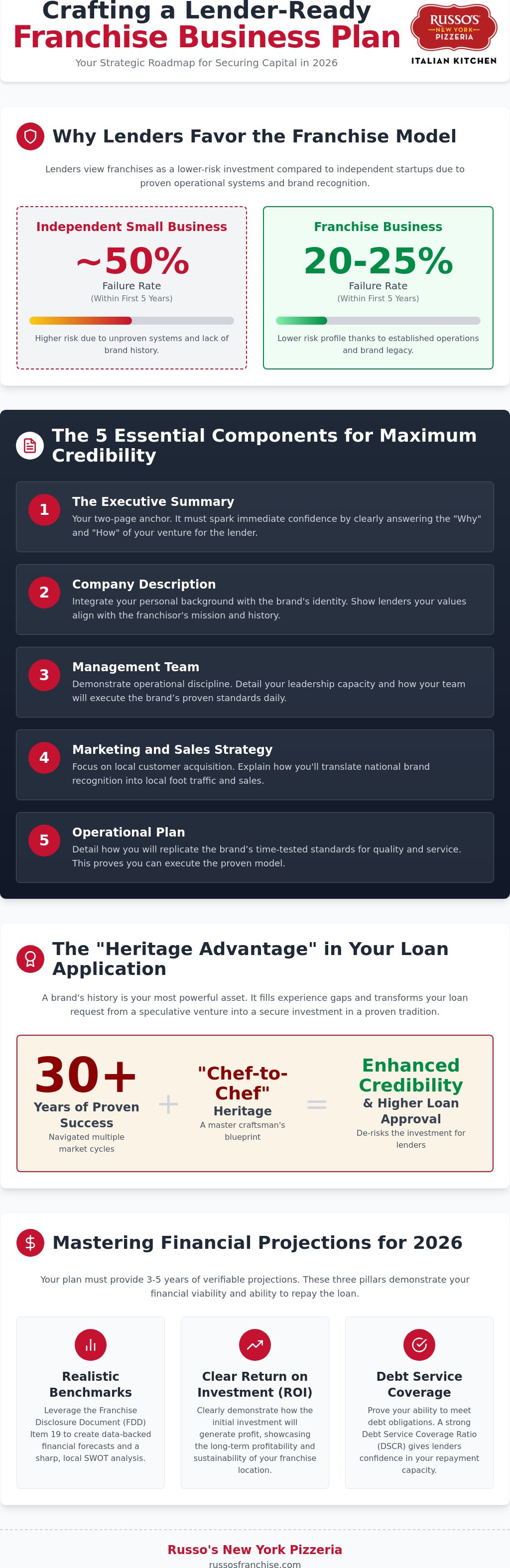
A franchise business plan is a sophisticated, dual-purpose document. It acts as your operational North Star while simultaneously serving as a high-stakes pitch for capital. When you're learning how to write a business plan for a franchise loan , you must recognize that lenders view franchises differently than independent startups. Data from the SBA indicates that approximately 20-25% of franchise businesses close within their first five years. This is a remarkably lower risk profile compared to independent small businesses, which face a failure rate of around 50%. This inherent stability comes from established operational systems that mitigate common entrepreneurial pitfalls.
In 2026, the lending landscape has shifted toward premium heritage brands. Bankers aren't just looking for a transactional business; they're looking for a legacy that has survived multiple market cycles. Your "Lender Narrative" should tell a story of stability and discipline. It should clearly demonstrate how the brand's time-tested blueprint will thrive when paired with your local market expertise and operational commitment.
Traditional vs. Lean Plans: Which Do Bankers Prefer?
While "lean" startup plans are popular in modern tech circles, traditional, detailed plans remain mandatory for SBA 7(a) and large commercial loans. Bankers require a deep dive into your projections, market analysis, and management structure to justify the investment. Think of the Executive Summary as your high-impact elevator pitch. It is the first section your banker will read, and it must spark immediate confidence through its professional poise. You might use a lean format for your internal weekly strategy, but the version you present for capital must be formal and exhaustive. In 2026, a "Lender-Ready" plan is defined as a comprehensive document that provides three to five years of verifiable financial projections backed by third-party market data and franchisor performance history.
The "Heritage Advantage" in Your Loan Application
Your strongest asset is often the brand's history. By understanding the franchising model, you can see how the franchisor’s decades of success become a pillar of your own personal credibility. If you lack direct industry experience, the brand's legacy fills that gap. It proves that the methods work and that you're following a master craftsman's blueprint. For example, exploring pizza franchise opportunities allows you to point to a model of stable, heritage-led growth that has already navigated thirty years of industry changes. This "Heritage Advantage" transforms a standard loan request into a secure investment in a proven tradition, making it far more attractive to conservative lenders.
The Essential Components: Structuring Your Plan for Maximum Credibility
Building a credible document requires more than just filling in blanks. It demands a narrative that connects your leadership skills to the brand's established success. While the SBA's official guide to business plans provides a general framework, learning how to write a business plan for a franchise loan requires a more specialized lens. You aren't just pitching a business. You're pitching your ability to steward a proven legacy. Your plan should follow a logical five-step structure that builds momentum with every page.
- The Executive Summary: This is your two-page anchor. It must articulately answer the "Why" and "How" of your venture, sparking immediate interest from the lender.
- Company Description: This section integrates your personal professional background with the brand’s identity. It shows the lender that your values align with the franchisor’s mission.
- Management Team: Here, you demonstrate operational discipline. Detail your leadership capacity and how your team will execute the brand’s standards daily.
- Marketing and Sales: Focus on local customer acquisition. Explain how you will translate national brand recognition into local foot traffic.
- Operational Plan: Describe how you will replicate the brand’s time-tested standards. This is where you prove you can follow the manual to the letter.
Marketing Strategy: Global Brand Power vs. Local Tactics
Your marketing strategy must highlight the synergy between the franchisor's national reach and your local tactics. While the brand handles broad awareness, your plan should detail how you will capture specific local demographics. This is especially critical when exploring a halal pizza franchise, where market capture relies on understanding cultural nuances and community-specific needs. Lenders appreciate a plan that identifies a clear, underserved niche. Using specific geographic data shows you've done the hard work of researching your territory.
The Operational Blueprint: Showing You Can Follow the System
Lenders prioritize "disciplined operators" who respect the system. Your operational section should detail the rigorous training provided by the franchisor, framing it as a vital risk-mitigation tool. Mention the technology stack, including POS systems and inventory management, to show how you'll maintain transparency and efficiency. This level of detail proves you aren't guessing. If you're ready to lead a team within a professional framework, exploring a franchise opportunity with a clear operational blueprint is the first step toward securing your future.
Bridging the Gap: Integrating Franchisor Data with Local Market Realities
Success in lending depends on your ability to prove the brand works specifically in your chosen territory. When you're mastering how to write a business plan for a franchise loan , you must treat the Franchise Disclosure Document (FDD) as your primary evidence locker. Item 19 is particularly vital. It provides financial performance representations that serve as your benchmarking gold standard. However, a lender needs to see how those national figures translate to your specific street corner. You must show that you aren't just buying a job; you're filling a void in the local economy.
A robust local SWOT analysis bridges this gap. You'll identify your Strengths, such as the brand's thirty-year legacy, and your Weaknesses, like your initial lack of local name recognition. In the 2026 dining market, authenticity has become a quantifiable metric. Consumers are increasingly moving away from processed, "fast" alternatives in favor of heritage-led experiences. Identifying that your territory lacks a truly authentic, chef-driven option provides the "Local Gap" that lenders find irresistible. It proves there's a hungry market waiting for what you're about to build.
Competitive Analysis: Beyond Just Proximity
Don't just list every restaurant within five miles. Analyze them by quality and price point. Positioning a premium Italian kitchen franchise requires showing how it stands apart from commoditized fast-food chains. Use local traffic patterns and data from "anchor" businesses, like high-end grocery stores or luxury residential developments, to justify your site selection. This proves your location isn't just convenient. It's strategically aligned with a high-value customer base that values tradition and quality over mere speed.
Leveraging the FDD for Your Pro-Forma
Translating Item 19 earnings claims into your own projections is an exercise in discipline. Lenders always prefer "realistic" over "optimistic." If the national average for prime cost is a certain percentage, verify if local labor or utility rates in your city might push that figure higher. Adjusting these variables shows you aren't just copy-pasting data. It demonstrates that you've done the due diligence required to protect the lender's capital. By grounding the franchisor's national success in local fiscal realities, you build a pro-forma that stands up to the most rigorous banking scrutiny.
Financial Projections: Demonstrating ROI and Debt Service Coverage
Numbers provide the hard-nosed evidence that supports your ambitious vision. When you master how to write a business plan for a franchise loan , your financial section becomes the ultimate proof of your operational discipline. Lenders require three fundamental pillars: the Balance Sheet, the Income Statement, and the Cash Flow Statement. While a three to five year outlook is standard, your first year must be detailed month by month. This granularity proves you understand the seasonal ebbs and flows of the service industry. It shows you aren't just guessing at success; you're planning for it with precision.
Transparency is your greatest ally during the underwriting process. You must include a "Sources and Uses of Funds" table that accounts for every dollar of the requested capital. Bankers need to see exactly how much is allocated to kitchen equipment, leasehold improvements, and initial working capital. Your personal financial statement must be equally exhaustive. Any lack of clarity regarding your personal assets or liabilities can signal a lack of professional maturity. This often leads to immediate rejection before a lender even considers the strength of the brand you've chosen.
Key Metrics Lenders Look For in 2026
In the current lending environment, the Debt Service Coverage Ratio (DSCR) is the most critical metric. It measures your ability to pay the loan using your operating cash flow. A 1.25x DSCR is typically the magic number for franchise approval because it provides a 25% cushion above your debt obligations. You should also include a clear break-even analysis. Knowing exactly how many pizzas you need to sell each day to cover your fixed costs demonstrates a level of control that inspires trust in conservative bankers. It proves you have a firm grip on the levers of your business.
Accounting for Franchise Fees and Royalties
Don't bury your royalty fees or advertising fund contributions in a generic "miscellaneous" category. List them clearly as dedicated line items. Successful operators view these not as costs, but as investments in the "ROI of Royalties." These fees buy you a refined supply chain, national brand power, and lower operational overhead than an independent startup could ever achieve. You can see how pizza franchise ROI is stabilized by these collective efficiencies. This supply chain power protects your margins against inflation and market volatility. If you're ready to leverage a thirty year legacy of financial stability, explore our pizza franchise opportunities today.
Securing Your Future with the Russo’s New York Pizzeria Business Model
Your business plan is finally coming together, but the brand you choose is what gives those pages their weight. The Russo’s "Chef-to-Chef" heritage isn't just a marketing slogan; it's a powerful narrative for your lender. It tells a story of authenticity and culinary discipline that transcends the typical fast-food model. When you're finalizing how to write a business plan for a franchise loan , this unique background serves as your most persuasive argument. It proves that your business is built on thirty years of refined, time-tested recipes and a commitment to quality that creates a massive barrier to entry for competitors.
A thirty-year proven track record provides the immediate reliability bankers crave when approving commercial credit. This longevity demonstrates that the model has successfully navigated varying economic climates and shifting consumer tastes. Whether you choose a single-unit model or an ambitious multi-unit expansion, the flexibility of the business model allows you to match your capital levels to your growth goals. This scalability is a key feature that should be highlighted in your plan, showing lenders that your vision has room to mature and expand over time.
Comprehensive training programs are the backbone of a strong "Management Team" section. By detailing the rigorous operational support provided, you show the lender that your team will be mentored by seasoned industry experts. This mitigates the risk associated with a new operator. You aren't just opening a pizzeria; you're adopting a professional framework that has been perfected over decades. This level of preparation turns a standard loan application into a secure investment in a legacy of excellence.
The Russo’s Support System: Your Secret Weapon
The site selection and lease negotiation support included in your business plan directly addresses the "unforeseen" risks that often make lenders hesitant. By leveraging Russo’s expertise in identifying high-traffic locations with favorable terms, you provide concrete evidence of your store's potential for success. The assistance in store design and construction ensures that your build-out remains on schedule and within budget, which is a major concern for SBA underwriters. Highlighting the "Family Recipe" advantage also proves that your product cannot be easily replicated by local independent shops, securing your market position from day one.
Next Steps: From Plan to Pizzeria
Moving from a document to a physical storefront requires a final phase of due diligence. Start by speaking with current franchisees to understand the daily rhythm of the business and the support they receive. You should also assemble your professional team, including a qualified accountant and a lawyer who understands the service industry. Your Russo’s Development Manager will work alongside you to ensure every detail of your application is polished and professional. If you're ready to build your legacy with a brand that values tradition and growth, it's time to take the next step. Explore Russo’s New York Pizzeria Franchise Opportunities and start your journey toward securing the capital you need.
Build Your Legacy on a Foundation of Excellence
Mastering how to write a business plan for a franchise loan is the critical first step in transforming your entrepreneurial vision into a tangible storefront. You've learned to balance a franchisor's global brand power with your own local market mastery, while ensuring your financial projections meet the rigorous 2026 standards for debt service coverage. This methodical approach doesn't just secure capital; it builds the discipline required for long-term operational success. By aligning your strategy with a proven system, you replace uncertainty with a clear, professional roadmap.
Choosing a partner with a deep-rooted history provides an immediate advantage in the eyes of any lender. Established in 1992 by Chef Anthony Russo, our model offers the stability of dozens of locations worldwide and a proven track record of ROI. From site selection and lease negotiations to your grand opening, we provide the comprehensive support needed to turn your plan into a thriving reality. Your future as a business owner is within reach, and the right blueprint makes all the difference.
Start your journey with a Russo’s New York Pizzeria franchise today . We're ready to help you craft a successful future built on quality, tradition, and shared ambition.
Frequently Asked Questions
How much detail do I need in a business plan for an SBA franchise loan?
SBA loans demand an exhaustive level of documentation. You need a traditional, comprehensive plan that includes three to five years of projections and a month-by-month cash flow analysis for the first year. Bankers look for an operational blueprint that proves you understand the complexities of the service industry. This level of detail demonstrates your commitment to the brand's disciplined standards and provides the security lenders require to approve your capital.
Can I use the franchisor’s financial projections in my business plan?
You should use the financial representations in Item 19 of the FDD as a vital benchmark. However, simply copy-pasting these figures is a mistake. Lenders expect you to adjust those numbers based on your specific local labor rates, rent, and utility costs. Mastering how to write a business plan for a franchise loan means proving you can ground the franchisor’s national success in your territory’s fiscal realities.
What is the most important section of a franchise business plan for a banker?
The financial projections, specifically your Debt Service Coverage Ratio (DSCR), carry the most weight. Bankers typically look for a 1.25x cushion to ensure you can comfortably repay the loan. while the numbers provide the logic, your Executive Summary provides the heart. It must articulately convey your leadership capacity and your dedication to upholding a premium heritage brand’s time-honored methods and operational excellence.
How do I explain my lack of restaurant experience to a lender?
Shift the narrative toward your transferable leadership skills and the franchisor’s established support system. Emphasize that you are a disciplined steward of a thirty-year legacy. By highlighting the brand’s rigorous training and proven blueprint, you show the lender that your lack of direct experience is mitigated by a master craftsman’s guidance. This turns your background into an asset of fresh, professional management.
What happens if my local market research contradicts the franchisor’s data?
Present your local findings with confidence. If your research on traffic patterns or local demographics differs from the franchisor’s national averages, include those specifics in your plan. Lenders appreciate an operator who identifies the "Local Gap" and understands the unique nuances of their territory. Showing this level of due diligence proves you are a realistic partner who prioritizes accuracy over optimism and grounded strategy.
Is a business plan required for a franchise loan if I have a high credit score?
A professional business plan is always mandatory for commercial lending. Your high credit score proves personal financial discipline, but the plan proves the business model's local viability. It serves as the strategic roadmap that convinces a banker the venture can generate independent cash flow. Knowing how to write a business plan for a franchise loan is essential for any serious entrepreneur seeking to build a lasting legacy.
How often should I update my business plan after the loan is approved?
Treat your business plan as a living document and update it at least once a year. Comparing your actual monthly performance against your original Year 1 projections allows you to make precise operational adjustments. This habit of disciplined review ensures you remain a growth-oriented partner. Regular updates help you maintain the high standards of a premium brand while navigating the evolving realities of the 2026 market.