While the local corner shop once defined the industry, chained pizza outlets now command over 70% of the market's revenue in 2026. You've likely noticed the exhaustion that comes with an oversaturated market filled with low-quality options and rising ingredient costs. It's a challenging environment where labor expenses can consume up to 35% of your total operating budget. Staying ahead requires a deep understanding of the current new york pizza franchise market trends to ensure your investment stands on solid ground.
You deserve a business model that honors tradition while delivering modern profitability. This industry analysis uncovers how premium heritage brands are outperforming generic competitors by focusing on operational discipline and authentic craftsmanship. We'll identify the high-growth niches currently thriving, examine the impressive ROI of brands with deep-rooted legacies, and provide a blueprint for finding a recession-resistant model that thrives regardless of economic shifts. Success isn't just about following a trend; it's about mastering a time-tested path to excellence.
Key Takeaways
- Learn why 2026 represents a pivotal turning point for the industry as inflation drives consumers toward high-value, premium dining experiences.
- Discover why additive-free sauces and scratch-made dough have become non-negotiable requirements for the modern, health-conscious gourmet.
- Explore how specialized niches like the Halal pizza franchise model are creating massive untapped opportunities within current new york pizza franchise market trends.
- Understand the strategic pivot away from ghost kitchens toward a "return to the table" model that prioritizes sustainable brand loyalty.
- Analyze the superior profit margins of premium Italian kitchens and how high-quality ingredients directly correlate with higher customer retention.
The 2026 New York Pizza Franchise Market Landscape
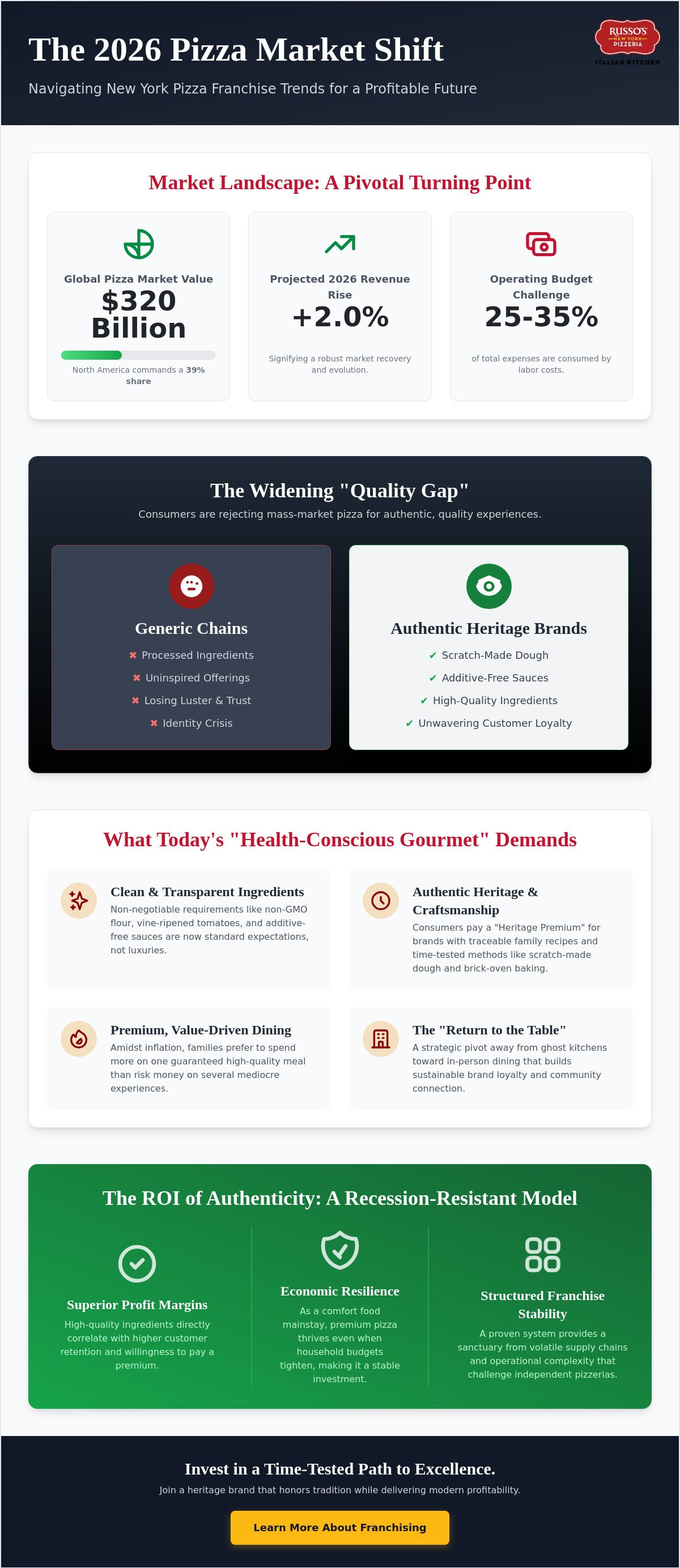
The year 2026 marks a decisive turning point for the industry. After a challenging five-year period where some sectors saw a 1.7% compound annual growth rate decline, we're witnessing a robust recovery. Industry forecasts now suggest revenue will rise by an estimated 2.0% this year. This isn't merely a return to form; it's a fundamental evolution in how investors and consumers interpret new york pizza franchise market trends . While mass-market chains grapple with identity crises, premium brands are finding success by returning to their roots.
Current data from the NAICS OD4320 performance reports indicates the global pizza foodservice market is now valued at $320 billion. North America remains the dominant force, commanding a 39% share of that total. However, the path to profitability has become more narrow. Average hourly wages have increased by nearly 3.9%, and labor costs for many pizzerias now sit between 25% and 35% of total operating expenses. These pressures have widened the "Quality Gap." Consumers are no longer satisfied with the generic, uninspired offerings of low-cost delivery chains. They're seeking the soul of an authentic Italian kitchen.
Economic Resilience and the 2.0% Growth Forecast
Pizza remains a household mainstay because it offers a unique form of economic resilience. It's the ultimate comfort food that persists even when household budgets tighten. High inflation hasn't eliminated the desire for dining out, but it has made consumers more discerning. We're seeing a significant shift toward value-driven premium dining. Families would rather spend their money on a authentic New York-style pizza that guarantees quality than risk a mediocre experience elsewhere. Multi-unit developers are capitalizing on this stability, using their organizational strength to anchor the 2026 market against volatility.
Competitive Forces: Chains vs. Heritage Brands
The landscape is bifurcating. On one side, generic "fast-food" pizza is losing its luster as consumers grow weary of processed ingredients. On the other, fast-casual Italian concepts are thriving. Independent pizzerias often find themselves overwhelmed by the complexity of modern supply chains and volatile ingredient prices. In contrast, a structured pizza franchise provides a sanctuary of stability. These heritage-based brands offer the refined, time-tested path that modern investors crave. By focusing on craftsmanship rather than just convenience, these brands have established the "Authentic Italian Kitchen" as the most prestigious and profitable sub-sector in the current market.
Consumer Demand for Authentic Heritage and Clean Ingredients
Consumers in 2026 have evolved far beyond the simple convenience of a quick, greasy slice. They've become "Health-Conscious Gourmets" who scrutinize every ingredient on their plate with the precision of a critic. This shift is a cornerstone of current new york pizza franchise market trends . People are choosing to eat out less frequently due to economic pressures, but when they do, they demand an authenticity that a corporate factory simply cannot replicate. They want to know where their flour was milled, how long their dough was aged, and whether the sauce contains hidden additives.
There's a tangible "Heritage Premium" at play in the modern market. When a brand can trace its recipes back to a family kitchen in Italy rather than a corporate test lab, it builds immediate, unshakeable trust. This emotional connection translates directly to higher ticket averages and unwavering customer loyalty. According to the 2026 Pizza Industry Trends Report , transparency in sourcing is no longer an optional luxury for those aiming for a high ROI. Utilizing non-GMO flour and fresh, vine-ripened tomatoes isn't just a matter of taste; it's a strategic business decision that protects your margins by attracting a demographic willing to pay for quality.
The Science of the Scratch-Made Advantage
Scratch-made dough serves as the living, breathing foundation of New York pizza authenticity, providing the structural integrity and complex flavor profile that frozen alternatives lack. In a franchise environment, the temptation to use frozen dough is high, but the quality trade-off is severe. Fresh dough develops a superior crust texture and a distinct aroma that acts as a natural marketing tool for every passerby. Traditional brick-oven methods further elevate the product, creating a char and crispness that separates a premium pizza franchise from a generic chain.
Health Trends and the Italian Kitchen
Adapting to modern dietary needs doesn't mean abandoning tradition. The most successful operators are integrating gluten-free crusts and vegan cheese options while maintaining the robust flavors of an authentic Italian kitchen. Consumers now view "real food" as a baseline requirement for long-term sustainability. For instance, Russo’s New York Pizzeria successfully balances these time-honored family recipes with modern nutritional expectations, ensuring that every guest finds something to love. If you're looking to capitalize on these new york pizza franchise market trends , exploring a pizza & Italian kitchen franchise can provide the blueprint you need to succeed in this sophisticated market.
The Explosion of Specialized Niche Markets: Halal and Global Expansion
Success in the current economy requires more than just a quality product; it demands a precise understanding of underserved demographics. One of the most significant new york pizza franchise market trends in 2026 is the rapid bifurcation of the market into specialized niches. While generic chains struggle to maintain relevance, brands that embrace cultural and dietary inclusivity are unlocking massive new revenue streams. This is particularly evident in the surging demand for premium, Halal-certified Italian dining, a sector that has long been overlooked by major corporate pizzerias.
The global Pizza Foodservice Market Size and Forecast indicates a total valuation of $320 billion this year. Within this vast landscape, the intersection of authentic heritage and Halal standards represents a high-growth frontier. Investors are no longer looking for broad, "one-size-fits-all" models. They're seeking sophisticated frameworks that allow them to capture loyal, quality-conscious communities that have been historically underserved by the premium Italian segment. Mastering these niche markets is the key to building a truly recession-resistant business.
The Halal Food Industry Growth in 2026
The global Halal food sector is expanding at a remarkable pace, and its integration with Italian cuisine offers a unique competitive edge in major metropolitan hubs. Authenticity remains the primary driver here. Consumers don't want a "Halal-style" substitute; they want the same scratch-made dough and coal-fired flavor profile discussed earlier, simply prepared according to their dietary requirements. Leveraging a Halal pizza franchise model allows developers to enter high-density markets with a distinct value proposition that corporate competitors cannot easily replicate. It's a strategic move that fosters deep community trust and ensures consistent, long-term growth.
International Master Franchise Opportunities
Bringing authentic New York flavors to new continents requires a partner with a proven operational blueprint. The role of the master developer has become vital in 2026, as these professionals secure regional territory rights to scale heritage brands across diverse cultures. While managing a global supply chain for authentic ingredients like non-GMO flour and specific olive oils is complex, it's essential for maintaining brand integrity. Successful international master franchise expansions demonstrate that when the "Authentic Italian Kitchen" model is exported with discipline, it resonates powerfully with global audiences. These developers aren't just selling food; they're providing a prestigious, time-tested experience that transcends borders.
Operational Resilience: Moving Beyond the Ghost Kitchen Hype
The temporary fascination with ghost kitchens has largely faded in 2026, replaced by a renewed appreciation for the physical dining room. While digital ordering remains a vital component of the business, accounting for approximately 26.9% of sales across the industry, the "return to the table" has become the defining movement of the year. Consumers are dining out less frequently due to economic pressures, but they have higher expectations for quality and atmosphere when they do choose to leave home. This shift is a critical component of new york pizza franchise market trends , as it highlights the enduring resilience of brick-and-mortar locations that offer a holistic experience rather than just a transaction.
Building a sustainable brand in this climate requires more than just a functioning kitchen; it requires a destination. The "Dining Experience" has transitioned from a secondary thought to a primary driver of customer retention. People aren't just looking for food; they're looking for a sense of place and a connection to tradition. By focusing on a controlled, branded environment, operators can ensure that every sensory detail, from the aroma of fresh basil to the warmth of the oven, reinforces the brand's premium positioning. This operational discipline is what separates established leaders from the fleeting novelty of delivery-only concepts.
The Pitfalls of Third-Party Ghost Kitchen Licensing
Third-party licensing often dilutes brand equity by stripping away the sensory elements that define a premium Italian kitchen. Without a controlled, branded environment, quality control becomes nearly impossible to maintain, leading to inconsistent products that frustrate loyal customers. This is why Russo’s explicitly excludes frozen retail products and ghost kitchens from its growth strategy. Success in this prestigious industry requires a commitment to excellence that can't be outsourced to a shared warehouse kitchen. Investors are recognizing that a physical presence is the only way to ensure every slice reflects the brand's heritage and rigorous standards. Owning the kitchen means owning the outcome.
Optimizing the Hybrid Dining Model
Mastering the hybrid model means balancing fast-casual speed with the warm, hospitable service found in traditional casual dining. Modern store designs now feature "theatrical kitchens" where guests can witness the craftsmanship of hand-tossed dough and the intense heat of the brick oven. This transparency builds immediate engagement and justifies the premium price point that heritage brands command. Operational flexibility allows pizzerias to thrive in both suburban neighborhoods and high-traffic urban centers by tailoring the service model to local demand. By utilizing proprietary technology and loyalty apps, operators can bypass the 15% to 30% commission fees charged by third-party delivery platforms. This allows the business to own the customer relationship directly, ensuring that the brand remains a staple in the community for years to come.
If you're looking to invest in a model that values operational integrity and long-term stability, consider our pizza & Italian kitchen franchise opportunities today.
Navigating the Investment: ROI in a Premium Market
Investing in the pizza sector requires a sharp eye for differentiation. While average net profit margins for independent shops often fluctuate between 7% and 15%, premium Italian kitchens operate on a more robust financial plane. High-quality ingredients and authentic methods aren't just cultural choices; they're the engine behind superior customer retention rates. When a guest experiences the depth of flavor in a scratch-made sauce, they aren't just buying a meal. They're becoming a long-term asset to your business. This loyalty significantly reduces the pressure on your marketing budget, allowing you to focus on operational excellence rather than constant customer acquisition.
A total investment in a New York pizza franchise in 2026 involves more than just real estate and kitchen equipment. It represents an entry into a refined, time-tested system where every operational detail has been perfected over decades. You're investing in a supply chain that prioritizes non-GMO flour and authentic olive oils, ensuring your product remains immune to the quality degradation seen in mass-market chains. These new york pizza franchise market trends favor the bold investor who understands that a founder-led, heritage-driven model provides a level of stability that corporate-heavy formulas simply cannot offer.
Calculating Pizza Franchise ROI
Success requires discipline. During your pizza franchise comparison process, you'll find that multi-unit agreements are a powerful tool for accelerating your return on investment. These structures allow you to leverage economies of scale across several locations, optimizing your labor costs and supply chain logistics. Brand recognition also plays a vital role in your early performance. An established name with a deep-rooted family legacy carries a prestige that naturally attracts a quality-conscious demographic, significantly lowering the barriers to entry in competitive metropolitan markets.
Due Diligence for the 2026 Investor
Entering the market today demands thorough preparation and a commitment to meticulous standards. You must ask critical questions about supply chain stability and the depth of franchisor support, particularly regarding the sourcing of specialized ingredients. Evaluating the authentic pizzeria franchise model reveals a blueprint designed for long-term growth and resilience against economic volatility. If you're ready to align your entrepreneurial spirit with a brand that values craftsmanship as much as profitability, the next steps are clear. Beginning the application process for a Russo’s New York Pizzeria & Italian Kitchen is the first move toward securing your place in a prestigious, growth-oriented industry.
Securing Your Legacy in the 2026 Pizza Market
The 2026 landscape rewards those who prioritize substance over speed. Success in this evolving market hinges on your ability to adapt to new york pizza franchise market trends that favor authentic heritage and operational discipline. We've explored how specialized niches like Halal-certified dining and the return to hybrid brick-and-mortar models are redefining profitability. By choosing a model rooted in craftsmanship rather than corporate convenience, you position yourself to capture a quality-conscious audience that values every bite.
Russo’s New York Pizzeria & Italian Kitchen offers a proven blueprint for this sophisticated path. Founder-led by Chef Anthony Russo since 1992, our system combines award-winning family recipes with Red Dot-level design to create an unparalleled guest experience. We provide comprehensive training and expert site selection support to ensure your venture stands on a foundation of stability and prestige. Begin your journey with a Russo’s New York Pizzeria & Italian Kitchen franchise today. Your future in the premium Italian segment starts with a legacy of excellence.
Frequently Asked Questions
What are the dominant pizza industry trends for 2026?
Operational discipline and margin-focused menu engineering define the current landscape. Operators are prioritizing direct online ordering systems to bypass the 15% to 30% commission fees charged by third-party apps, while consumers seek premium ingredients like Calabrian chiles and hot honey. These shifts reflect a broader move toward quality over mere convenience. Success now requires a balance of traditional craftsmanship and modern technological efficiency.
Is the New York style pizza market still growing?
Yes, New York style pizza remains the most popular variety in the United States, supported by a projected 2.0% industry revenue increase in 2026. This growth is fueled by a widening "Quality Gap" as consumers move away from processed, generic chains. Understanding these new york pizza franchise market trends is essential for investors seeking a stable, long-term foothold in the foodservice sector. Authenticity has become the ultimate currency for expansion.
How much does it cost to open a premium pizza franchise in 2026?
The total investment for a premium location depends on several variables, including regional real estate rates, site selection, and the specific equipment requirements for a "theatrical kitchen." Factors such as whether you choose a high-traffic urban center or a suburban neighborhood will influence your initial capital needs. Prospective partners should conduct a thorough review of the franchisor's disclosure documents to understand the specific financial commitments required for their chosen territory.
What is the average profit margin for a New York style pizzeria?
Independent pizzerias typically see average net profit margins between 7% and 15% according to recent industry data. Premium models often strive for the higher end of this range by leveraging superior customer retention and higher ticket averages. By focusing on scratch-made quality and operational efficiency, these businesses can better absorb rising labor costs, which currently account for 25% to 35% of total operating expenses for many operators.
Are ghost kitchens still a viable model for pizza franchises?
While ghost kitchens offered a temporary solution during previous market shifts, the 2026 market has seen a significant "return to the table." Consumers now prioritize the sensory experience of a physical dining room, making brick-and-mortar locations far more resilient long-term. Sustainable growth comes from owning the customer relationship through a branded environment rather than relying on third-party delivery platforms. Quality and atmosphere are the new drivers of loyalty.
What are the benefits of a Halal-certified pizza franchise?
A Halal-certified pizza franchise allows you to capture a massive, underserved demographic in major metropolitan markets. This certification provides a distinct competitive edge by offering an inclusive dining experience without sacrificing the authentic Italian flavor profiles consumers crave. It builds deep community trust and fosters loyalty among quality-conscious diners who are often overlooked by standard corporate chains. It's a strategic move for any growth-oriented developer.
How do I evaluate a master franchise opportunity in the pizza sector?
Evaluating a master franchise opportunity requires a careful analysis of regional territory rights and the stability of the franchisor's supply chain. You should look for a system that offers comprehensive training, proven operational blueprints, and a history of successful international scaling. A strong partner focuses on maintaining brand integrity while providing the tools to adapt to local cultural and dietary standards. Professionalism and heritage must go hand in hand.