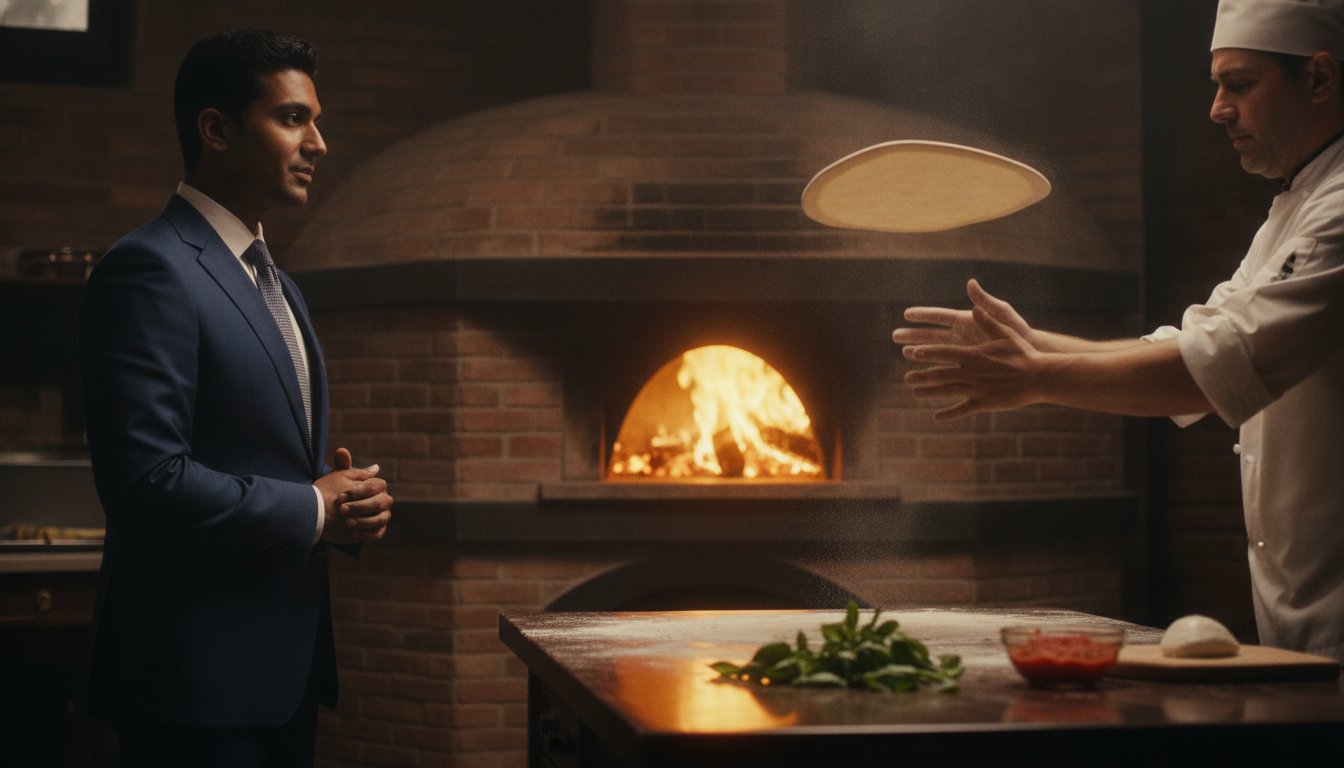
While North America holds a dominant 40.2% share of the global pizza market in 2026, the gap between commodity pizza and premium Italian experiences is wider than ever. Many entrepreneurs enter this space only to be met by the harsh realities of rising ingredient costs and high labor turnover. You know that a storefront alone doesn't guarantee a legacy. To truly stand out, you must understand What Makes a Pizza Franchise Successful? in a world that increasingly favors quality over convenience.
We believe that a profitable business should feel like an extension of your family while operating with the precision of a modern enterprise. It's about finding that rare intersection of heritage craftsmanship and data-driven systems. This guide reveals the critical pillars of profitability, from scratch-made recipes to operational technology, that allow you to build a predictable ROI. We'll show you how to move past the struggle of market saturation and toward a business model that creates lasting community impact and operational ease.
Key Takeaways
- Learn why the "Commodity Trap" of competing on price is a race to the bottom and how authentic Italian kitchens command higher customer retention.
- Understand the financial mechanics of What Makes a Pizza Franchise Successful? by leveraging scratch-made ingredients to lower raw material costs and improve margins.
- Discover how standardized operating procedures allow you to maintain old-world quality and operational excellence without requiring professional culinary training.
- Explore how strategic market adaptations, including the $2 trillion global Halal sector, provide a proven blueprint for scaling across diverse demographics.
- Identify why founder-led brands offer the stability and mentorship necessary to build a lasting community legacy compared to private-equity-backed chains.
The 2026 Pizza Market: Why Authenticity Outperforms Commodity Models
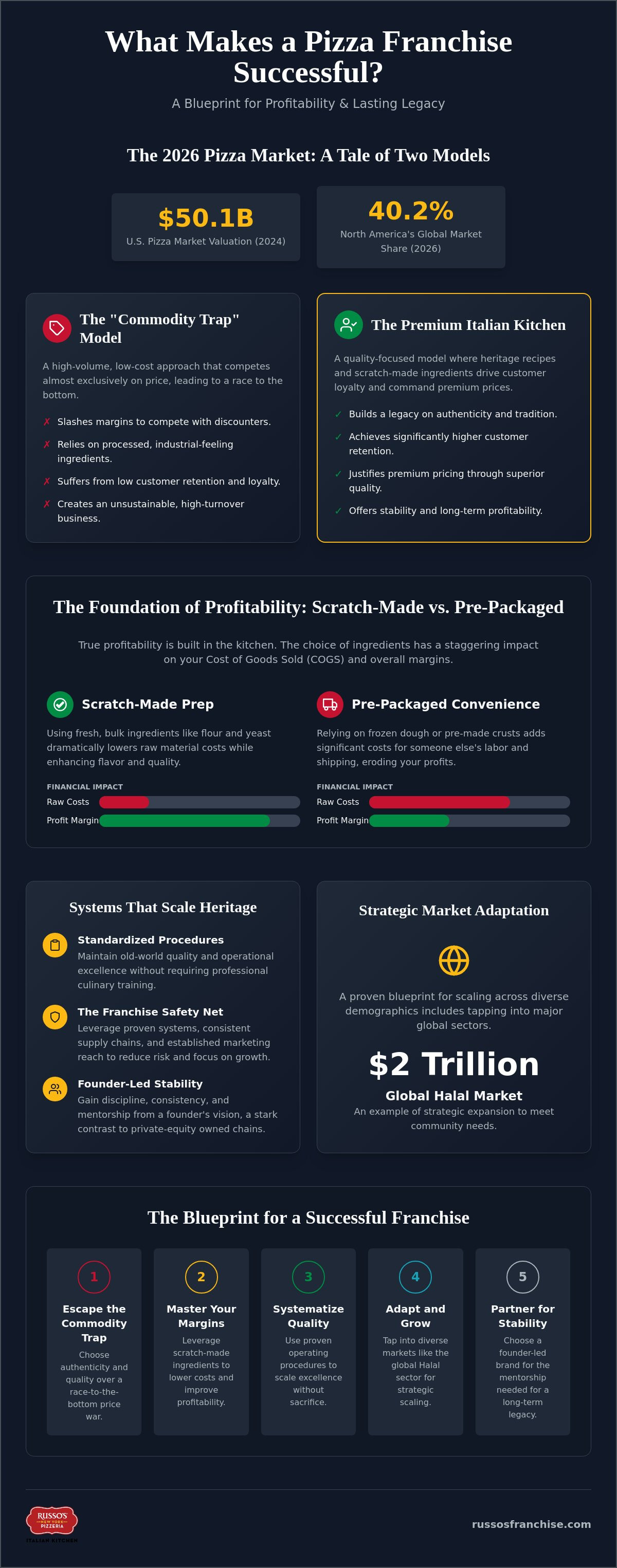
The U.S. pizza market reached a valuation of $50.1 billion in 2024. While this growth signals a healthy industry, it also reveals a widening success gap between two very different business models. On one side, you have commodity pizza; these are the high-volume, low-cost delivery chains that compete almost exclusively on price. On the other side, you find the premium Italian kitchen, where heritage recipes and scratch-made quality drive customer loyalty. Understanding What Makes a Pizza Franchise Successful? in 2026 begins with choosing which side of this gap you want to occupy.
Competing on price alone is a dangerous race to the bottom. This "Commodity Trap" forces owners to slash margins to keep up with national discounters, often resulting in a product that feels industrial rather than artisanal. Modern consumers are increasingly rejecting these processed options. They're looking for transparency, real ingredients, and a connection to tradition. When you examine the history of the U.S. pizza market, it's clear that while convenience initially drove expansion, quality is what sustains long-term profitability. A proven brand name doesn't just provide a logo; it provides an established reputation for excellence that reduces the inherent risk of a new business venture.
The Premium Advantage in a Saturated Market
In a market saturated with "fast-food" pizza, authenticity becomes your greatest competitive advantage. Customers in 2026 view dining as an experience rather than a simple transaction. They're willing to pay a premium for New York-style crust that's been hand-tossed and baked in a brick oven. This shift toward quality over quantity is why premium Italian kitchen franchise models see significantly higher customer retention rates. You aren't just selling a meal; you're building a local legacy based on time-honored methods that a conveyor-belt oven simply can't replicate.
Reliability and Stability: The Franchise Safety Net
Stability is the most valuable asset for any 2026 investor. While independent pizzerias often struggle with high failure rates due to inconsistent supply chains and lack of marketing reach, an established franchise offers a safety net of proven systems. A founder-led vision, such as the heritage established by Chef Anthony Russo, provides a level of discipline and consistency that's hard to find in private-equity-owned chains. This stability allows you to focus on growth rather than survival. When you ask What Makes a Pizza Franchise Successful? , the answer often lies in the strength of the blueprint you're following.
The Foundation of Profitability: Scratch-Made Quality and COGS
Profitability in the food industry often feels like a balancing act between maintaining high standards and managing the Cost of Goods Sold (COGS). When entrepreneurs ask What Makes a Pizza Franchise Successful? , they often look at the front-of-house marketing while ignoring the financial engine in the kitchen. True profitability is built on the back-end efficiency of your ingredients. Relying on "cheap" or pre-processed ingredients often leads to a cycle of low customer retention and diminishing margins. High-quality, authentic components create a product that customers crave, allowing you to maintain premium pricing even when commodity chains are slashing theirs.
A recent pizza foodservice market analysis highlights that operational efficiency and ingredient transparency are now primary drivers of growth. Balancing premium Italian imports, like extra virgin olive oil and Pecorino Romano, with a highly efficient local supply chain ensures that your plates look as good on a balance sheet as they do on a table. This strategic sourcing allows you to deliver a superior experience without ballooning your overhead.
Scratch-Made vs. Pre-Packaged: A Financial Comparison
The financial difference between scratch-made prep and pre-packaged convenience is staggering. Consider the margin on dough. Purchasing frozen dough balls or pre-made crusts adds significant cost to every pizza you sell because you're paying for someone else's labor and shipping. By using bulk flour, yeast, and water, you slash your raw material costs while delivering a fresher, more flavorful product. This authentic approach creates a "moat" around your business; while a competitor can buy the same frozen dough as everyone else, they can't easily replicate a proprietary, hand-stretched family recipe. Scratch-made dough is the heartbeat of an authentic brand, transforming simple ingredients into an irreplaceable sensory experience.
Menu Diversification for All-Day Revenue
Expanding your offerings beyond the standard slice is a critical success factor for maximizing revenue per square foot. While a simple pizza shop might see a lull between lunch and dinner, a full Italian kitchen model thrives on menu diversification. High-margin items like pasta, fresh salads, and signature appetizers significantly increase the average check size. Leveraging time-tested family recipes allows you to offer signature dishes that justify a higher price point while keeping prep simple and consistent. If you're ready to see how these diversified revenue streams can stabilize your investment, you might consider the benefits of a pizza & Italian kitchen franchise that prioritizes both heritage and high margins.
Ultimately, What Makes a Pizza Franchise Successful? is the ability to scale quality. When you own the process from the dough hook to the delivery box, you control your costs and your brand's destiny. This disciplined approach to COGS ensures that your business remains resilient regardless of market fluctuations.
Operational Excellence: Systems That Scale Without Sacrificing Heritage
Scaling a heritage-driven brand requires more than just a family recipe; it requires a disciplined operational blueprint. When considering What Makes a Pizza Franchise Successful? , many overlook the necessity of standardized operating procedures (SOPs). These systems allow you to replicate the soul of an Italian kitchen across multiple locations without losing the quality that defines the brand. By following a refined set of procedures, you can manage a high-end kitchen with precision, even if you don't have a professional culinary background. It's about working on the business, not just in it.
Modern technology plays a vital role in this operational harmony. In 2026, successful franchises utilize integrated POS systems that handle everything from real-time inventory tracking to automated labor management. These tools remove the guesswork from daily operations, ensuring that food waste is minimized and staffing levels remain optimal. Unlike many competitors who have pivoted toward third-party ghost kitchens to cut costs, Russo's maintains a strict focus on brick-and-mortar growth. This commitment protects brand integrity and ensures that the "dining as an experience" philosophy remains intact, providing a tangible sense of place that digital-only brands simply cannot match.
The "No Experience" Success Path
Success in the pizza industry shouldn't be reserved for master chefs. By evaluating a comprehensive pizza franchise training program, you'll see how a structured education process bridges the gap between passion and professional execution. From the initial site selection to the final build-out assistance, the path to ownership is paved with expert guidance. Having a dedicated franchise business consultant provides a level of stability that independent owners lack. This support system accelerates your break-even point by preventing common startup errors and ensuring you hit the ground running with a proven model.
Efficiency Through Design
Optimizing kitchen flow is essential for handling high-volume New York-style pizza production without overwhelming your staff. A smart kitchen layout reduces unnecessary movement, allowing your team to balance dine-in guests, take-out orders, and internal delivery services seamlessly. By implementing rigorous prep schedules and ergonomic designs, you can significantly reduce labor waste. This level of efficiency ensures that your team remains focused on quality rather than chaos. When you ask What Makes a Pizza Franchise Successful? , the answer is often found in the quiet efficiency of a well-designed kitchen during a Friday night rush.
Strategic Market Adaptation: Halal Options and Global Scaling
Growth in the competitive food industry requires more than just a great product; it demands a keen eye for underserved demographics. While many brands focus on traditional markets, the most profitable opportunities often lie in specialized niches that others ignore. When analyzing What Makes a Pizza Franchise Successful? on a global scale, the ability to adapt a heritage brand to local cultural needs without losing its soul becomes a primary differentiator. This strategic flexibility allows an investor to capture market share in regions where demand for premium dining is high but supply remains limited.
The global Halal economy represents one of the most significant growth sectors in the world today. Muslim consumer spending across key sectors, including food, reached approximately $2.43 trillion in 2023. This figure is projected to grow to around $3.36 trillion by 2028. For a savvy investor, this isn't just a statistic; it's a massive, underserved segment of the population looking for authentic, high-quality Italian dining that respects their dietary requirements. By offering a specialized model, you can tap into this surging demand and build a loyal customer base that has few other premium options.
The Halal Opportunity
Halal-certified Italian dining is a rare find in many urban centers and international markets. Maintaining the authenticity of New York-style pizza while meeting strict Islamic compliant standards requires a disciplined approach to sourcing and preparation. This niche allows a halal pizza franchise to stand out in a crowded marketplace. Success stories in the Middle East and diverse metropolitan areas prove that when you combine old-world recipes with cultural respect, the result is a resilient and highly profitable business model. It's about providing an inclusive experience that never compromises on the quality of the ingredients.
Scaling via Master Franchise Agreements
For high-net-worth investors, the path to long-term wealth often leads beyond owning a single storefront. Master franchising offers the opportunity to control entire regions, providing the rights to develop multiple locations and sub-franchise to other partners. The role of a master developer is fundamentally different from a single-unit operator; it's about building an ecosystem of success across a territory. This model allows you to scale the New York Pizzeria concept globally while tailoring the brand's presence to specific regional nuances. Evaluating territory rights and expansion potential is a critical step in determining What Makes a Pizza Franchise Successful? for those looking to build a multi-generational legacy.
Strategic expansion into these high-growth markets provides a level of stability and ROI that traditional models often struggle to match. If you're ready to explore how these specialized models can fit into your investment portfolio, learn more about our international growth opportunities today.
Choosing Your Partner: The Russo’s Blueprint for Long-Term Success
Building a profitable enterprise requires more than just a passion for great food; it requires a partnership with a brand that understands the balance between tradition and technology. When we ask What Makes a Pizza Franchise Successful? , the answer consistently returns to the "Heritage + Systems" formula. This unique blend ensures that while your recipes remain rooted in old-world craftsmanship, your operations are optimized for 2026 performance levels. Choosing a partner who prioritizes this synergy is the most critical decision an investor will make.
Founder-led brands offer a level of stability that private-equity-owned chains simply cannot replicate. While corporate-owned entities often focus on short-term quarterly gains, a founder-led organization is driven by a multi-generational commitment to excellence. This long-term perspective provides a secure foundation for your investment. It ensures that every decision made at the corporate level is designed to protect the brand's integrity and the franchisee's local reputation. Stability is not just a benefit; it is the cornerstone of a thriving business.
The Russo’s Difference: A Founder’s Legacy
Chef Anthony Russo has maintained a singular standard since 1992: "If it isn’t fresh, don’t serve it." This uncompromising commitment to quality is the engine that drives multi-unit growth for our most ambitious entrepreneurs. We provide the tools and support necessary to scale from a single storefront to a regional presence without losing the artisanal touch that customers expect. In the modern marketplace, a family recipe is more than a list of ingredients; it is a promise of consistency that builds a community legacy. This dedication to the craft ensures that your business remains a destination rather than just another option.
Your Entrepreneurial Journey Starts Here
The path toward ownership begins with a clear understanding of the pizza franchise opportunities available in today's landscape. Success requires both adequate capital and a growth-oriented mindset. Once you've assessed your personal fit for a premium model, the next steps are methodical and purposeful. You'll start with an initial inquiry, followed by a thorough review of the Franchise Disclosure Document (FDD). This document provides the transparency you need to make an informed decision about your future. From there, our team guides you through site selection and training, leading you toward a successful Grand Opening. Your legacy is waiting to be built.
Building Your Heritage in a Modern Market
Identifying the right investment means looking beyond the surface of a simple storefront. We've explored how scratch-made quality reduces raw material costs and why specialized models like Halal-certified kitchens open doors to massive, underserved global demographics. Ultimately, What Makes a Pizza Franchise Successful? is the seamless integration of Chef Anthony Russo’s 1992 family legacy with the high-performance systems required for international growth. It's a blueprint built on stability, prestige, and a refusal to compromise on the artisanal methods that define our craft.
Your transition from investor to community leader begins with a proven foundation and a mentor who has already navigated the complexities of the industry. With a global presence and master franchise opportunities available, the path to a multi-unit legacy is clear and well-supported. We invite you to start your journey toward owning a premium Russo’s franchise today and discover the reward of excellence. The future of Italian dining is authentic, disciplined, and ready for your leadership. We look forward to building this legacy together.
Frequently Asked Questions
How much experience do I need to open a pizza franchise?
You don't need to be a professional chef to own a successful franchise. Our comprehensive training program covers every operational aspect, from hand-tossing dough to managing a full Italian kitchen. By following our standardized operating procedures, you can maintain the high standards of a heritage brand without prior culinary experience. This structured support is a key part of What Makes a Pizza Franchise Successful? for first-time business owners.
Is a pizza franchise a good investment in 2026 with rising food costs?
Investing in a premium pizza franchise remains highly viable in 2026 because authentic models are less vulnerable to price wars. While rising ingredient costs affect everyone, premium brands command higher price points that protect your margins. Consumers increasingly prefer transparency and real ingredients over low-quality commodity pizza. This shift toward quality ensures that your business stays resilient even when operational costs fluctuate across the industry.
What is the average profit margin for a premium pizza shop?
Average profit margins for premium Italian franchises vary, but our focus on scratch-made ingredients helps keep the cost of goods sold manageable. According to the 2026 Franchise Disclosure Document, Russo's New York Pizzeria reported an average store volume of approximately $1.165 million. By making dough and sauces in-house rather than buying pre-packaged goods, you retain more of your revenue as profit while delivering a superior product.
Can I open a Halal-certified pizza franchise?
You can absolutely open a Halal-certified pizza franchise through our specialized model. We've developed a rigorous system that meets strict Islamic compliant standards without sacrificing the authentic New York-style taste our brand is known for. This specialized approach allows you to tap into the $2.43 trillion global Halal market, providing a high-demand dining experience in diverse urban centers where premium options are often scarce.
What is the difference between a single-unit and a master franchise?
The primary difference between these models is the scale of your territory and your role as an owner. A single-unit franchise involves operating one specific location, focusing on daily excellence and local community growth. Conversely, a master franchise grants you regional rights to develop multiple stores and sub-franchise to other partners. This model is ideal for high-net-worth investors looking to build a multi-generational legacy across an entire city or country.
How long does it take to break even on a pizzeria investment?
The time required to reach a break-even point depends on your specific location, market conditions, and management efficiency. However, choosing a proven brand name significantly reduces the new business risk compared to starting an independent pizzeria. Our site selection assistance and established supply chain are designed to accelerate your growth. Understanding What Makes a Pizza Franchise Successful? involves recognizing that a strong blueprint helps you navigate the early stages of business more effectively.
Why should I choose a New York-style pizza model over a fast-casual chain?
Choosing a New York-style model offers a dining as an experience atmosphere that fast-casual chains often lack. While fast-casual focuses on speed and transaction volume, a premium Italian kitchen builds deep local loyalty and higher average check sizes. This model allows you to offer a more diverse menu, including pasta and appetizers, which maximizes your revenue per square foot and separates your business from low-quality delivery competitors.
What kind of support does a franchisor provide for site selection?
We provide extensive support for site selection, including sophisticated demographic analysis and real estate expertise. Our team helps you identify high-traffic areas and second-generation restaurant spaces that can reduce your initial startup costs. We also assist with the build-out process and kitchen layout optimization. This professional guidance ensures that your physical location is perfectly positioned to support high-volume production and a welcoming guest experience from day one.