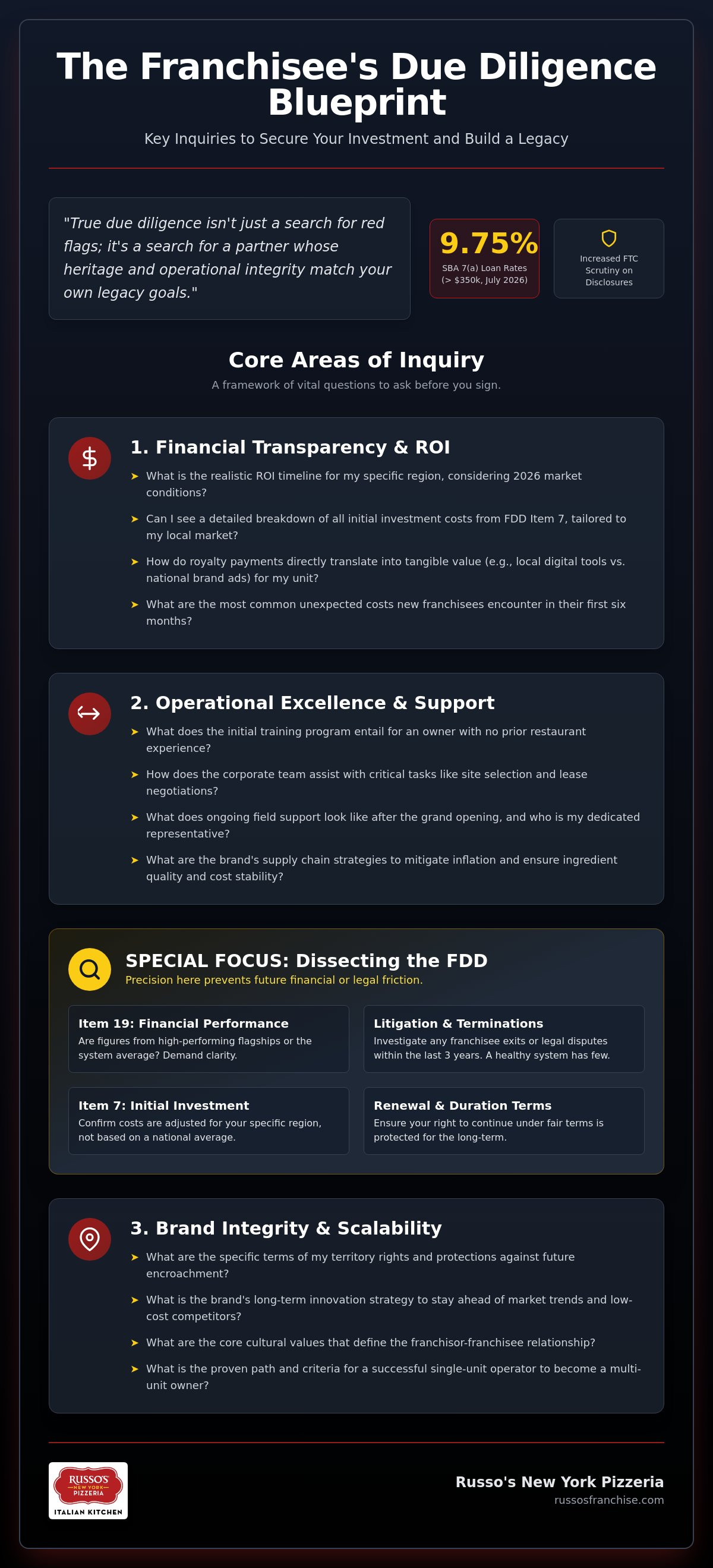
If you believe a standard due diligence checklist is enough to protect your family's financial future, you're missing the most critical part of the equation. True due diligence isn't just a search for red flags; it's a search for a partner whose heritage and operational integrity match your own legacy goals. With the FTC increasing scrutiny on disclosures and SBA 7(a) loan rates for larger loans reaching 9.75 percent as of July 2026, the stakes for your investment have never been higher.
It's natural to feel a sense of hesitation when facing complex contracts or worrying about territory encroachment. You want more than a business; you want a proven blueprint that offers genuine stability and a path to growth. This article will help you master the essential questions to ask a franchisor before signing so you can move forward with absolute confidence. We'll provide a framework of 21 vital inquiries that reveal the truth about ROI timelines, the actual depth of day-to-day support, and the long-term health of the brand you're choosing to represent.
Key Takeaways
- Evaluate the true financial health of a potential partnership by mastering the nuances of FDD Item 7 and regional ROI timelines.
- Secure your investment by knowing the exact questions to ask a franchisor before signing regarding site selection, supply chain stability, and ongoing operational support.
- Protect your future market share from encroachment and low-cost competitors by clarifying territory rights and the brand's innovation strategy.
- Align your entrepreneurial ambitions with a proven blueprint by vetting the franchisor's ten-year vision and core cultural values.
- Gain the clarity needed to transition from a single-unit operator to a multi-unit legacy builder through disciplined legal and operational due diligence.
Financial Transparency: Questions Regarding Initial Investment and ROI
Financial transparency forms the bedrock of any successful partnership. You aren't just buying a business; you're investing in a legacy. Before committing your capital, you must understand the movement of every dollar. What is the realistic timeline for reaching the break-even point in the current 2026 market? Markets evolve, and what worked in 2024 may not hold true today. Ask for a detailed breakdown of Item 7 in the FDD for your specific region. Real estate costs in Texas differ wildly from those in Maryland, and your projections should reflect that reality. With SBA 7(a) loan interest rates reaching 9.75 percent for loans over $350,000 in July 2026, every point of margin matters.
Understanding the concept of Franchising requires looking beyond the initial fee. You need to know how your ongoing royalty payments directly translate into marketing and operational value for your specific unit. Is that money fueling national brand awareness, or is it providing you with localized digital tools? Additionally, probe for the "hidden" hurdles. Ask about the typical unexpected costs franchisees encounter during their first six months. Whether it's local licensing delays or initial staffing surges, knowing these potential drains on your working capital is essential for maintaining stability.
Dissecting the Franchise Disclosure Document (FDD)
Precision is paramount when reviewing the FDD. These are the most critical questions to ask a franchisor before signing if you want to avoid future legal or financial friction. Request a deep dive into Item 19 financial performance representations to see if the numbers reflect high-performing flagship stores or the system average. Transparency here is a sign of a confident franchisor. You should also identify any litigation history or franchisee terminations within the last three years. A healthy system has few exits. Finally, clarify the duration and renewal terms. You're building a business for the next decade, so ensuring your right to continue under fair terms is non-negotiable.
Evaluating the Profitability Framework
Profitability in a pizza franchise comparison 2026 depends on more than just high sales volume. It's about margins. Inquire about average gross margins for premium Italian kitchen models, which often command higher price points than standard quick-service options. Discuss how 2026 inflation has impacted ingredient sourcing. A franchisor with a robust supply chain will have strategies to mitigate these costs, preserving your bottom line. When finalizing your list of questions to ask a franchisor before signing , ensure you ask how they help you manage labor costs through operational efficiency. Look for a partner who treats your profitability as their own success.
Operational Excellence: Evaluating Training, Supply Chain, and Support
Operational excellence represents the bridge between a visionary concept and a profitable reality. While a strong brand name gets customers through the door, it's the consistency of the experience that keeps them returning for generations. When you're refining your list of questions to ask a franchisor before signing , you must look beyond the glossy marketing materials and into the daily mechanics of the kitchen and the back office. A truly sophisticated partner doesn't just provide a manual; they provide a mentorship that transforms an entrepreneur into a refined operator. The Consumer's Guide to Buying a Franchise highlights that understanding these operational commitments is vital for long-term success.
Start by asking what the initial training program entails for owners with no prior restaurant experience. Transitioning from a corporate environment to a high-volume kitchen requires more than just learning recipes. It requires a deep dive into labor management, local marketing, and the nuances of the service industry. You should also inquire how the franchisor assists with site selection and lease negotiations. A prime location is the most stable foundation for your investment, and having an expert team analyze foot traffic and demographic data is a key advantage of the franchise model. Beyond the grand opening, verify what ongoing field support is available. You want the assurance that a dedicated representative will be there to help you navigate the complexities of the 2026 labor market and shifting consumer habits.
The Training and Onboarding Blueprint
Verify the length and location of the initial management training. Is it held at a corporate headquarters where you can witness the brand's heritage firsthand? You should also ask about the availability of on-site support teams during your opening week. Having seasoned professionals by your side as you serve your first customers provides a level of security that's invaluable. In the modern era, inquire about digital training platforms for hourly staff. These tools ensure that every team member, from the pizzaiolo to the server, understands the meticulous standards required to maintain a premium experience. If you're ready to explore these standards further, you can review our operational philosophy to see how we support our partners.
Supply Chain and Quality Control
Quality is a financial driver. Question the use of proprietary recipes versus third-party pre-made ingredients. A brand that relies on authentic, scratch-made methods often enjoys better vendor pricing and higher customer loyalty. Understand how the brand maintains "New York Style" authenticity globally, ensuring that a slice in Dubai tastes exactly like a slice in Manhattan. For those interested in specialized markets, discuss the logistics of sourcing for a halal pizza franchise. Maintaining these strict standards requires a disciplined supply chain and a deep commitment to cultural integrity. These are the questions to ask a franchisor before signing that reveal whether a brand is built for longevity or mere convenience.
Brand Integrity: Assessing Heritage, Market Trends, and Innovation
Brand integrity represents the invisible thread that connects a family's secret recipe to a global business empire. It's the soul of your investment. In a market saturated with generic, high-volume concepts, you must determine how a brand maintains its premium positioning. When refining your list of questions to ask a franchisor before signing , probe the brand's long-term vision, not just its current balance sheet. As highlighted in the Forbes guide to 10 Questions To Ask A Franchisor, understanding the core direction of the company is a prerequisite for any serious investor.
In 2026, the industry faces a significant crossroads regarding delivery and product accessibility. Many competitors have embraced third-party ghost kitchens or frozen retail products to chase short-term volume. These moves often cannibalize the sales of brick-and-mortar partners and dilute the premium experience that justifies higher price points. You should ask the franchisor for their definitive stance on these trends. A partner who prioritizes the integrity of the dine-in and authentic delivery experience over quick-fix licensing deals is one that values your unit's long-term profitability. Protecting family recipes and traditional methods in a high-tech kitchen environment is a delicate balance. It requires a disciplined approach to ensure that innovations planned for the 2026-2030 growth cycle enhance, rather than replace, the craftsmanship that built the brand's reputation.
Heritage vs. Corporate Standardization
Authenticity cannot be manufactured by a committee. Ask about the founder's ongoing involvement in the daily business. A brand rooted in personal passion is far more resilient than one governed solely by a revolving door of private equity executives. You want to evaluate the balance between traditional quality and modern operational speed. The italian kitchen franchise model succeeds because it refuses to compromise on the culinary experience while utilizing refined systems to ensure consistency. These are the questions to ask a franchisor before signing that reveal if the brand's heart is still in the kitchen.
Adapting to Global Culinary Trends
Resilience comes from the ability to evolve without losing your identity. Inquire about the flexibility of the menu for local market tastes and how the brand stays ahead of shifting dining habits. Understanding the certification process for specialized models, such as halal, is also vital for international or diverse domestic markets. This level of detail shows a franchisor's commitment to inclusivity and market reach. A brand that remains steady during economic shifts does so by offering a holistic experience that customers view as an essential luxury, not just a financial transaction.
Scalability and Legalities: Territory Rights and Multi-Unit Growth
Growth is the natural ambition of every disciplined entrepreneur. You don't just want a single successful unit; you want to build a regional or even global presence. This ambition requires a legal framework that protects your expansion as much as your initial investment. One of the most vital questions to ask a franchisor before signing is how they define and protect your territory. In an era where digital delivery and ghost kitchens are common, a simple radius on a map is no longer sufficient. You need to know what prevents encroachment from sister brands or corporate-owned delivery hubs that could siphon off your local customer base.
Transitioning from a single-unit operator to a multi-unit owner is a significant milestone. Multi-unit operators now control 58.8 percent of all franchised locations in the United States, despite making up less than 20 percent of total franchisees. This shift toward sophisticated, larger-scale operations means you must understand the specific requirements for scaling. Ask about the criteria for opening your second or third location. Is there a performance threshold you must meet, or a specific timeline you're committed to? For those with even bolder visions, the structure of an international master franchise agreement offers a path to scaling authentic heritage on a global stage, providing the rights to develop entire countries or regions.
Master Developer and Territory Rights
Clarify the "Right of First Refusal" for adjacent territories immediately. This right ensures that as you succeed, you have the first opportunity to capture neighboring markets before they're offered to others. You should also understand the development schedule required for master agreements. These schedules are often rigorous, requiring a steady cadence of store openings to maintain your exclusivity. Inquire about regional marketing fund contributions. You want to ensure that your advertising dollars are being used to build brand equity in your specific market, giving you a tangible return on your investment. If you're ready to build a lasting empire, explore our multi-unit development opportunities today.
Exit Strategies and Succession Planning
A business is truly an asset when it can be sold or passed down. This is where the emotional resonance of a family legacy meets hard-nosed business planning. Ask about transfer fees and the approval process for new buyers. You don't want to find yourself ready to retire only to be blocked by an overly restrictive transfer clause. Discuss the long-term vision for the brand's ownership. Is the franchisor committed to staying independent, or is a private equity buyout on the horizon? Finally, evaluate the support for multi-generational family business models. A franchisor who values legacy will have systems in place to help you transition the business to your children, ensuring that the excellence you've built continues for decades. These are the questions to ask a franchisor before signing that secure your family's future.
The Final Vetting: Cultural Alignment and Executive Vision
The final stage of your due diligence is perhaps the most revealing. It moves beyond the spreadsheets and maps into shared values and mutual respect. You are choosing a mentor as much as a business model. When finalizing your questions to ask a franchisor before signing , you must look for a partner whose vision for the next decade mirrors your own personal legacy goals. Ask yourself if this organization feels like a family you want to join. A brand's culture is its most resilient asset, and it's what sustains a community of owners through shifting economic cycles.
Transparency is the hallmark of a secure leader. Inquire about how the franchisor handles conflict or disagreements with owners. Disagreements are a natural part of growth, but the method of resolution defines the health of the system. Is there a collaborative franchise advisory council in place? These councils provide a vital voice for the operators, ensuring that the brand evolves with the input of those on the front lines. You should also seek to understand what the most successful franchisees have in common. Is it a specific operational focus, a commitment to local community, or a relentless pursuit of excellence?
Interviewing the Leadership Team
A sophisticated brand is led by people, not just policies. Request a meeting with the executive team or the founder if possible. This is your opportunity to ask about the brand's core values and, more importantly, how those values are enforced when challenges arise. Evaluate the responsiveness and professionalism of the corporate office during your interactions. Their behavior during the discovery phase is a direct preview of the support you'll receive as an owner. You want a team that is as disciplined in their leadership as they are passionate about their craft.
Connecting with the Franchisee Community
Peer perspective is the ultimate truth-teller. Don't rely solely on referral units provided by the sales team. Instead, select random names from the FDD list to contact directly. Ask your peers about the real ROI they've experienced versus the corporate projections provided in Item 19. These conversations reveal the day-to-day reality of the business and the actual level of support provided by the franchisor. As you explore pizza franchise opportunities, focus on the strength of the community. A brand that fosters a sense of pride and hospitality among its owners is one that is built to last. These final questions to ask a franchisor before signing will provide the peace of mind you need to secure your future.
Securing Your Legacy with Clarity and Confidence
Mastering your due diligence is the definitive step toward building a business that stands the test of time. By internalizing these questions to ask a franchisor before signing , you've moved beyond simple curiosity into the territory of a sophisticated investor. You now understand that true success requires a blend of financial transparency, operational discipline, and a deep alignment with a brand's heritage. Whether you're evaluating territory rights or vetting an executive team, your focus remains on protecting your investment and ensuring long-term growth.
Choosing a partner who values authenticity is essential in an evolving market. Since 1992, Chef Anthony Russo has led our organization with a commitment to traditional family recipes and a proven ROI across diverse international markets. Our global presence is built on the stability and quality that only a founder-led system can provide. If you're ready to combine your entrepreneurial ambition with a refined, time-tested blueprint, we invite you to take the next step. Begin your journey with a Russo’s New York Pizzeria franchise today. We look forward to helping you build a proud and profitable legacy.
Frequently Asked Questions
What is the most important question to ask a franchisor before signing?
The most critical question centers on the franchisor's long-term commitment to your unit's daily success. You must ask if they have a proven system for ongoing support that evolves with shifting market demands. This inquiry reveals the difference between a partner focused on selling licenses and a mentor dedicated to your profitability. It's one of the essential questions to ask a franchisor before signing to ensure your investment has the stability to become a multi-generational legacy.
How do I verify the financial claims made in the FDD Item 19?
Verification requires a dual approach of rigorous data analysis and direct peer validation. Start by asking the franchisor for the raw data used to calculate the averages presented in Item 19. Next, cross-reference these figures with current franchise owners who operate in markets similar to your own. These conversations often reveal the real world margins and expenses that averages might obscure, providing you with a more authentic picture of your potential return on investment.
Can I negotiate the terms of a franchise agreement in 2026?
Negotiation is often possible on specific operational riders or development schedules, even if the core agreement remains standardized. While most franchisors maintain strict consistency to protect brand integrity, they may be open to discussing territory definitions or the timing of multi-unit expansion. You should focus your efforts on terms that directly impact your ability to scale. Always involve a specialized franchise attorney to ensure any modifications are legally sound and beneficial to your long-term growth.
What are the red flags to look for when interviewing a franchisor?
High litigation rates or a pattern of franchisee terminations in the last three years are immediate warning signs. You should also be wary of a corporate team that provides vague answers about their supply chain or site selection process. A healthy franchisor is proud of their systems and will be transparent about their challenges. If the executive team feels more like high-pressure salespeople than seasoned mentors, it's a sign that their interests don't align with yours.
How much liquid capital do I really need beyond the franchise fee?
You should typically maintain enough liquid capital to cover six to twelve months of operating expenses. This reserve acts as a safety net during the initial ramp-up phase when revenue may be inconsistent. Many owners underestimate the costs of local marketing and initial staffing surges. Having this financial cushion ensures you can focus on maintaining the brand's meticulous standards without the stress of immediate cash flow pressure, protecting the integrity of your new business.
Should I talk to former franchisees as well as current ones?
Speaking with former franchisees provides an unfiltered look at why people leave the system. This is one of the most revealing questions to ask a franchisor before signing when you request their contact information. These individuals can offer insights into how the franchisor handles terminations, transfers, or business downturns. Their perspective helps you understand the brand's resilience and whether the support promised during the honeymoon phase remains consistent during more challenging periods.
What is the difference between a master franchise and a multi-unit agreement?
A multi-unit agreement involves your commitment to personally own and operate a specific number of locations within a set timeframe. In contrast, an international master franchise grants you the rights to act as a sub-franchisor for an entire region. In a master model, you take on the responsibility of recruiting and supporting other owners while sharing in their royalties. This distinction is vital for determining whether you want to be a hands-on operator or a regional developer.
How does a founder-led franchise differ from a private-equity-owned one?
Founder-led organizations typically prioritize culinary heritage and long-term brand integrity over short-term volume. These brands are often driven by a personal passion for the craft, which translates into more authentic support and a stable vision. Private equity owned brands may focus more on rapid expansion and cost cutting to prepare for an eventual exit. Choosing a founder-led model often provides a more hospitable and reliable partnership for entrepreneurs who are looking to build a lasting family legacy.