The most significant barrier between a premium investor and a legacy-defining opportunity isn't the capital requirement; it's the sheer weight of the legal paperwork. You're likely staring at a stack of over 200 pages, feeling the pressure of complex jargon and the fear of a hidden operational clause that could jeopardize your future. We know that understanding the franchise disclosure document (FDD) feels like deciphering a cryptic code when you'd rather focus on the artistry of the craft and the ambition of growth. It's a daunting task for any entrepreneur seeking a secure, time-tested path to success.
You deserve a transparent view into your potential partnership, free from the anxiety of overlooked fees or the weight of recent regulatory shifts. This guide provides a master framework for evaluating the 23 essential items of the FDD to ensure long-term viability in 2026. We'll reveal how to verify financial performance claims and assess the franchisor's stability with professional precision. You'll gain a precise roadmap for the 14-day disclosure period, ensuring your next move is backed by poise and absolute confidence in the heritage you're about to join.
Key Takeaways
- Master the art of understanding the franchise disclosure document (FDD) to decode the comprehensive DNA of your future business relationship and legal rights.
- Distinguish between initial franchise fees and ongoing operational costs in Items 5, 6, and 7 to ensure your capital is positioned for long-term stability.
- Analyze Items 19 and 20 to verify financial performance claims and assess the health of the franchise system through its unit census and turnover rates.
- Utilize the mandatory 14-day cooling-off period to review Item 8, ensuring you understand how strict product standards preserve the brand’s premium quality and heritage.
- Learn how FDD alignment empowers international master franchise partners to scale authentic Italian traditions while maintaining Chef Anthony Russo’s uncompromising standards.
The Anatomy of Transparency: What is the Franchise Disclosure Document?
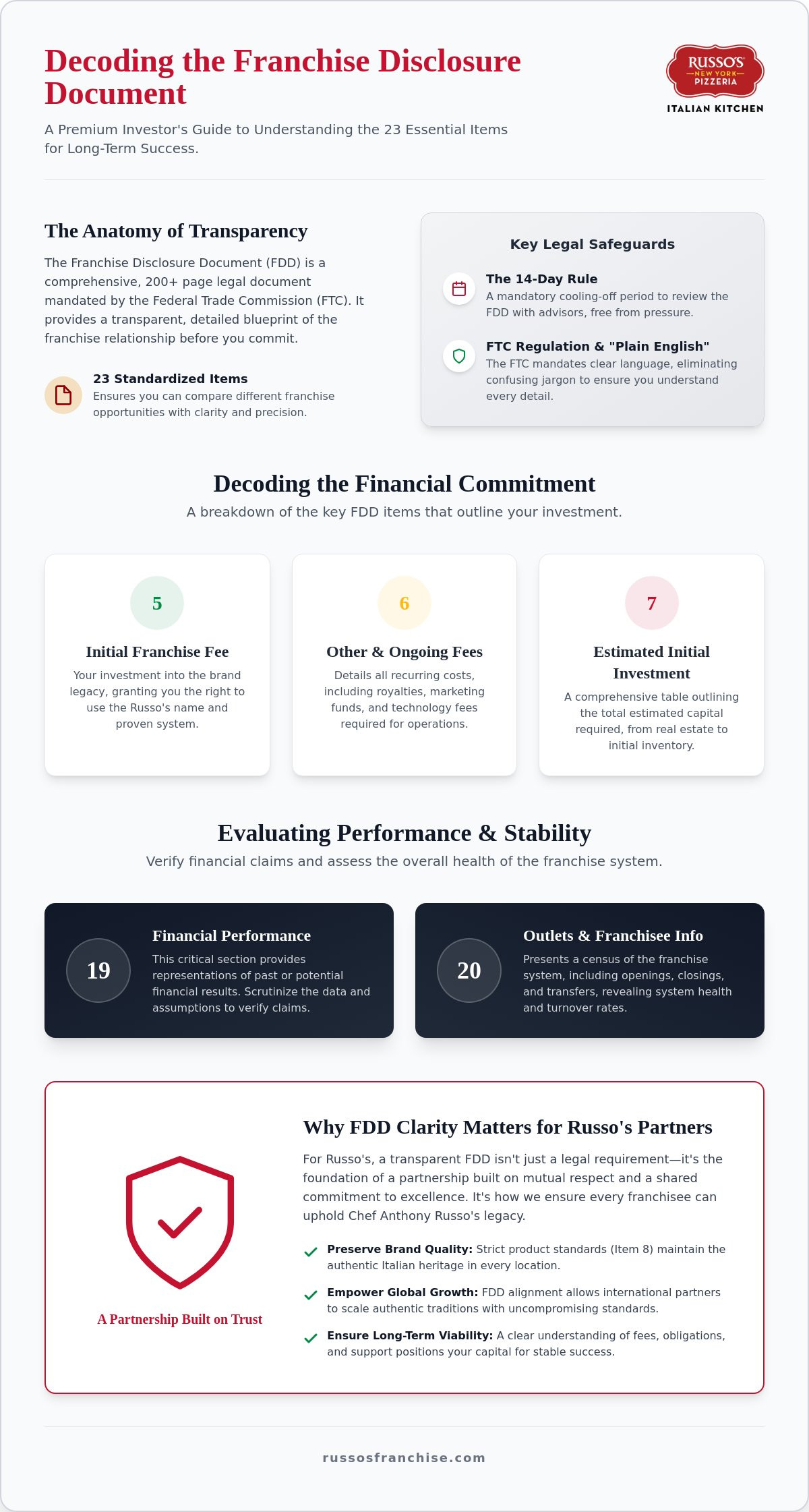
Integrity serves as the foundation of any enduring legacy. For an investor seeking to build a future upon a time-honored brand, understanding the franchise disclosure document (FDD) is the first step toward verifying that integrity. The FDD is a federally mandated document, strictly regulated by the Federal Trade Commission (FTC), that every franchisor must provide to a prospective partner at least 14 days before any contract is signed or any payment is made. This "14-day rule" acts as a protective buffer, allowing you the space to consult with advisors without the pressure of a closing clock.
The FDD is the comprehensive DNA of the business relationship between franchisor and franchisee. It isn't merely a collection of rules; it's a 23-item blueprint that details everything from the brand's litigation history to the granular specifics of your territory rights. By standardizing these 23 items, the FTC ensures a level playing field for due diligence, allowing you to compare different opportunities with clarity and precision. To ensure these details aren't lost in a sea of legalese, the FTC mandates a "plain English" requirement. This ensures you understand every operational nuance and financial obligation before committing your capital to a new venture.
You can find more detailed historical context and a breakdown of the 23 items in the Franchise Disclosure Document records, which highlight how this transparency has evolved to protect the modern entrepreneur.
The Legal Foundation: FTC Rule 436
The modern era of franchise transparency began in earnest with the 2007 FTC revisions. These updates modernized the disclosure process, requiring franchisors to be more explicit about financial performance and electronic delivery. While federal law provides a baseline, 13 specific "registration states," including California, New York, and Illinois, add an extra layer of scrutiny. In these jurisdictions, state regulators must review and approve the FDD before a franchise can even be offered for sale.
It's vital to distinguish between the FDD and the Franchise Agreement. While the FDD is a disclosure document intended to inform your decision, the Franchise Agreement is the actual contract that governs your daily operations once you join the system. One informs you of the risks and rewards; the other binds the partnership in law.
Why Premium Brands Prioritize FDD Clarity
For those exploring pizza franchise opportunities, a detailed FDD isn't a hurdle; it's a shield. At Russo’s, we believe that transparency is the first sign of a healthy, prosperous relationship. Our FDD reflects a deep commitment to Chef Anthony Russo’s original family recipes and exacting standards. It ensures that every partner, whether in Houston or Dubai, follows the same time-honored methods that have defined our brand for decades. When a franchisor is open about their fees, their supply chain, and their financial health, they aren't just following the law. They're inviting you into a culture of mutual respect and disciplined excellence.
Decoding the Financial Commitment: Items 5, 6, and 7
Financial transparency is the hallmark of a disciplined and successful organization. For the sophisticated investor, understanding the franchise disclosure document (FDD) requires a deep dive into the capital required to bring a heritage-driven vision to life. This clarity begins with Item 5, which outlines the initial franchise fee. This isn't just a cost of entry; it's your investment in a proven legacy and the right to utilize a brand name that has already earned the trust of the community. Item 6 continues this narrative by detailing ongoing obligations, such as royalties, technology fees, and marketing fund contributions. These requirements are strictly defined by the FTC's Franchise Rule to prevent any ambiguity in the financial relationship between you and the franchisor.
Item 7 presents a comprehensive table of the estimated initial investment, covering everything from leasehold improvements to your first order of authentic Italian ingredients. To avoid surprises, you must scrutinize the footnotes within this table. These small notes often contain critical details about local permitting, utility deposits, or specific equipment needs that vary by region. A thorough review here ensures that your capital is positioned for stability from day one. If you're ready to see how these numbers translate into a thriving location, you can explore our current opportunities to begin your journey.
Royalties and Marketing: Investing in Brand Equity
Royalties are the engine for franchise support and training. They fund the constant innovation and operational guidance that keep your kitchen running at peak efficiency according to time-honored standards. Marketing fees are typically split between national brand funds and local requirements. This dual approach protects your pizza franchise roi by ensuring both wide-scale brand recognition and consistent neighborhood-level traffic. It's a collective investment that maintains the brand's premium market positioning.
Item 7: Real Estate and Construction Nuances
The investment range in Item 7 is often wide because real estate costs fluctuate significantly between different markets. A high-traffic corner in a metropolitan center requires a different capital outlay than a boutique suburban storefront. Pay close attention to the "working capital" line, which typically covers your first three months of operation. This cash cushion is vital for maintaining meticulous standards while you build your local following. Whether you're considering a single unit or an expansive development, these numbers provide the professional roadmap for your growth and long-term viability.
Evaluating Performance and Stability: Item 19 and Item 20
Success leaves a trail of data. When you're understanding the franchise disclosure document (FDD) , the most revealing sections for your future prosperity are Item 19 and Item 20. While Item 19 offers a glimpse into the financial performance of existing units, Item 20 serves as the system’s census, documenting growth, closures, and the overall stability of the network. A transparent Item 19 is a hallmark of a confident, successful brand. At Russo's, we believe that sharing these figures isn't just about compliance; it's about proving the viability of Chef Anthony’s time-honored business model to our future partners. Consulting the FTC's Guide to Buying a Franchise provides additional context on how these figures should be interpreted during your deep dive.
Item 20 allows you to track the "churn rate" of the franchise system. You want to see a history of steady growth and high retention. If you notice a high number of closures or reacquired units in a single year, it serves as a significant red flag that warrants further investigation. This section provides the hard numbers you need to assess whether franchisees are staying in the system because they're thriving or leaving because the operational reality doesn't match the promise.
Analyzing Item 19: Beyond the Top Line
Gross sales numbers look impressive on a page, but a sophisticated investor looks for the net profit. Item 19 disclosures vary in detail, so it’s essential to distinguish between top-line revenue and the actual costs of labor, food, and rent. You should prioritize data from "representative" units that match your intended market’s demographics and size. Are these figures based on company-owned or franchised locations? This distinction is vital, as company-owned stores may operate under different cost structures than a typical franchise unit.
The Power of the Franchisee List in Item 20
Item 20 provides the contact information for current and former franchisees, offering you a direct line to real-world due diligence. These individuals are your best source of information regarding the daily reality of the italian kitchen franchise experience. Reach out to them to validate the level of support provided by the franchisor and the consistency of the supply chain. A healthy brand will encourage these conversations, confident that their partners will speak to the discipline, quality, and heritage that define the organization. Beware of systems where a large percentage of units have been transferred or terminated, as this often indicates underlying friction or financial instability.
Navigating Legal Safeguards: The 14-Day Rule and Obligations
Precision matters in any high-level investment. Success is often determined by what you do during the quiet moments of reflection, and the 14-day rule provides exactly that opportunity. This mandatory "cooling-off" period is designed to protect you from high-pressure sales tactics, ensuring you have the time to complete your due diligence without the rush of a closing deadline. During this window, understanding the franchise disclosure document (FDD) becomes an exercise in mapping your future responsibilities. Item 9 provides a vital cross-reference table that points exactly to where your duties are located within the actual contract. Meanwhile, Item 17 outlines your "exit strategy," detailing your rights regarding renewal, termination, and transfer. It's the pre-nuptial of business, ensuring you have a clear path for your investment’s entire lifecycle.
The 14-Day Due Diligence Checklist
- Step 1: Review the audited financial statements in Item 21 with a qualified CPA to confirm the franchisor's long-term stability.
- Step 2: Interview at least 3 to 5 current franchisees listed in Item 20 to validate the daily operational reality and support levels.
- Step 3: Map the territory rights found in Item 12 to ensure you have adequate market protection and a clear area for growth.
Understanding Sourcing Restrictions (Item 8)
Quality is never an accident. For a premium brand, Item 8 is where the commitment to heritage becomes legally binding. This section outlines restrictions on sources of products, explaining why a brand might mandate specific flour, cheese, or tomatoes. These requirements are critical for maintaining the uncompromising standards of a halal pizza franchise, ensuring that every location delivers the same authentic experience. While these restrictions might seem rigid, centralized sourcing often lowers your costs through bulk purchasing power while protecting the integrity of family recipes. Transparency is key here; you should evaluate the franchisor’s revenue from your purchases to ensure their interests remain aligned with your success. If you're ready to partner with a brand that values transparency and quality above all else, view our detailed franchise disclosure information today.
Beyond the Paperwork: Why FDD Alignment Matters for Russo’s Partners
A legal document is only as strong as the values it protects. For those who prioritize quality and tradition, understanding the franchise disclosure document (FDD) is the definitive way to see Chef Anthony Russo’s standards in writing. Our FDD is not just a regulatory requirement; it is a formal pledge to uphold the original family recipes and time-honored methods that have defined our brand for decades. It ensures that every partner who joins our family is equipped with the same blueprint for excellence that has sustained our growth across the globe. This alignment is what transforms a simple contract into a successful, heritage-driven partnership.
We take specific measures to protect the value of your investment. We explicitly exclude ghost kitchens and third-party frozen retail licensing from our business model. This strategic decision ensures that the Russo’s New York Pizzeria name remains synonymous with a premium, dine-in experience. By focusing on the integrity of the brick-and-mortar location, we prevent the brand dilution that often comes with mass-market retail or hidden kitchen operations. A thorough review of these exclusions in the FDD reveals our unwavering commitment to the long-term success of our physical storefronts.
Master Franchise and Multi-Unit Nuances
The complexity of the FDD shifts when you transition from evaluating a single unit to regional development rights. For developers pursuing an international master franchise, the document provides the structure necessary to scale authentic heritage across borders. It details how regional rights are managed and how our rigorous standards are maintained in diverse markets. This is particularly vital for halal franchise investment compliance, where global certification and supply chain transparency are non-negotiable. Russo’s provides the granular data you need to make a sophisticated investment decision, ensuring your multi-unit expansion is built on a stable and transparent foundation.
Your Next Steps in the Discovery Process
The journey toward ownership begins with a request for the current Russo’s New York Pizzeria FDD. Once you have the document, we encourage you to review it with your legal and financial advisors to fully grasp the depth of the opportunity. This initial review is the precursor to your "Discovery Day," where you will meet our team and experience the artistry of our kitchen firsthand. We believe that transparency at this stage is the first step toward a prosperous and reliable relationship. Start your journey by reviewing our franchise opportunities today.
Securing Your Legacy Through Informed Partnership
Mastering the 23 standardized items isn't just about legal compliance; it's about verifying the strength of your future partnership. By scrutinizing financial performance representations and operational safeguards, you transform a complex document into a strategic advantage. You've learned how to decode the initial investment and how to use the mandatory cooling-off period to validate the brand’s stability. understanding the franchise disclosure document (FDD) is your final step of due diligence before stepping into a kitchen built on authenticity and disciplined growth.
Russo's New York Pizzeria has been founder-led by Chef Anthony Russo since 1992, offering a proven blueprint for multi-unit and international master franchise success. Our transparent Item 19 and rigorous financial reporting reflect a commitment to stability that has defined our family for over three decades. If you're ready to align your ambition with a brand that values heritage as much as profitability, Download the Russo's Franchise Opportunity Guide to explore our current opportunities. The path to a prestigious investment is clear, and we're honored to guide you toward your next great achievement.
Frequently Asked Questions
Is the Franchise Disclosure Document the same as the Franchise Agreement?
No, these documents serve distinct purposes in your investment journey. The FDD is a comprehensive disclosure intended to inform your due diligence, providing 23 items of historical and operational context. The Franchise Agreement is the actual legally binding contract that governs your daily operations once you join the system. You'll find the Franchise Agreement included as an exhibit within the FDD, but it's the latter that helps you decide whether to sign.
What happens if a franchisor doesn't provide an Item 19?
Providing an Item 19 is optional under federal law. If a franchisor chooses to omit this section, they're legally prohibited from making any verbal or written financial performance representations. While some emerging brands lack sufficient data, a premium, established brand like Russo's prioritizes transparency. A missing Item 19 simply means you must rely more heavily on your own market research and conversations with current franchisees to gauge potential returns.
Can I negotiate the terms found in the FDD?
You generally don't negotiate the FDD because it's a historical disclosure of facts and data. However, the terms of the Franchise Agreement can sometimes be adjusted, particularly for multi-unit developers or international master franchise partners. Most premium brands maintain strict standards to ensure system-wide consistency and quality. Significant deviations are rare because they can undermine the time-honored methods that make the brand successful for all partners involved.
How often is a franchisor required to update their FDD?
Franchisors must update their FDD annually within 120 days of their fiscal year end. They're also required to provide quarterly updates if material changes occur, such as significant litigation or changes in ownership. This ensures that when you're understanding the franchise disclosure document (FDD) , you're reviewing the most current data available. Always check the issuance date on the cover page to confirm the document's relevance before making a decision.
What is the most important section of the FDD for a first-time buyer?
While all 23 items are essential, first-time buyers should focus intensely on Items 7, 19, and 20. Item 7 provides the total investment breakdown, Item 19 offers the financial performance data, and Item 20 lists the contact information for current partners. These sections collectively reveal the capital required, the potential rewards, and the real-world experiences of those already following the brand's path. They're the cornerstone of a disciplined due diligence process.
Do I need a lawyer to review the FDD?
Yes, engaging a specialized franchise attorney is a vital step for any sophisticated investor. General business lawyers may overlook nuances specific to FTC regulations or territory protections. A professional review ensures you fully grasp your obligations and the long-term implications of the contract. This isn't just about legal safety; it's about entering a partnership with the confidence that every clause aligns with your ambitious growth goals and heritage-driven values.
What are 'registration states' and how do they affect my FDD review?
Registration states, such as California, New York, and Illinois, require franchisors to register their FDD with state regulators before offering opportunities. These states provide an additional layer of scrutiny, often requiring more detailed disclosures than federal law alone. If you're understanding the franchise disclosure document (FDD) in one of these jurisdictions, you can feel an extra sense of security knowing that state officials have already reviewed the document for compliance and transparency.
How can I verify the information provided in Item 20?
The most effective way to verify Item 20 is to call the current and former franchisees listed in the document. Prepare a disciplined list of questions regarding the franchisor's support, the consistency of the supply chain, and their actual financial outcomes. Most partners in a heritage-driven system are proud of their craft and will speak honestly about their journey. These conversations transform dry data into a vivid, reliable picture of your potential future.