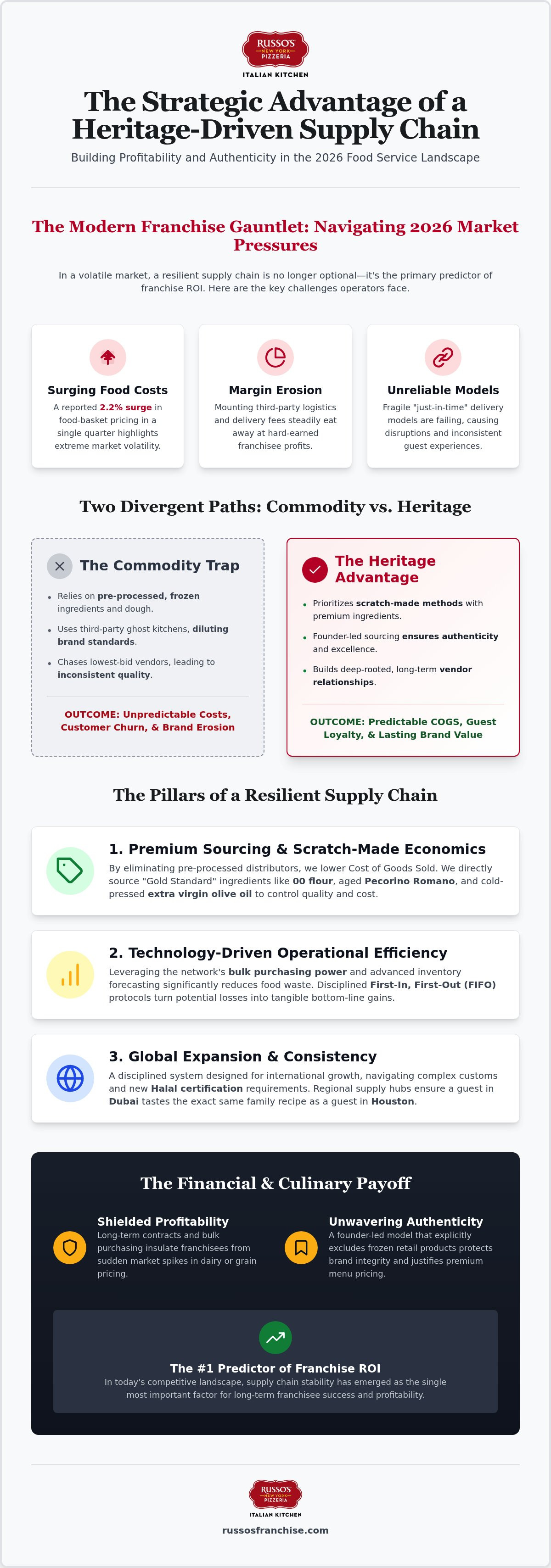
When industry leaders report a 2.2% surge in food-basket pricing within a single quarter of 2026, the era of mass-produced, "cheap and fast" pizza faces a stark reckoning. You've likely felt the mounting pressure of rising costs for premium flour and imported cheeses, watching as third-party logistics fees slowly erode your hard-earned margins. It's a difficult balance to maintain. Every dedicated operator understands that consistency is the bedrock of guest trust, yet global disruptions make that stability feel increasingly fragile. A resilient pizza franchise supply chain isn't just a back-office function; it's the strategic foundation of a profitable, authentic brand.
We promise to show you how a premium, heritage-driven supply model secures your profitability and preserves your authentic culinary standards. You'll learn how to achieve a predictable cost-of-goods-sold (COGS) model that doesn't compromise on the scratch-made quality your guests expect. This guide previews the systems that allow for seamless international growth. We'll explore everything from navigating new 2026 Halal certification deadlines to establishing regional hubs that bring the time-honored taste of Italy to a global audience.
Key Takeaways
- Understand why supply chain stability serves as the primary predictor for franchise ROI in the competitive 2026 landscape.
- Learn how a premium pizza franchise supply chain lowers your cost of goods sold by prioritizing scratch-made methods over expensive pre-processed distributors.
- Protect your margins from third-party delivery fee spikes by utilizing real-time inventory data and optimized logistics.
- Navigate international customs and Halal certification requirements to establish successful regional supply hubs for global expansion.
- Discover the financial and culinary advantages of a founder-led model that explicitly excludes frozen retail products to maintain authenticity.
The Strategic Role of the Pizza Franchise Supply Chain in 2026
In the high-stakes restaurant environment of 2026, a pizza franchise supply chain is no longer just a series of back-office transactions. It's the lifeblood of the entire operation. We define this modern food supply chain as a seamless, disciplined journey from the sun-drenched fields of Italy directly to the intense heat of a brick oven. This journey ensures that every sprig of fresh basil and every barrel of extra virgin olive oil arrives with its culinary soul intact. For the sophisticated investor, supply chain stability has emerged as the single most important predictor of long-term ROI. It provides a vital shield against the volatility of global markets and the unpredictability of local logistics disruptions.
The industry is moving away from the fragile "just-in-time" delivery models that crumbled during previous global shocks. Instead, we see a decisive pivot toward resilient sourcing. This shift prioritizes redundancy and deep-rooted vendor relationships over the pursuit of the lowest possible bid. A unified system protects the authentic Italian food franchise experience by ensuring that a guest in Dubai tastes the exact same family recipe as a guest in Houston. Consistency isn't an accident; it's the engineered outcome of a highly disciplined logistics network that values heritage as much as efficiency.
Supply Chain as a Profitability Driver
Precision matters in a thin-margin industry. Advanced inventory forecasting allows operators to significantly reduce food waste, turning potential losses into tangible bottom-line gains. By leveraging the collective bulk purchasing power of a global network, a franchise can secure premium ingredients like 00 flour and authentic Pecorino Romano at rates independent pizzerias simply cannot match. A franchisor-managed supply chain stabilizes cost-of-goods-sold by negotiating long-term contracts that insulate the individual investor from sudden market spikes in dairy or grain pricing.
The Heritage vs. Commodity Logistics Debate
The market is speaking clearly through consumer choices. Diners are increasingly rejecting "cheap and fast" commodity models in favor of genuine quality. Frozen dough concepts are losing market share because they lack the complex flavor profile and airy texture of traditional, scratch-made methods. We maintain brand integrity by strictly avoiding third-party ghost kitchen licensing, which often dilutes the guest experience and compromises ingredient standards. Founder-led sourcing ensures that every product meets a standard of excellence established over decades. It's about choosing the difficult right over the easy wrong to ensure a pizza franchise supply chain remains a mark of prestige and reliability.
Premium Sourcing: The Economics of Quality Ingredients
True profitability begins with the uncompromising selection of raw materials. In a refined pizza franchise supply chain , we prioritize the "Gold Standard" of ingredients: finely milled 00 flour, aged Pecorino Romano, and cold-pressed extra virgin olive oil. While commodity competitors might view these as luxury expenses, we recognize them as essential investments in brand longevity. By choosing scratch-made dough over pre-processed, frozen alternatives, you eliminate the high markups charged by industrial distributors. This approach requires more culinary skill, but it significantly reduces your reliance on external middle-men, keeping more profit within your four walls.
We balance the necessity of authentic Italian imports with the vibrancy of local produce. This duality ensures that while the soul of the recipe remains New York-authentic, the vegetables and proteins are as fresh as the morning market. Maintaining this standard requires a disciplined First-In, First-Out (FIFO) rule. Proper inventory rotation prevents the waste that often plagues less organized kitchens, ensuring every dollar spent on premium stock returns its full value. If you're ready to see how these standards translate into a scalable business, you might explore our current franchise opportunities.
The Cost of "Cheap" Ingredients
Choosing low-grade ingredients is a short-term gamble with long-term consequences. Inconsistent quality leads to customer churn, a hidden cost that far outweighs the pennies saved on cheaper cheese. Premium Italian kitchens consistently command higher ticket averages than value-driven pizzerias because guests are willing to pay for a superior sensory experience. If you are evaluating how these standards impact your bottom line, consider reviewing The Italian Kitchen Franchise Buying Guide. Excellence is a choice that pays dividends through guest loyalty and brand prestige.
Supply Chain Transparency and Consumer Trust
The 2026 consumer is more informed than ever before. They demand "clean labels" and verifiable origins for their food. Global logistics networks now allow us to trace a family recipe back to its source, providing a level of transparency that builds profound trust. A sophisticated pizza franchise supply chain leverages these narratives to justify premium pricing, turning transparency into a competitive advantage. When guests know their tomatoes were grown in San Marzano and their dough was hand-kneaded this morning, they become loyal brand advocates. This level of dedication is what separates a legacy brand from a mere transaction.
Operational Efficiency: Technology and Logistics
Efficiency isn't just a buzzword; it's the invisible hand that keeps a kitchen humming during the peak rush. A sophisticated pizza franchise supply chain integrates real-time inventory tracking to eliminate the dreaded "Friday night shortage." There's nothing more damaging to guest trust than running out of a signature ingredient mid-shift. By utilizing smart data, operators can see exactly what's on their shelves and what needs to be ordered before a crisis occurs. This level of foresight allows you to focus on the dining room rather than the stockroom.
Maintaining the cold chain is equally vital. Freshness shouldn't be compromised between the distribution center and the kitchen. We ensure that temperature-sensitive imports, like our premium cheeses, are monitored every mile of the journey. This meticulous oversight preserves the integrity of the product and reduces the likelihood of spoiled inventory. It's a disciplined approach that respects both the ingredient and the investment. When the product arrives in pristine condition, the kitchen staff can execute the menu with total confidence.
Protecting your margins also requires a strategic look at the delivery mix. High third-party fees can quickly eat into the profits of a premium pizza. We help operators optimize their own delivery systems while using third-party platforms as a discovery tool, not a crutch. This balance ensures that the convenience of modern dining doesn't come at the expense of your bottom line. Additionally, training staff on strict supply chain protocols helps minimize kitchen waste. When every team member understands the value of the ingredients they handle, the entire operation becomes more sustainable.
Tech-Enabled Procurement
Modern systems have replaced the era of manual clipboards and guesswork. Automated ordering platforms now learn from seasonal trends, adjusting for the surge in holiday orders or the dip during local school breaks. Centralized portals reduce administrative labor, allowing you to focus on the hospitality and craft that define your brand. POS data serves as the predictive engine that transforms historical sales figures into precise future procurement orders.
Distribution Networks and Multi-Unit Scaling
Scaling your business requires a logistical blueprint that grows with you. Those pursuing multi-unit franchise opportunities benefit immensely from established regional distribution hubs. These hubs act as the anchor for your growth, ensuring that your fifth or tenth location receives the same high-quality support as your first. Regional master developers play a crucial role here, providing the local oversight needed to manage a complex pizza franchise supply chain without friction. It's a scalable system designed for ambitious, multi-unit growth.
Global Expansion: Halal and International Logistics
Scaling a premium brand across international borders requires a logistical blueprint that is as disciplined as it is ambitious. When a pizza franchise supply chain moves into high-growth markets like the Middle East or Southeast Asia, the complexity of customs and local regulations increases significantly. Success depends on establishing regional supply hubs that mirror the efficiency of our domestic operations. These hubs ensure that even in a bustling city thousands of miles from New York, the core brand DNA remains untouched. We help our partners navigate the intricate web of international import laws to ensure that authentic Italian ingredients arrive without delay or compromise.
The global pizza foodservice market is projected to reach US$173.2 billion in 2026, with much of that growth occurring in regions that demand specialized standards. Maintaining consistency in these diverse environments requires a delicate balance. While we adapt certain menu elements to respect local palates, the foundation of every pizza remains our time-honored family recipe. This commitment to quality ensures that the guest experience is identical, whether they are dining in Riyadh, Jakarta, or Houston. If you are ready to lead a territory, you should learn more about our international master franchise opportunities.
The Halal Pizza Supply Chain
Integrity is the cornerstone of our Halal offerings. With the global Halal economy projected to reach $3.4 trillion by the end of 2026, and mandatory certification deadlines approaching in markets like Indonesia by October 17, 2026, we have perfected a compliant pizza franchise supply chain . We maintain strict Halal certification from the initial supplier selection down to the final slice served. This involves sourcing premium, Halal-certified proteins that meet our rigorous New York standards for flavor and texture. For a deeper look at these specialized operations, consult our Halal Pizza Franchise Buying Guide.
Master Developer Logistical Responsibilities
Master Developers act as the regional stewards of our heritage. They carry the financial and operational responsibility for establishing sub-franchising networks and regional distribution. We support our international master franchise partners by vetting local suppliers to ensure they meet our "Anthony Russo" standard of excellence. This structure creates a compounding revenue model where the Master Developer benefits from both their own units and the growth of their sub-franchisees. It is a sophisticated partnership built on transparency, stability, and a shared passion for authentic Italian craft.
The Russo’s Advantage: A Supply Chain Built on Heritage
The Russo's advantage is rooted in a philosophy that views the supply chain as a guardian of heritage rather than a mere logistical necessity. Chef Anthony Russo maintains direct oversight of ingredient quality, ensuring that every distributor meets the exacting standards established in 1992. This isn't a restrictive corporate mandate designed to pad the franchisor's bottom line. It's a protective measure for your investment. While some competitors prioritize vertical integration to maximize their own profits by selling ingredients back to their partners, we focus on a pizza franchise supply chain that empowers the individual operator through uncompromising excellence.
We say a firm "no" to frozen products. This decision is central to protecting the premium pizza franchise ROI. Frozen dough and pre-made sauces might offer short-term convenience, but they erode the distinctiveness that allows a brand to command higher ticket averages. By sticking to scratch-made integrity, we ensure your kitchen remains a place of genuine craft. This dedication translates into a product that guests cannot find at a value-driven chain, fostering the kind of loyalty that drives long-term profitability. Guests recognize the difference that fresh, hand-stretched dough makes, and they vote for it with their repeat business.
A premium supply chain is only as effective as the hands that use it. We provide comprehensive training on authentic Italian kitchen operations, teaching your team the nuances of dough fermentation and sauce preparation. When you join our network, you aren't just signing a vendor agreement; you're joining a family. Our partnership model is built on mutual success, where the franchisor acts as a seasoned mentor who has already navigated the complexities of global logistics. You receive a proven blueprint that balances the heart of a family kitchen with the discipline of a sophisticated business.
Unwavering Quality in a Volatile Market
In a volatile 2026 market where food-basket pricing has seen recent increases of 2.2% for some major chains, our model resists the "commodity trap." We don't chase the lowest price at the expense of our culinary soul. Instead, we provide founder-led support to every single and multi-unit investor, helping them maintain their standards even when the global market fluctuates. This stability is what makes our model a safe and exciting opportunity for those who value excellence over convenience. If you're ready to invest in a brand that refuses to compromise, it's time to explore Russo's franchise opportunities and see how our heritage can become your legacy.
Master Your Future with a Proven Supply Chain
Success in the 2026 restaurant landscape demands more than just a great recipe. It requires a sophisticated logistics network that can weather global volatility while delivering uncompromising quality. We've explored how a resilient pizza franchise supply chain serves as the ultimate safeguard for your margins and your brand's authenticity. By prioritizing scratch-made integrity over the convenience of frozen commodities, you position your business as a premium destination in a crowded market. Whether you're opening a single unit or leading an international territory, the foundation remains the same: quality ingredients and disciplined operations.
Since 1992, Chef Anthony Russo has led our network with a commitment to fresh, authentic Italian kitchen standards. Our global distribution capabilities are specifically designed to support diverse needs, from Halal-certified requirements to the complex logistics of an International Master Franchise. You aren't just investing in a business; you're joining a family that has already perfected the path to success. We invite you to Request the Russo’s Franchise Supply Chain Overview to see how our heritage can fuel your growth. Your journey toward a profitable, authentic legacy starts here.
Frequently Asked Questions
How does a pizza franchise supply chain impact my daily operations?
A robust pizza franchise supply chain streamlines your daily workflow by providing predictable delivery schedules and pre-negotiated pricing. This system removes the burden of finding and vetting multiple vendors, allowing you to focus on guest hospitality and kitchen execution. You'll spend less time managing invoices and more time ensuring every pizza meets our high standards. It's a disciplined approach that turns complex logistics into a simple, repeatable process.
Can I source my own ingredients in a Russo’s New York Pizzeria franchise?
To maintain the integrity of our family recipes, franchisees must use our network of approved vendors for core ingredients. This ensures that every location serves the same premium 00 flour and aged Pecorino Romano that defines the Russo’s brand. We permit local sourcing only for specific fresh produce items that meet our rigorous quality benchmarks. This consistency is what protects the brand's reputation and your individual investment.
What are the biggest supply chain challenges for pizzerias in 2026?
The primary hurdles in 2026 include rising food-basket pricing and the need for stricter certification compliance in global markets. With industry data showing a 2.2% increase in food costs for major chains, maintaining a stable COGS requires a resilient logistics model. Operators also face the challenge of navigating new international regulations, such as the mandatory Halal certification deadlines in Indonesia by October 17, 2026.
How does Russo’s ensure ingredient quality for international locations?
We utilize a network of regional supply hubs and dedicated master developers to oversee quality control across international borders. Key Italian imports are shipped directly to these hubs to ensure every location has access to authentic ingredients. This structure allows us to scale globally without diluting the culinary standards established by Chef Anthony Russo. It's a sophisticated system designed to bring the taste of Naples to any corner of the world.
What is the difference between a commodity and a premium supply chain?
A commodity supply chain focuses on the lowest possible cost, often relying on frozen dough and pre-processed toppings. In contrast, a premium supply chain prioritizes scratch-made integrity and authentic imports like extra virgin olive oil. This investment in quality supports higher ticket averages and deeper guest loyalty, which ultimately protects your long-term ROI. Choosing quality over convenience is the hallmark of a legacy-driven brand.
How does a Halal pizza franchise manage its suppliers?
Managing a Halal pizza franchise requires a disciplined approach to supplier verification to ensure every ingredient is fully compliant. We vet our protein suppliers through rigorous certification processes and maintain transparent tracking from the source to the kitchen. This meticulous oversight ensures that our Halal offerings meet both religious standards and our own premium culinary expectations. We treat certification as a benchmark of purity and quality assurance.
What role does technology play in your supply chain management?
Technology serves as the predictive engine of our logistics, using POS data to automate inventory forecasting and prevent shortages. Smart systems learn your store's specific sales patterns, adjusting orders for seasonal peaks or local events. This tech-enabled approach reduces human error and ensures that your kitchen always has the fresh ingredients it needs to succeed. It's about using modern tools to protect a traditional craft.
How long does it take to set up the supply chain for a new franchise location?
Setting up the supply chain for a new location typically occurs during the site construction and training phase, which spans several months. We work closely with you to onboard regional distributors and establish delivery schedules well before your grand opening. This ensures a seamless transition so your team is ready to serve the community from day one. Our goal is to have every logistical detail perfected before the first oven is turned on.