In a 2026 market valued at $49.5 billion, the greatest risk to your capital isn't a lack of demand. It's the invisible weight of a brand that has traded its heritage for the hollow promise of convenience. You likely recognize that while the pizza industry is thriving, the landscape is increasingly cluttered with "ghost kitchens" and frozen concepts that feel more like logistics hubs than authentic kitchens. It's natural to feel overwhelmed by the common mistakes when buying a pizza franchise, from the complexity of a modern Franchise Disclosure Document to the fear of sinking your life savings into a model that lacks long-term market relevance.
This guide will identify the critical financial, legal, and operational traps that cause many new ventures to stall before they truly begin. We will examine how to navigate hidden costs that can add $80,000 to your initial investment. We also explore why a commitment to traditional craftsmanship and physical storefronts consistently outperforms the digital-only trend. You'll gain a clear, disciplined blueprint for building a profitable business that reflects your own ambition for excellence and your desire for a legacy that stands the test of time.
Key Takeaways
- Master the 2026 financial landscape by identifying hidden costs and meticulously vetting the Franchise Disclosure Document to protect your initial capital.
- Avoid the common mistakes when buying a pizza franchise by choosing a brand that prioritizes authentic, scratch-made quality over the "commodity" fast-food model.
- Recognize why physical, open-kitchen storefronts are essential for building consumer trust and why ghost kitchen models often fail to sustain long-term brand equity.
- Learn how to leverage international master franchise opportunities to achieve scalable growth while ensuring your business remains relevant to local market demographics.
- Discover how a time-tested, founder-led operational blueprint can guide you toward a profitable enterprise, even if you have no previous restaurant industry experience.
The High Cost of Haste: Why Most Pizza Franchisees Fail in Their First Year
Speed is often the enemy of stability. Many investors rush into agreements without realizing that the 2026 market demands more than just a quick delivery radius. Premium Italian dining is currently outperforming standard fast-food pizza. This shift occurs because modern consumers prioritize the experience and the quality of the meal over the mere transaction. One of the most common mistakes when buying a pizza franchise is failing to distinguish between a temporary trend and a brand with a 30 year track record. Concepts that lack history struggle when the market shifts. A foundation built on decades of success provides a proven blueprint for growth.
Don't fall into the psychological trap of buying a job instead of building an enterprise. If you approach your investment as a way to secure a daily shift, the operational intensity will lead to rapid burnout. Success requires a passion for the product that goes beyond the spreadsheet. To scale effectively, you must master the franchising business model as a leadership platform. It's about creating a scalable entity that works for you, rather than you working for it. Without this mindset, the daily grind of dough preparation and staff management will eventually erode your initial ambition.
The 'Easy Entry' Delusion
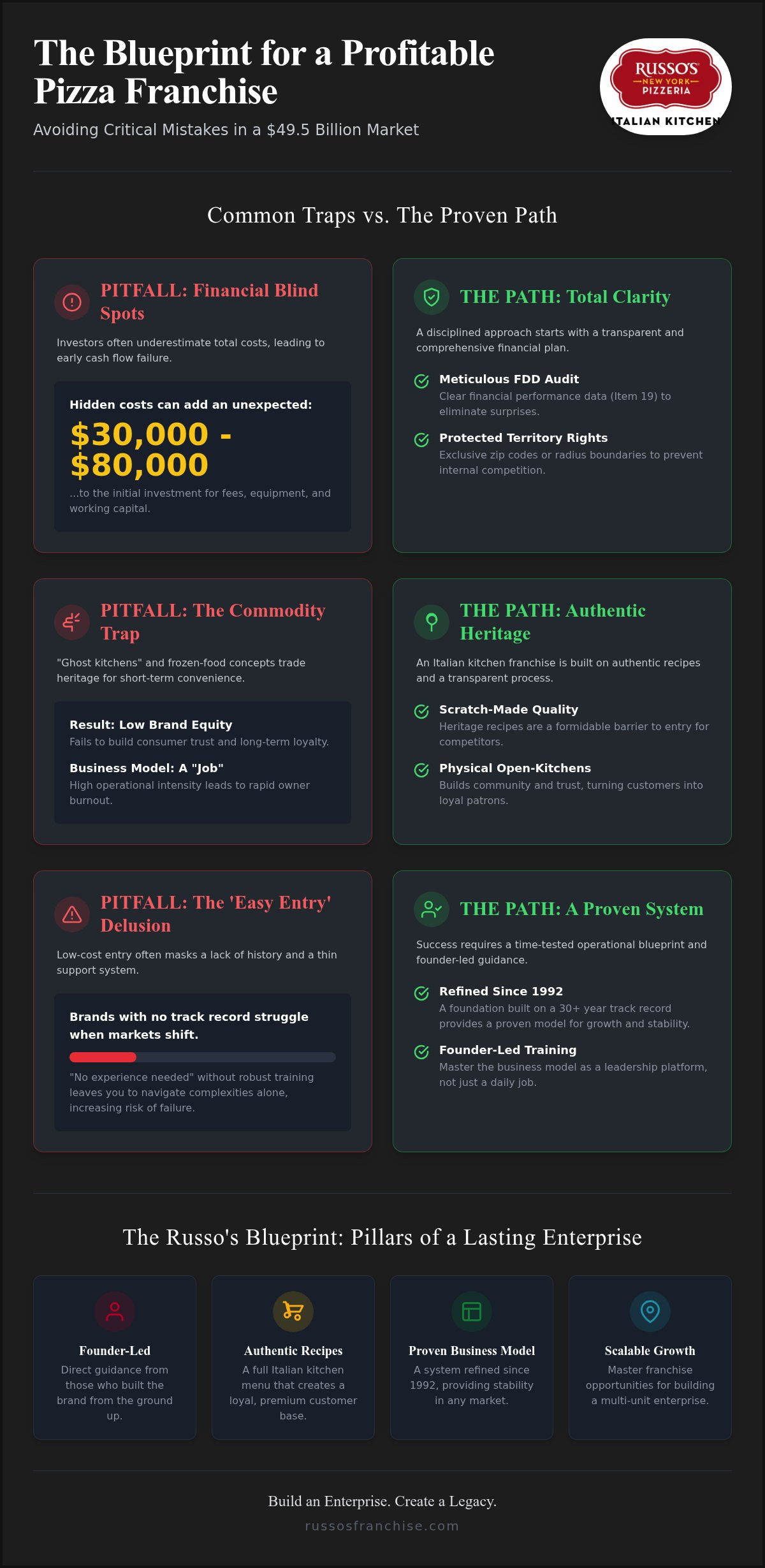
Low-cost entry points often mask massive operational inefficiencies. These hidden costs drain your profits over time. A brand that claims no experience is needed without providing robust, founder-led training is essentially leaving you to navigate the complexities of the industry alone. True stability comes from a system that has been refined since 1992. This ensures that every operational detail has already been tested and perfected by those who built the brand from the ground up. If the entry seems too easy, it's likely because the support system is dangerously thin.
Ignoring the Heritage Factor
There's a profound difference between a simple pizza shop and an Italian kitchen franchise that offers a full range of authentic recipes. Consumer loyalty in 2026 is driven by authenticity and transparent ingredient sourcing. It's not just about speed. Heritage recipes act as a formidable barrier to entry, preventing competitors from duplicating the unique flavor profile and cultural resonance of your brand. When you invest in a legacy, you aren't just selling food; you're inviting the community into a story that began decades ago in a family kitchen.
Financial and Legal Blind Spots in the Franchise Agreement
Financial clarity is the bedrock of any successful enterprise. One of the most common mistakes when buying a pizza franchise involves a shallow reading of the initial costs. Many investors focus solely on the entry fee, ignoring the total investment required to open and sustain a location. Beyond the build-out, you must account for grand opening fees, POS systems, and specialized equipment. Industry data suggests that hidden costs often add $30,000 to $80,000 to the published range. Failing to secure enough working capital for the first six to twelve months is a frequent cause of early failure. You need a cash reserve to cover labor and occupancy costs while the business builds its local presence.
Ignoring territory rights is another legal pitfall that can kill your profitability. If your agreement doesn't include clear protection against encroachment, the franchisor could theoretically open another unit in your immediate neighborhood. This dilutes your market share and forces you to compete against your own brand. A disciplined investor ensures that their territory is exclusive and clearly defined by zip codes or radius boundaries. This protection provides the security needed to invest in local marketing without the fear of internal competition.
The FDD Deep Dive: What Your Lawyer Must Check
A professional investor never signs an agreement without a meticulous audit of the Franchise Disclosure Document. This document is regulated by the FTC's Franchise Rule, ensuring transparency between the franchisor and the partner. Your legal counsel should focus on Item 19, which outlines financial performance representations. If a brand refuses to provide these figures, it's a significant red flag. Pay close attention to sourcing restrictions. Mandatory vendors can inflate your food costs, shrinking your margins before you even sell a slice. Ensure your renewal terms are favorable to protect your long-term equity and capital investment.
Capitalization vs. Over-Leveraging
The structure of your financing determines your ultimate stability. While debt is a common tool, 100% debt-financed acquisitions are dangerously fragile. A healthy equity-to-debt ratio ensures you can weather seasonal fluctuations or unexpected market shifts. Your pizza franchise ROI depends on keeping interest payments manageable. High-leverage models often force owners to cut corners on ingredient quality or staffing, which erodes the customer experience. Securing a future in this industry requires a partner that values transparency and operational stability. If you are looking for a brand with a proven financial blueprint, explore how a pizza franchise opportunity with a legacy of excellence can anchor your investment.
The Commodity Trap: Sacrificing Quality for Convenience
In the rush to maximize efficiency, many investors fall into a dangerous commodity trap. They mistake speed for sustainability. One of the most common mistakes when buying a pizza franchise is prioritizing low-cost convenience over the very quality that builds customer loyalty. When you treat pizza as a mere logistics challenge rather than a culinary craft, you enter a race to the bottom where the only differentiator is price. This strategy is fragile. A brand built on "cheap and fast" is easily replaced by the next trending concept. True enterprise value is found in the craftsmanship that cannot be replicated by a generic competitor.
Mistaking "frozen retail" success for "restaurant" success is another frequent error. A product that performs well in a grocery freezer doesn't necessarily translate to a premium dining experience. Consumers in 2026 are increasingly savvy; they seek transparency and authenticity. If a brand doesn't control its supply chain quality or relies on pre-processed ingredients, the lack of soul becomes evident to the guest. As highlighted in various analyses of common pitfalls when buying a franchise, failing to understand the operational reality of your product is a fast track to irrelevance. You must choose a partner that values the integrity of the plate as much as the health of the balance sheet.
Brick-and-Mortar vs. Virtual Brands
Traditional dining rooms provide a strategic moat against delivery-only competitors. While virtual brands and third-party licensing might seem like low-overhead shortcuts, they often dilute brand equity and strip away the sensory appeal of a real kitchen. High-end equipment, such as authentic brick ovens, creates a premium product that a ghost kitchen simply can't match. To protect the long-term interests of its partners, Russo’s New York Pizzeria explicitly excludes ghost kitchen models. This ensures that every franchisee benefits from a physical storefront that acts as a beacon of quality in their community.
The Economics of Scratch-Made Italian
Fresh ingredients do more than just taste better; they actually improve your bottom line. Scratch-made dough and house-simmered sauces reduce waste because you aren't paying for the packaging and preservatives of pre-made alternatives. Using pre-shredded cheese and frozen dough in a gourmet market is a mistake that erodes your margins and your reputation. Authentic family recipes deliver a significant ROI in the premium pizza segment by justifying higher price points and fostering deep-rooted customer loyalty. When guests know your kitchen uses traditional methods, they're willing to pay for that expertise, ensuring your business remains profitable and respected.
Operational and Strategic Misalignment in Global Markets
Scaling a brand globally is a sophisticated endeavor that requires more than just a famous name. A major error among investors is the "one-size-fits-all" mentality. They ignore local market demographics, assuming what works in a suburban American neighborhood will naturally translate to a high-traffic urban center in Dubai or London. This lack of cultural and operational nuance is one of the most common mistakes when buying a pizza franchise . You must also consider the single-unit ceiling. If you don't plan for multi-unit growth from day one, you limit your ability to dominate a territory and achieve true enterprise scale. Strategic scaling often involves evaluating an international master franchise opportunity. This model allows you to act as a regional developer, de-risking your investment by controlling a larger market with a proven, time-tested system.
Navigating International Expansion
Maintaining brand standards while localizing the supply chain is a delicate balance. You can't sacrifice the quality of your ingredients, yet you must ensure logistical efficiency. Identifying a specialized halal pizza franchise opportunity is a prime example of strategic alignment. In emerging markets, this niche provides a massive growth sector that many generic brands overlook. A Master Developer serves as a mentor, guiding you through these complexities while ensuring the heritage of the recipes remains intact. By focusing on these underserved markets, you avoid the common mistakes when buying a pizza franchise that lead to stagnation and brand dilution.
Strategic Site Selection Errors
The "Cheap Rent" trap is a common financial pitfall. A bad location is expensive at any price if it lacks the visibility and foot traffic necessary to drive sales. You must analyze your "anchor" neighbors. Are you near high-end retail or professional hubs? In the 2026 market, "New York Style" visibility is essential. Your storefront should be a beacon of authenticity, showcasing an open kitchen and a sophisticated dining environment. Ignoring foot traffic data or failing to conduct a thorough neighbor analysis can lead to a quiet dining room, regardless of how good the food is. If you're ready to move beyond the limitations of a single shop and want a partner with a disciplined approach to site selection, explore our pizza & Italian kitchen franchise opportunities to start building your legacy today.
The Russo’s Blueprint: Mitigating Risk Through Heritage
Building a sustainable business requires more than just capital; it requires a foundation that has weathered decades of market shifts. Chef Anthony Russo established his first location in 1992, and those original founding principles still serve as a safeguard against the common mistakes when buying a pizza franchise . While many brands prioritize rapid, unchecked expansion through private equity backing, Russo’s remains a family-driven organization. This heritage-led approach ensures that every operational standard is rooted in culinary excellence rather than corporate genericism. If you're an entrepreneur with zero restaurant experience, you don't have to navigate the complexities alone. You're following a proven blueprint that has been refined over 30 years to minimize trial and error.
Our comprehensive support system begins long before your first guest walks through the door. We provide disciplined guidance on site selection, ensuring your location has the visibility and demographics necessary for high-volume sales. We focus on pizza franchise opportunities that explicitly avoid the ghost kitchen trend. This commitment to physical storefronts ensures your investment is anchored by a tangible presence that builds real community value. By choosing a model that values craftsmanship over convenience, you avoid the commodity trap that erodes the margins of lesser brands.
A Founder-Led Support System
Investors often feel isolated once the initial agreement is signed. At Russo’s, you have direct access to the culinary and operational standards set by Chef Russo himself. This is the distinct benefit of a family-driven brand. You aren't just another number in a conglomerate's portfolio; you're a partner in a shared legacy. The 2026 menu reflects our dedication to continuous innovation, staying ahead of consumer trends while maintaining the integrity of traditional recipes. This balance of modern efficiency and time-honored methods provides the stability needed for long-term growth.
Your Next Steps in Due Diligence
The path to ownership should be methodical and transparent. We invite you to schedule a Discovery Day, where you can see the brick-oven process firsthand and meet the team behind the brand's global success. This is your opportunity to evaluate the multi-unit path, which remains the most effective vehicle for long-term wealth generation. By choosing a partner that values heritage over shortcuts, you protect your capital and your future reputation. It's time to transition from an interested investor to a confident business owner. Explore Russo's New York Pizzeria Franchise Opportunities to take the first step toward a legacy of your own.
Secure Your Legacy with a Proven Blueprint
Success in the 2026 pizza market belongs to those who prioritize authenticity over shortcuts. You've learned that financial transparency and a commitment to scratch-made quality are the primary shields against failure. Avoiding the common mistakes when buying a pizza franchise requires more than just capital; it demands a partnership with a brand that values heritage as much as growth. By focusing on physical storefronts and time-honored recipes, you build a business that resonates with the community and stands firm against digital-only competitors.
Since 1992, Chef Anthony Russo has led our brand with a disciplined focus on authentic New York-style family recipes. We offer a stable, refined path for entrepreneurs through single, multi-unit, and Global Master Franchise opportunities. This is your moment to transition from a cautious observer to a bold business leader. Start Your Journey with a Russo's New York Pizzeria Franchise and secure a future built on craftsmanship and professional excellence. Your ambition deserves a blueprint that has already navigated the path to success. We look forward to building this legacy together.
Frequently Asked Questions
What is the most common financial mistake when buying a pizza franchise?
The most frequent financial error is underestimating the total initial investment by focusing only on the franchise fee. Beyond the entry cost, you must account for grand opening marketing, signage, and high-end kitchen equipment. Industry data indicates that secondary costs can add $30,000 to $80,000 to your budget. Failing to prepare for these expenses is one of the common mistakes when buying a pizza franchise , often leading to cash flow shortages before the store reaches maturity.
Do I need prior restaurant experience to buy a Russo's franchise?
You don't need previous restaurant experience to partner with us. We provide a comprehensive, founder-led training program that covers every operational detail from dough preparation to inventory management. Our system is designed as a proven blueprint for entrepreneurs coming from corporate or diverse business backgrounds. By following our time-tested methods established in 1992, you can confidently manage a premium kitchen without having spent years behind a pizza oven yourself.
Why is a brick-and-mortar model safer than a ghost kitchen in 2026?
Physical storefronts provide a strategic moat that virtual brands cannot replicate. In 2026, consumers seek authenticity and a connection to the food preparation process, which only a brick-and-mortar location with an open kitchen can offer. Ghost kitchens often suffer from high customer acquisition costs and lack the long-term brand equity of a physical presence. A traditional dining room establishes your business as a permanent community fixture, ensuring stability and higher customer lifetime value.
How much working capital should I have before opening my pizza shop?
You should ideally secure six to twelve months of working capital before your grand opening. This reserve covers essential expenses like labor, occupancy costs, and inventory while your customer base grows. Relying on immediate profits to cover daily operations is a risky strategy that often leads to early closure. Having this liquidity ensures you can maintain high standards of service and ingredient quality during the critical first year of business without financial strain.
What should I look for in a Franchise Disclosure Document (FDD)?
You must prioritize the audit of Item 19 to understand the reality of financial performance representations. It's also vital to examine sourcing restrictions, as mandatory vendors can significantly impact your food cost margins. Your legal counsel should verify that the renewal terms protect your long-term investment and equity. A transparent FDD is a hallmark of a reliable partner, whereas a lack of financial disclosure is a major red flag for any prospective investor.
Is a halal pizza franchise a good investment for international markets?
A halal pizza franchise represents a significant growth opportunity in many international and domestic markets. This specialized model addresses an underserved demographic that values premium Italian dining prepared according to specific dietary standards. By offering a certified halal menu, you tap into a loyal and expanding consumer base while differentiating your business from generic competitors. It's a strategic way to capture market share in high-traffic urban centers where diverse culinary needs are often overlooked.
How do I avoid territory encroachment from other franchisees?
You avoid encroachment by securing clearly defined, exclusive territory rights within your franchise agreement. These protections should be based on specific geographic boundaries such as zip codes or a set mile radius. Without these legal safeguards, a franchisor could permit another unit to open nearby, diluting your market share and profitability. Ensuring these rights are non-negotiable is a critical step in protecting your local presence and long-term return on investment.
What is the benefit of a master franchise agreement over a single unit?
A master franchise agreement allows you to scale rapidly by developing an entire region rather than a single location. This model provides the right to open multiple units and, in some cases, sub-franchise to other partners within your territory. It offers a higher level of control and a more robust path to wealth generation through diversified revenue streams. For ambitious investors, this structure provides the platform needed to build a significant enterprise with a wider market footprint.