The "niche" label for halal food is officially dead. By 2026, the global halal food market is projected to reach a staggering $2.24 trillion, proving that what was once considered a specialized segment is now a dominant force in the global economy. If you've been searching for halal food business opportunities that offer both stability and rapid scale, the data suggests there's never been a more opportune moment to enter the space.
You might feel skeptical about whether strict halal compliance can truly coexist with a premium, high-end brand identity. It's natural to worry about complex supply chains or the perceived limitations of a traditional model. However, the most successful investors today recognize that halal isn't a restriction; it's a mark of quality, hygiene, and ethical craftsmanship that resonates with both Muslim and non-Muslim consumers alike.
Discover why the halal sector is the fastest-growing segment in global franchising and how to capitalize on this massive market in 2026. This analysis explores verified growth projections, identifies how to find a franchise partner that merges deep-rooted heritage with strict compliance, and breaks down the impressive ROI of these ethical food models. Success in this industry is a natural outcome of following a refined, time-tested path.
Key Takeaways
- Understand why the transition from ethnic niche to global standard is opening new doors in major metropolitan hubs across the world.
- Explore the untapped potential of halal-certified Italian cuisine and why diners are looking for premium variety beyond traditional comfort foods.
- Identify the most profitable halal food business opportunities by analyzing the ROI of dedicated versus optional compliance models.
- Master the operational nuances of securing global certifications and engineering a menu that maintains culinary integrity without compromising standards.
- Learn how to leverage a legacy of craftsmanship to build a stable, scalable investment that honors both tradition and modern market demands.
The 2026 Global Landscape of Halal Food Business Opportunities
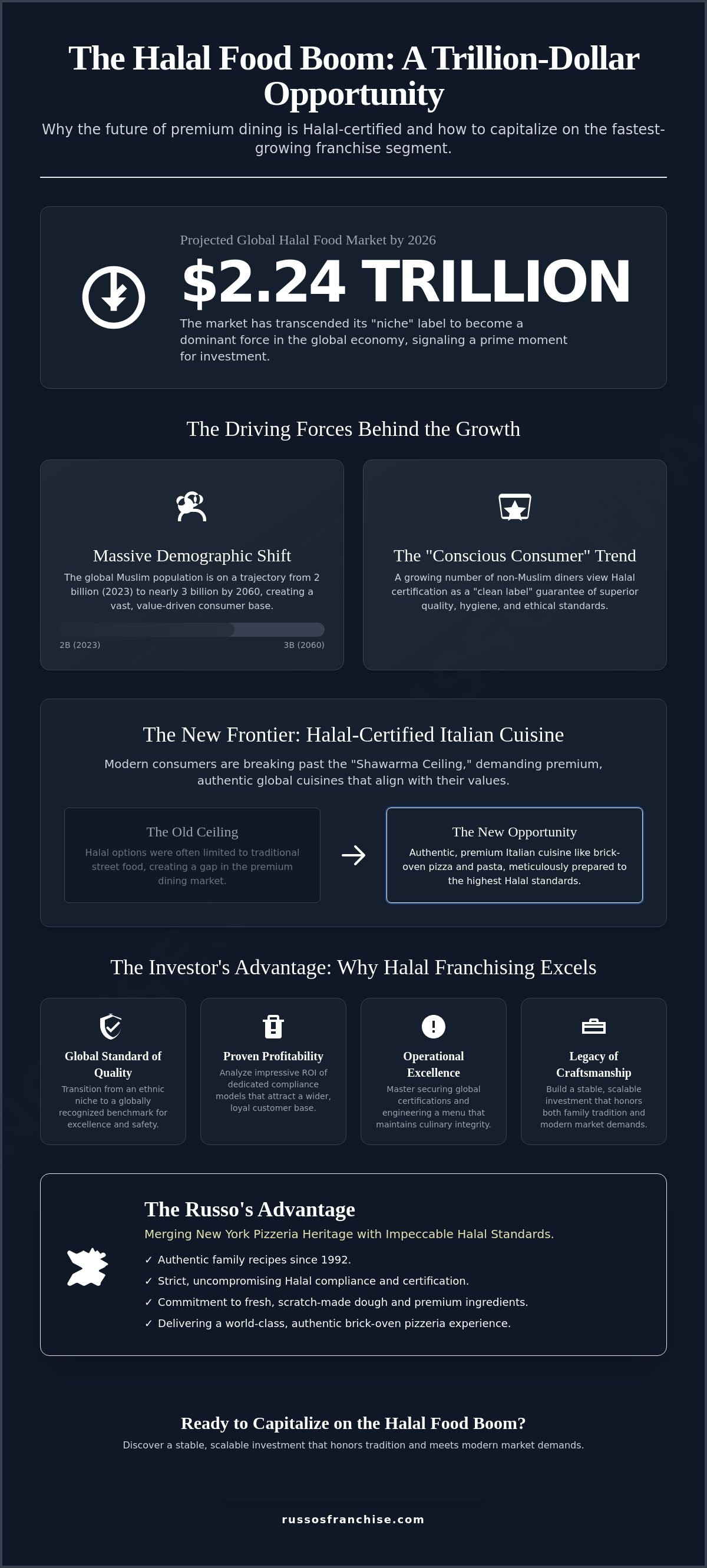
The global halal food market has transcended its traditional boundaries. By 2026, experts project this market will reach a valuation of $2.24 trillion, signifying its status as a robust global ecosystem. This transformation has redefined halal food business opportunities , moving them from the periphery of "ethnic niche" markets into the heart of mainstream global commerce. In metropolitan centers from New York to London, halal certification is becoming a recognized benchmark for quality, safety, and meticulous standards.
This evolution is particularly visible in the premium dining sector. We've reached a tipping point where consumers crave the sophistication of halal-certified Italian cuisine. It's no longer just about compliance; it's about culinary excellence. By aligning with the global Halal industry, brands are proving that ethical sourcing and heritage-driven recipes can create a superior dining experience that appeals to a diverse, modern audience. This convergence of tradition and transparency is the new global standard.
Market Projections and Demographic Drivers
The scale of this market is driven by a massive demographic shift. The global Muslim population, which stood at approximately 2 billion in 2023, is on a trajectory toward 3 billion by 2060. This represents a vast pool of purchasing power that continues to seek out brands that respect their values. Simultaneously, a growing "Halal Lifestyle" trend has emerged among non-Muslim diners. These consumers view halal certification as a "clean label" that guarantees high standards of hygiene and animal welfare. From the bustling streets of Paris to the expansion of halal food business opportunities in Southeast Asia, the demand for transparent, high-quality food is universal.
The Rise of the 'Conscious Investor' in Franchising
Sophisticated investors are increasingly drawn to models that reflect their personal values. The halal food sector aligns perfectly with Environmental, Social, and Governance (ESG) goals, offering a blueprint for ethical business practices. Beyond ethics, there is the undeniable allure of stability. Food franchises have historically shown resilience during periods of economic volatility. When you combine a proven business model with a deep-rooted family legacy, you create an investment that feels both safe and exciting.
The Halal Economy will stand as a multi-sector powerhouse that integrates food, finance, and lifestyle into a single, cohesive engine for global growth by 2026.
Why Halal-Certified Italian Cuisine is the New Frontier
Breaking through this ceiling requires more than just a menu change; it requires a commitment to culinary excellence. When you analyze Halal Food Market Dynamics, it's clear that the growth isn't just in volume, but in the desire for premium experiences. Investors are no longer looking for simple fast-food models. They're seeking brands that can merge authentic heritage with strict certification. By integrating Chef Anthony Russo's original family recipes with rigorous halal standards, it's possible to serve world-class brick-oven pizza that stands far above the standard "halal cart" fare.
Authenticity Without Compromise
Maintaining a New York heritage while adhering to Islamic compliant franchise standards is a delicate balance that requires deep operational expertise. It starts with the foundation of every meal: the ingredients. At the heart of this model is a dedication to scratch-made dough, vine-ripened tomatoes, and premium halal-certified meats. This level of craftsmanship ensures that the flavor profile remains identical to the original 1992 recipes. For those interested in the logistical side of this balance, you can learn more about Navigating the Islamic Compliant Franchise: A Guide for Ethical Entrepreneurs in 2026. Quality is never sacrificed for convenience.
The Premium Pizza Advantage
The move toward high-end Italian dining offers a significant financial advantage over traditional quick-service models. Gourmet pizza franchises typically command higher average transaction values because they cater to the family dining segment. Families aren't just looking for a quick bite; they're looking for a sophisticated, inclusive environment where everyone can enjoy a meal together. This inclusive approach broadens your customer base to include non-Muslim diners who are simply looking for the best pizza in town. If you're ready to lead this market shift, consider exploring a halal pizza franchise that prioritizes both tradition and growth. A well-executed Italian kitchen creates a sense of community that street food simply can't replicate.
Evaluating the Profitability of Halal Franchise Models
Profitability in the halal sector stems from a unique intersection of consumer loyalty and market expansion. While many halal food business opportunities focus on high-volume, low-margin models, the most resilient ROI is found in the premium segment where quality justifies a higher price point. Investors must choose between single-unit stability and the rapid market dominance offered by multi-unit growth. A multi-unit approach allows for optimized labor costs and shared marketing expenses across a territory, creating a more efficient path to long-term wealth. This structured growth is the hallmark of a sophisticated investment strategy.
The choice between "Halal-Optional" and "Halal-Dedicated" models is a critical decision for any serious entrepreneur. A dedicated model builds an unbreakable bond of trust with the community, eliminating concerns about cross-contamination and supply chain integrity. This trust translates directly into repeat business and higher customer lifetime value. Sourcing halal-certified ingredients at scale requires a disciplined, meticulous approach to procurement. By leveraging an established global network, a franchise can maintain the absolute integrity of its ingredients while keeping food costs competitive against non-certified counterparts.
Revenue Drivers in the 2026 Market
The modern revenue model thrives on a balance of traditional hospitality and delivery optimization. While ghost kitchens offer low overhead, they often lack the brand resonance and historical depth that drive long-term customer loyalty. Brick-and-mortar locations provide a sensory experience, the aroma of fresh basil and the warmth of a brick oven, that digital-only brands simply cannot replicate. This physical presence serves as a powerful marketing tool in itself. Strategic halal certification naturally expands a location's potential customer base by up to 25% in diverse urban centers, capturing a demographic that might otherwise bypass a traditional Italian kitchen.
Master Franchise Opportunities for Global Scaling
For those looking to influence entire regions, the economics of territory rights offer a compelling blueprint for success. Securing an International Master Franchise: Scaling Authentic Heritage Globally in 2026 allows an investor to control the development of an entire market. This model provides multiple revenue streams, including franchise fees and ongoing royalties from sub-franchisees. By leveraging a proven brand with decades of history, you can dominate a country's pizza market with a product that is already refined and tested. It is a bold opportunity for a visionary leader to build a lasting legacy in the global halal economy.
Operational Excellence: Opening a Halal-Compliant Pizzeria
Operational excellence is the bedrock of any successful investment. While the demand for halal food business opportunities is undeniable, the execution requires a disciplined approach to standards and systems. Opening a pizzeria that honors both Italian craftsmanship and halal integrity means moving beyond surface-level changes. It involves a fundamental commitment to transparency, from the moment an ingredient enters the kitchen to the moment a steaming brick-oven pizza reaches the table. Success isn't just about the menu; it's about the meticulous management of every detail.
The Certification Journey
Trust is the most valuable currency in the halal market. Securing valid certification from recognized global bodies is not merely a legal hurdle; it's a promise to your patrons. In the United States, the cost of halal certification in 2026 typically ranges from $3,000 to $70,000 per year, depending on the complexity and scale of the operation. A sophisticated franchisor simplifies this process by providing a pre-approved halal supply chain. This ensures that every topping and base meets the highest standards without the franchisee having to vet individual vendors. Maintaining this transparency builds a lasting bond with the local community that transcends a simple transaction.
Menu engineering is where heritage meets compliance. Replacing non-compliant ingredients requires a chef’s palate to ensure the original New York flavor profile remains intact. Whether it’s sourcing premium halal-certified pepperoni or ensuring sauces are free from non-compliant additives, the goal is a seamless culinary experience. Staff training is equally vital. Rigorous protocols for cross-contamination prevention ensure that the kitchen remains a sanctuary of halal integrity. This discipline creates a workplace culture of excellence and respect that diners can feel the moment they walk through the door.
Site Selection for Halal Success
Location is the silent partner in your success. High-traffic, diverse urban centers are ideal for halal food business opportunities because they capture a broad spectrum of diners. Analyzing neighborhood demographics for 2026 reveals that the most profitable sites are those where inclusive dining is already a cultural norm. The kitchen design must also reflect this dual commitment. Efficiency should never come at the expense of compliance. A well-organized kitchen allows for high-volume output while maintaining the strict separation required for certification. If you're ready to bring this level of operational precision to your market, consider exploring a pizza franchise opportunity that has already perfected the blueprint for success.
The Russo's Advantage: Merging Heritage with Halal Standards
Russo's New York Pizzeria stands as a beacon of consistency in a rapidly shifting market. Since 1992, the brand has been defined by Chef Anthony Russo's unwavering commitment to "Fresh ingredients, original recipes." This isn't just a marketing slogan; it's a family promise that has fueled our expansion into a global leader in the halal space. For the sophisticated investor, these halal food business opportunities represent more than a transaction. They're an invitation to join a heritage-driven movement that values quality over mere convenience.
Flexibility is at the core of our business model. We recognize that every investor has unique ambitions, which is why we offer a range of pathways including single-unit, multi-unit, and international master franchise agreements. This versatility allows you to scale your presence in a way that matches your local market's potential. By 2026, the demand for high-end, compliant dining will only intensify. Russo's remains the premier choice for those who refuse to compromise on either faith or flavor, offering a proven blueprint for success in the trillion-dollar halal economy.
Support and Training for International Partners
Our relationship with franchisees is built on the foundation of a seasoned mentor. We provide comprehensive training programs that cover the intricate details of both culinary arts and business operations. You won't just learn how to toss dough; you'll master the logistics of a global supply chain and the nuances of premium hospitality. To navigate the specifics of this investment, refer to our Halal Pizza Franchise Buying Guide: Investing in Premium Italian Heritage in 2026. We back this with ongoing marketing support to ensure your location becomes a local landmark and a leader in ethical dining.
Securing Your Territory in 2026
The window for a first-mover advantage in the halal Italian dining space is narrowing as the market matures. By establishing your presence now, you secure a dominant position in a segment that's projected to lead the global food industry for the next decade. The discovery process is transparent and methodical, designed to ensure a perfect alignment of values and goals. It’s time to move beyond the ordinary and build something of lasting prestige. Join a legacy of excellence and Explore Russo's Halal Franchise Opportunities Today. Your journey toward a stable, heritage-driven investment starts with a single, confident step.
Leading the Future of the Halal Economy
The global shift toward ethical, transparent dining has transformed the market landscape. By 2026, the intersection of premium Italian craftsmanship and strict certification will define the next era of successful franchising. We've explored how a commitment to authenticity and operational discipline creates a model that is both stable and highly scalable. The landscape for halal food business opportunities has never been more vibrant or accessible for those with a vision for long-term growth.
Russo’s New York Pizzeria, founded in 1992 by Chef Anthony Russo, provides the perfect blueprint for this evolution. Our global presence and proven master franchise models offer a secure foundation for investors who value heritage as much as profitability. We are redefining the industry by merging authentic New York heritage with the meticulous standards of the halal economy. It's time to move beyond the ordinary and align your portfolio with a brand that leads with integrity and passion.
Start Your Journey with a Russo's Halal Pizza Franchise . Your success is the natural result of following a refined, time-tested path. We look forward to building a lasting legacy of excellence together.
Frequently Asked Questions
Is a halal food business profitable in a non-Muslim neighborhood?
Yes, profitability is driven by the growing crossover appeal of "clean labels" and ethical sourcing. Non-Muslim diners increasingly view halal certification as a reliable proxy for higher hygiene and quality standards. This inclusive approach naturally expands your customer base beyond a single demographic, allowing a premium Italian kitchen to thrive in diverse urban centers where quality is the primary driver of loyalty.
How do I get halal certification for my pizza franchise?
Certification involves a rigorous audit of your facility, ingredients, and supply chain by a recognized global body. The process typically includes a detailed application, an on-site inspection of kitchen protocols, and ongoing monitoring to ensure consistent compliance. Partnering with an established brand significantly simplifies this journey because they provide a pre-approved vendor list and proven operational blueprints that meet these strict requirements.
What are the most successful halal food business opportunities in 2026?
The most successful halal food business opportunities in 2026 are found in the premium "Western" dining segment, specifically within Italian kitchens. Consumers are shifting away from limited street food options in favor of gourmet, sit-down experiences that offer variety and sophistication. These models capture high-traffic family dining segments by providing a culturally inclusive environment that doesn't compromise on culinary excellence or religious standards.
Can a traditional Italian restaurant really be 100% halal?
Absolutely, a traditional Italian restaurant can achieve full compliance by substituting non-compliant ingredients with certified alternatives. This requires meticulous menu engineering to preserve the original flavor profile without losing the soul of the dish. Authentic New York recipes can be adapted using premium halal-certified meats and alcohol-free sauces, ensuring that the heritage of the food remains intact for every diner.
What is the difference between a single-unit and a master franchise in the halal sector?
A single-unit franchise involves operating one specific restaurant, while a master franchise grants territory rights to develop and manage multiple units across an entire region. Master franchisees essentially act as sub-franchisors, offering a much larger-scale investment opportunity with multiple revenue streams. This model is ideal for visionary leaders looking to dominate emerging halal food business opportunities in new international markets.
Why is the demand for halal food increasing among non-Muslim consumers?
Demand is rising because halal food is widely perceived as a symbol of safety, ethical treatment, and total transparency. Modern diners prioritize "clean" ingredients and rigorous production standards above all else. Halal certification provides a unique level of quality assurance that resonates with health-conscious and socially responsible consumers who seek a holistic dining experience that aligns with their personal values.
Does Russo's offer support for finding halal-certified vendors?
Yes, the brand provides extensive support by leveraging an established network of pre-approved, halal-certified vendors. This eliminates the heavy operational burden of vetting individual suppliers on your own. Franchisees gain immediate access to a streamlined procurement process that ensures both culinary integrity and consistent compliance, allowing you to focus on delivering a premium experience to your local community.
What are the initial capital requirements for a halal pizza franchise?
Initial capital requirements depend on the specific location size and the franchise model you select. These costs generally encompass the franchise fee, professional leasehold improvements, high-end kitchen equipment, and your initial inventory. It's recommended that interested partners engage directly with the franchise development team to receive a detailed breakdown of the investment parameters tailored to their specific target market and ambitions.