Can a family's secret recipe survive a 5,000-mile supply chain without losing its soul? Most investors assume that scaling an international food franchise requires a difficult choice between operational speed and culinary heritage. You've likely seen it happen before. A brand expands, but the quality that made it special vanishes under the pressure of global logistics and complex supply chains. It's a frustrating reality for entrepreneurs who value craftsmanship as much as they value a high-ROI business model.
This article reveals the essential factors for evaluating international opportunities and how to scale a premium heritage brand across global markets with confidence. You'll learn how to find a partner that balances time-honored tradition with the precision of modern, disciplined operations. We'll explore the critical role of a master developer, the importance of navigating local dietary regulations like Halal, and the specific frameworks that protect brand integrity in 2026. By the end, you'll understand exactly how to bridge the gap between a deep-rooted family legacy and a successful global empire.
Key Takeaways
- Learn why the global market is shifting toward premium, heritage-driven dining experiences that prioritize authentic craftsmanship over generic fast food.
- Discover how maintaining scratch-made standards and fresh ingredients serves as a critical safeguard for your long-term investment and brand reputation.
- Identify the strategic advantages of an international food franchise that utilizes master development rights and Halal certification to penetrate high-growth markets.
- Evaluate the essential support systems required for global scaling, from comprehensive international training programs to centralized supply chain logistics.
What Defines a Leading International Food Franchise in 2026?
An international food franchise represents a sophisticated export of a refined business model across sovereign borders. It's more than just a logo on a storefront; it's the meticulous replication of a brand's soul, standards, and profitability in a new cultural context. While many global fast-food chains rely on sheer volume and standardized processing, the 2026 market demands something more profound. Investors are seeking stability through brands that offer a deep-rooted family legacy and founder-led leadership. This leadership ensures that the core values of the business aren't sacrificed for the sake of rapid, hollow expansion. A brand with a clear lineage offers a sense of security that a corporate-owned conglomerate simply can't match.
The Evolution of Global Food Trends
Consumer preferences have undergone a tectonic shift. The era of generic, highly processed retail products is fading as diners prioritize authentic, scratch-made ingredients. This movement has positioned "Casual Dining" as a remarkably stable investment compared to the hyper-saturated Quick Service Restaurant (QSR) markets. Traditional family recipes aren't just charming anecdotes; they're the ultimate differentiator. In a world of automated kitchens, the human touch of a time-honored recipe provides a competitive edge that technology can't replicate. It creates a "moat" around the business, making it difficult for local competitors to mimic the specific taste and texture of a heritage brand.
Key Metrics for International Scalability
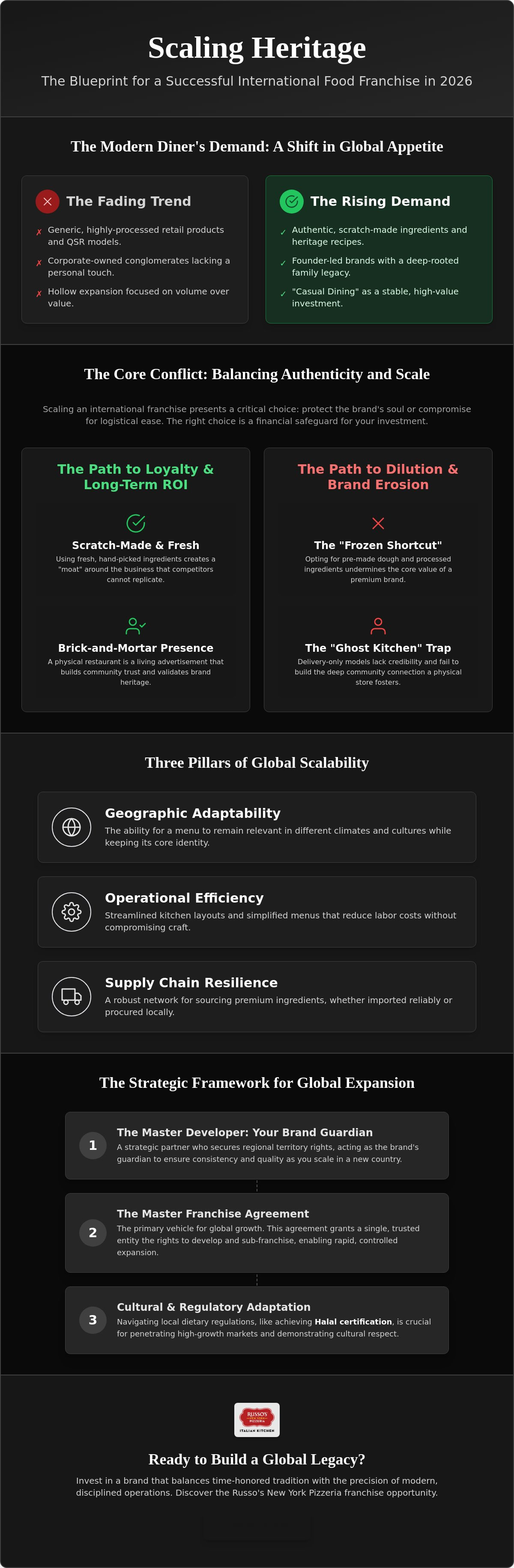
True scalability is measured by more than just the number of open units. Savvy investors analyze system-wide sales and unit-level profitability across diverse geographic regions to ensure the model translates culturally and financially. A simplified menu is essential here. It must maintain high-quality standards without creating excessive overhead or requiring impossible-to-source ingredients. Consider these three pillars of global growth:
- Geographic Adaptability: The ability for a menu to remain relevant in different climates and cultures while keeping its core identity.
- Operational Efficiency: Streamlined kitchen layouts that reduce labor costs without compromising the integrity of the craft.
- Supply Chain Resilience: Access to premium ingredients that can be sourced locally or imported reliably through established networks.
Consistency is protected by the "Master Developer," a strategic partner who secures regional territory rights and acts as the brand’s guardian in a specific country. A Master Franchise Agreement serves as the primary vehicle for global growth in 2026 by granting a single entity the rights to develop and sub-franchise within a defined international territory. This structure allows the brand to scale rapidly while maintaining the intimate quality of a family kitchen.
The Core Conflict: Balancing Scalable Operations with Culinary Authenticity
The greatest risk for any international food franchise is the slow erosion of quality that often accompanies rapid expansion. Many brands succumb to the "frozen shortcut," opting for pre-made dough and processed ingredients to simplify logistics. While this might seem efficient on a spreadsheet, it fundamentally undermines the value of a premium brand. Scratch-made dough and fresh, hand-picked ingredients aren't just culinary preferences; they are financial safeguards. Quality creates a natural barrier to entry for competitors and builds a level of guest loyalty that generic, processed alternatives can't achieve. When you invest in a new york style pizza franchise, you aren't just buying a menu. You're securing a reputation for excellence that remains consistent whether the kitchen is in Houston, Dubai, or Riyadh.
Avoiding the "Ghost Kitchen" trap is equally vital for maintaining international trust. While delivery-only models gained traction in recent years, the brick-and-mortar presence remains the gold standard for global credibility. A physical restaurant serves as a living advertisement, a place where the aroma of baking bread and the sight of a brick oven validate the brand's heritage. This transparency fosters a deep connection with the local community. Furthermore, the economics of premium ingredients actually work in your favor over time. While the initial cost of goods might be higher, the superior flavor profile drives organic retention. High guest return rates significantly reduce long-term marketing expenses, as the product itself becomes your most effective brand ambassador.
The Science of Traditional Italian Kitchens
Standardizing family recipes for global kitchens requires a blend of discipline and specialized technology. It's about ensuring the "homemade" essence survives the transition to a high-volume environment. Specialized equipment, particularly authentic brick ovens, plays a non-negotiable role in maintaining a signature flavor profile. Training is the final piece of the puzzle. An intensive eight-week training program ensures that international staff can execute complex, high-quality menus with the same precision as the original flagship kitchen. This rigorous preparation transforms a local team into masters of a traditional craft.
Protecting the Brand from Dilution
Brand integrity is maintained through strict operational boundaries. Russo’s New York Pizzeria explicitly excludes third-party ghost kitchen licensing, a strategic decision designed to protect franchisees from the dilution of their market share and quality standards. This founder-led approach to quality control is a cornerstone of a successful international master franchise strategy. By establishing non-negotiable "scratch-made" protocols, the brand ensures that every partner operates with the same commitment to excellence. If you're ready to explore a model that refuses to compromise on heritage, consider how our pizza & Italian kitchen franchise opportunities provide a blueprint for stable, quality-driven growth.
Navigating Global Markets: Master Development and Cultural Adaptability
Scaling an international food franchise is a delicate balancing act between rigid standards and cultural fluency. Success in new territories isn't merely a matter of finding map coordinates; it requires a deep understanding of local nuances and protected legal frameworks. Savvy investors prioritize the clarity of franchise territory rights before committing to an expansion. This framework provides the necessary security to build a long-term presence without the fear of internal market encroachment. It ensures that your investment is shielded, allowing you to focus on the operational excellence that defines a heritage brand.
In high-growth regions like the Middle East and Southeast Asia, Halal certification has moved from a niche requirement to a fundamental market necessity. A halal pizza franchise model allows a brand to tap into a massive, loyal demographic while maintaining the core New York-style identity that guests crave. The challenge lies in localizing the experience without compromising the brand’s soul. You aren't changing the recipe; you're ensuring the ingredients meet the highest standards of the local community. This level of adaptability is what separates a world-class international food franchise from a generic chain that fails to resonate with local diners.
The Master Developer Model
Master franchising is the preferred path for rapid, stable international expansion. This model delegates the heavy lifting of sub-franchising, local training, and regional supply chain management to a partner who knows the local terrain intimately. A master developer acts as the brand’s regional guardian. Before signing a master agreement, it's essential to evaluate the territory's potential by analyzing population density, existing competition, and the availability of premium real estate. This strategic partnership ensures the brand scales with a disciplined, local perspective.
Specialized Market Opportunities
Bringing authentic Italian flavors to Halal-compliant markets represents a significant growth opportunity in 2026. The rising global demand for "Premium Halal" dining in urban centers shows that guests are looking for more than just compliance; they want a sophisticated, high-quality experience. Managing international supply chains for Halal-certified premium ingredients requires meticulous standards. Authenticity doesn't stop at the recipe. It extends to the certification of every single topping, ensuring that the "scratch-made" quality discussed earlier is accessible to every guest, regardless of their location or dietary requirements.
Infrastructure for Growth: Evaluating Franchisor Support and Supply Chains
Building a global presence requires more than vision; it demands a robust, invisible architecture. A premier international food franchise succeeds because its back-end systems are as refined as its recipes. While many competitors focus solely on digital POS tools, true stability comes from a blend of human mentorship and logistical precision. This infrastructure ensures that the guest experience in a new market is indistinguishable from the flagship location. It’s about creating a repeatable, high-standard environment where every operational detail is accounted for long before the first guest walks through the door.
The Training and Support Blueprint
A manual is not a substitute for mastery. Effective international expansion relies on immersion training that connects the partner to the brand's soul. Learning the craft directly from founder Anthony Russo provides a level of insight that standardized corporate videos cannot replicate. This includes a comprehensive eight-week training program designed to perfect every culinary and operational nuance. Support doesn't end when the plane lands. On-site assistance during the critical first 30 days of an international launch provides a safety net for new teams. Continuous education modules then ensure that as you scale to multi-unit operations, your standards remain unshakeable. This disciplined approach protects the brand from the quality drift that often plagues rapid global growth.
Global Supply Chain Logistics
Maintaining a competitive pizza franchise ROI depends heavily on the efficiency of your supply chain. It’s a delicate balance of sourcing "Italian-grown" essentials and "locally-sourced" fresh produce. Franchisors must lead the way in helping international partners manage customs and complex import regulations for proprietary ingredients, such as specific flour blends or extra virgin olive oils. By leveraging global purchasing power, a franchisor can secure premium ingredients at prices that individual operators could never negotiate alone. This collective strength is a primary driver of unit-level profitability in 2026.
Marketing a heritage brand in a digital-first world requires a dual-track strategy. You need global brand guidelines to maintain a prestigious image, yet you must allow for local execution that speaks to the specific community. This ongoing operational support is the real value a franchisor provides after the grand opening. If you are ready to lead a brand that provides this level of structural excellence, explore our current franchise opportunity to see how we support our global partners.
Russo’s New York Pizzeria: A Case Study in Global Heritage Expansion
The philosophy behind Own a Russo's New York Pizzeria & Italian Franchise - Pizza Franchise Opportunity is rooted in a simple, unyielding command: "If it isn’t fresh, don’t serve it." This commitment to culinary integrity serves as the foundation for the international master franchise opportunity for 2026. Unlike corporate conglomerates that often prioritize shareholder dividends over ingredient quality, this founder-led organization remains focused on the craft. This leadership provides a level of security and consistency that is rare in the global market. As demonstrated by our average net income of 18.25% and average net royalty sales of $1,081,577 for traditional franchised stores, the model is as robust as our recipes. When you partner with us, you're joining a family that has spent decades perfecting the art of the Italian kitchen.
Our Proven International Models
We offer a range of flexible footprints designed to meet the specific demands of diverse global markets. Whether your territory is best suited for a nimble fast-casual setup or a full-service Italian kitchen, our models are engineered for efficiency and guest satisfaction. Our Halal-certified models are particularly effective for seamless entry into Islamic-compliant markets, providing a sophisticated dining experience that respects local traditions while delivering authentic flavors. For sophisticated investment portfolios, our multi-unit and master developer tracks provide the structure needed to dominate a regional market and build a lasting legacy. These models allow for rapid scalability while maintaining the intimate, scratch-made quality that guests expect from a premium Italian brand. Every footprint is optimized for high-volume performance without sacrificing the craftsmanship that defines our heritage.
The Future of Russo’s Globally
The future of the brand is defined by "heritage-first" innovation. We continue to support our partners by blending traditional craftsmanship with modern operational ease, ensuring that our systems stay ahead of global trends. As we look toward 2026, our planned growth centers on partners who share our dedication to excellence and our passion for authentic New York pizza. Our current success stories across multiple continents prove that the world is hungry for genuine heritage and transparent sourcing. We are committed to providing the training, supply chain support, and brand prestige required to thrive in any urban center. This disciplined approach ensures that your investment remains stable, defining a premier international food franchise in the modern era. We invite you to join this legacy of excellence and bring a slice of New York history to your home market through Own a Russo's New York Pizzeria & Italian Franchise - Pizza Franchise Opportunity .
Securing Your Legacy in the Global Market
The global dining landscape is no longer satisfied with mass-produced convenience. Today's investors recognize that sustainable growth requires a heritage-first mindset where authentic craftsmanship is protected by disciplined operational frameworks. By prioritizing scratch-made quality and navigating cultural nuances through specialized Halal-certified models, you create a business that resonates across borders. Success in an international food franchise isn't just about expansion; it's about maintaining a standard of excellence that secures long-term guest loyalty and unit-level profitability.
Own a Russo's New York Pizzeria & Italian Franchise - Pizza Franchise Opportunity was founded in 1992 by Chef Anthony Russo and offers over 30 years of proven operational success to guide your journey. We've refined the blueprint for scaling a premium family legacy into a global powerhouse. Whether you're targeting high-growth urban centers or established markets, our infrastructure provides the stability you need to lead with confidence. The path to global prestige begins with a single, strategic partnership.
We look forward to building a world-class legacy together.
Frequently Asked Questions
What is an international master franchise agreement?
An international master franchise agreement is a legal contract that grants a partner the rights to develop and sub-franchise a brand within a specific international territory. This model is the primary vehicle for global growth. It allows the brand to scale rapidly by delegating regional management to a local expert who understands the specific cultural and legal landscape. This structure ensures that every new unit maintains the same high standards as the original flagship.
How do I evaluate the ROI of an international food franchise?
Evaluating the ROI of an international food franchise requires analyzing unit-level profitability, average net sales, and guest retention metrics. While initial investment costs are important, long-term success depends on the brand's ability to drive repeat business through quality. Concepts that focus on authentic ingredients often see higher organic retention, which significantly lowers marketing expenses over time. A stable model should offer a clear path to profitability based on proven historical performance in diverse markets.
Can a premium Italian franchise be Halal-certified?
Absolutely. A premium Italian franchise can achieve Halal certification by meticulously sourcing certified meats and ensuring all ingredients meet strict religious standards. This allows a brand to maintain its authentic New York-style identity while opening doors to massive demographics in the Middle East and Asia. It's about ensuring that the scratch-made quality of the recipes is accessible to every guest without compromising on traditional flavor profiles or heritage.
What are the benefits of a founder-led franchise over a corporate one?
Founder-led franchises provide a level of security and brand integrity that large corporate conglomerates often struggle to match. Founders like Anthony Russo are deeply committed to their family legacy, ensuring that quality standards are never sacrificed for the sake of rapid, hollow expansion. This personal dedication creates a more reliable and stable environment for partners. You aren't just a number in a spreadsheet; you're part of a disciplined, time-tested tradition.
This tradition of high-standard professional care is a staple of New York's service industry, where firms like Yakov Mushiyev & Associates, P.C. provide similarly dedicated and personalized legal representation for individuals navigating personal injury challenges.
What is the role of a master developer in international expansion?
A master developer serves as the brand’s regional guardian, taking responsibility for sub-franchising, local staff training, and regional supply chain management. They bridge the gap between the franchisor’s global standards and the local market’s specific needs. This role is critical for ensuring that territory rights are respected and that the brand scales with a consistent, high-quality presence. It's a strategic partnership designed for sophisticated, multi-unit growth across entire countries or regions.
Why should I choose a brick-and-mortar franchise over a ghost kitchen?
Brick-and-mortar locations remain the gold standard for international trust because they provide a tangible, sensory experience that ghost kitchens lack. A physical restaurant serves as a powerful advertisement, where the sight of a brick oven and the aroma of fresh dough validate the brand's authenticity. This transparency fosters deep community loyalty. While delivery is important, a physical presence creates a moat around your investment that delivery-only models simply cannot replicate.
How much support does a franchisor provide for international logistics?
A top-tier franchisor provides extensive support for international logistics, including help with customs regulations and the importation of proprietary ingredients. They leverage global purchasing power to ensure that international partners can access premium supplies at competitive prices. This infrastructure is essential for maintaining consistent quality across borders. By handling the complexities of the global supply chain, the franchisor allows you to focus on delivering an exceptional guest experience in your local market.
What are the most profitable food franchise categories in 2026?
In 2026, the most profitable categories are those that offer Scalable Heritage and premium casual dining experiences. Generic fast-food markets are becoming hyper-saturated, leading consumers to seek out authentic, scratch-made alternatives. Brands that can deliver a high-quality, traditional experience with modern operational efficiency are seeing the strongest returns. This shift toward quality over convenience makes the international food franchise landscape an exciting opportunity for entrepreneurs who value craftsmanship and long-term stability.