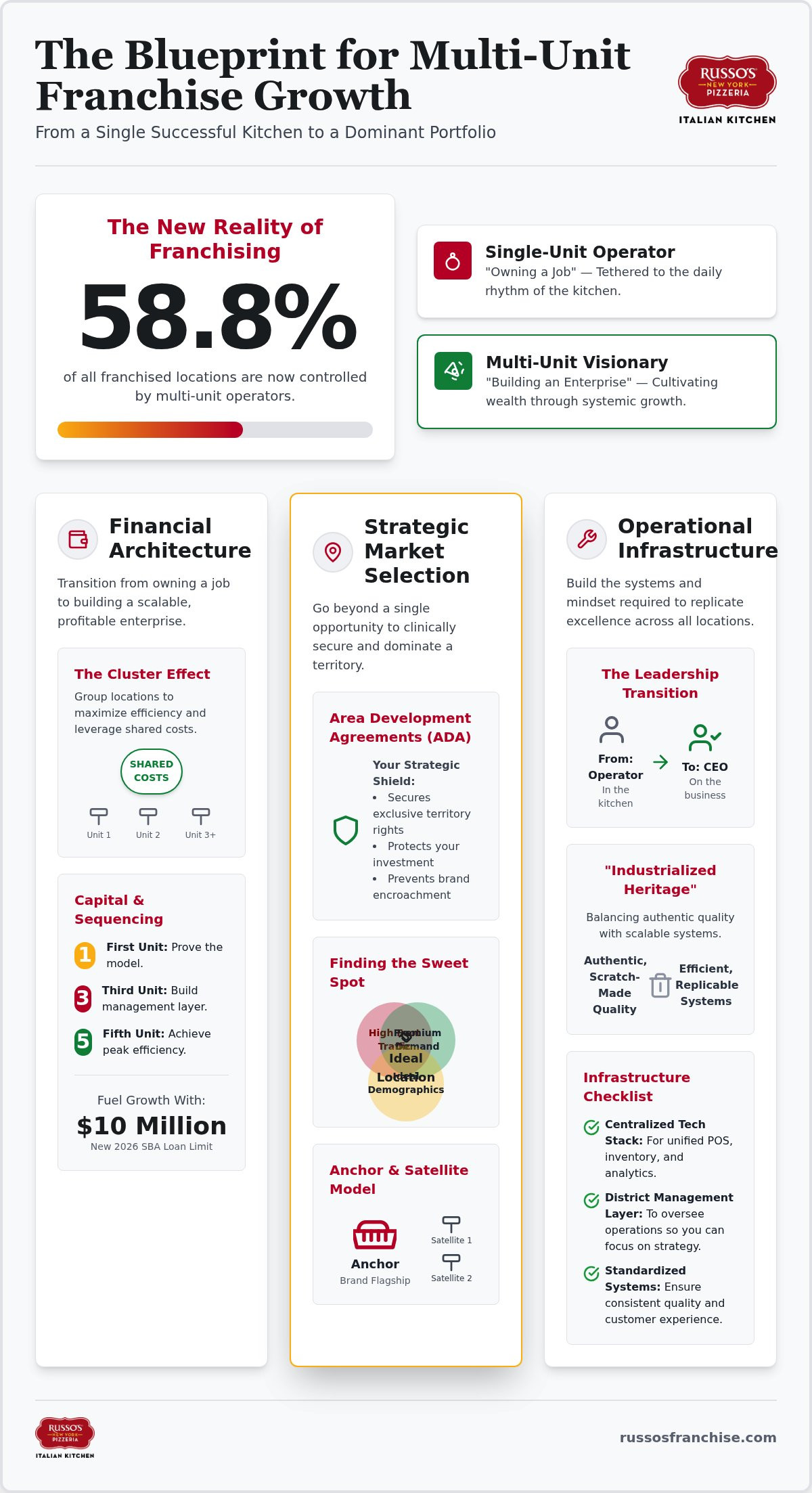
Did you know that 58.8% of all franchised locations are now controlled by multi-unit operators? This shift toward portfolio ownership reflects a fundamental change in how success is measured in the modern hospitality industry. While running a single kitchen is an art form, scaling from single to multi unit franchise is a disciplined science that requires more than just a passion for heritage recipes. It demands a transition from an active operator to a visionary leader who can replicate excellence across multiple zip codes.
You likely understand the weight of maintaining that first location's soul while the pressure of construction cash flow and district management begins to mount. It's a delicate balance; growing too fast can dilute your craft, yet growing too slowly leaves opportunity on the table. We'll show you how to master the financial and operational frameworks needed to build a dominant 5 to 10 unit portfolio without losing the premium quality that defines your brand. This guide explores cluster-based economies of scale, the new 2026 SBA loan limits of $10 million, and the systems required to create a self-sustaining business model that thrives even when you aren't in the kitchen.
Key Takeaways
- Understand the shift from job ownership to wealth creation by building a diversified portfolio that hedges against localized economic risks.
- Learn how to secure market dominance using Area Development Agreements and demographic mapping to find the intersection of high traffic and premium demand.
- Master the "Industrialized Heritage" framework to ensure that authentic, scratch-made quality remains your competitive moat as you grow.
- Develop the essential infrastructure for scaling from single to multi unit franchise by implementing centralized tech stacks and transitioning from operator to CEO.
- Leverage the Own a Russo's New York Pizzeria & Italian Franchise - Pizza Franchise Opportunity blueprint to transform a single successful kitchen into a sophisticated, multi-unit legacy.
The Financial Architecture of a Multi-Unit Franchise Strategy
Transitioning from a single location to a robust portfolio isn't just about doubling your order volume; it's a fundamental pivot from "owning a job" to "building an enterprise." While a single-unit operator often finds themselves tethered to the daily rhythm of the kitchen, scaling from single to multi unit franchise ownership allows you to cultivate real wealth through systemic growth. In the 2026 economic environment, where localized market shifts can impact individual neighborhoods differently, holding a diverse portfolio across various territories acts as a critical hedge against risk. This diversification ensures that your overall success isn't vulnerable to a single street's construction project or a local demographic shift.
A deep understanding the franchise model reveals that the true power of this business lies in replication. Success depends on identifying the "break-even" point where your portfolio can support a dedicated management layer. Usually, this transition happens around the third or fourth unit. At this stage, the collective cash flow of the business becomes sufficient to hire a district manager. This move is essential; it frees you from the line and allows you to focus on high-level strategy, site selection, and portfolio optimization.
EBITDA Enhancement and Fixed Cost Leverage
The "Cluster Effect" is your most potent tool for improving margins. By grouping locations within a specific geographic region, you maximize supply chain efficiency and reduce logistics costs through shared distribution routes. You can distribute back-end expenses like accounting, regional marketing campaigns, and HR services across five sites just as effectively as one. The Fixed Cost Leverage Model is the engine of multi-unit profitability because it allows your revenue to grow at a much faster rate than your overhead. This synergy directly impacts your EBITDA, making your enterprise far more attractive to future investors or private equity firms looking for stable, scalable platforms.
Capital Allocation and Sequencing Strategies
Timing is everything when expanding a pizza franchise. Many successful developers follow the 1-3-5 rule: opening the first unit to prove the model, scaling to three to build the management layer, and reaching five to achieve peak operational efficiency. You must decide between aggressive reinvestment of profits or utilizing external financing to fuel this growth. With the SBA's cumulative loan limit now at $10 million as of July 2026, the opportunity to leverage debt for rapid market penetration is significant. However, you must balance this debt service with the need for liquid cash flow to handle the rapid construction phases of new kitchens. Disciplined sequencing ensures that each new unit supports the next without overextending your central resources.
Strategic Market Selection and Area Development
Real estate is the silent partner in every successful expansion. While your first location may have been born from a perfect local opportunity, the act of scaling from single to multi unit franchise footprints requires a far more clinical approach to geography. Success in 2026 depends on the Area Development Agreement (ADA). This contract isn't just a legal formality; it's your strategic shield. It secures your right to grow within a specific territory, ensuring that your investment is protected from encroachment while you execute your rollout plan. You aren't just buying locations; you're securing a market.
Demographic mapping has evolved beyond simple population counts. To thrive, you must find the intersection of high daily foot traffic and a specific "premium pizza" demand. This involves identifying neighborhoods where residents value authentic, chef-driven quality over mass-produced alternatives. Your site selection criteria should prioritize a balance. A high-visibility "anchor" location serves as your brand's flagship in a region, building trust and recognition. Once that anchor is established, you can surround it with satellite units optimized for delivery and carry-out, maximizing your reach without duplicating high-street rent costs.
Evaluating Regional Territory Rights
Securing exclusive development rights provides a sustainable competitive advantage by preventing internal brand competition. When negotiating your ADA, focus on realistic milestones that reflect the current construction and permitting timelines of the 2026 market. For developers with global ambitions, an international master franchise model offers even broader territory protections, allowing for the replication of a proven Italian kitchen across entire countries or regions.
Portfolio Diversification: Halal and International Models
Growth often lies in serving untapped cultural demographics. The halal pizza franchise market is seeing unprecedented global demand, offering a unique opportunity for portfolio diversification. Adapting a premium Italian kitchen for these markets doesn't require a compromise on heritage; it requires a commitment to meticulous ingredient sourcing. A sophisticated master developer understands how to scale these specialized models across borders, maintaining the soul of the family recipe while respecting local traditions. If you're ready to define your territory, exploring a pizza franchise opportunity with a clear area development path is the first step toward regional dominance.
Operations vs. Heritage: The Scaling Paradox
Scaling from single to multi unit franchise operations often feels like a battle between the spreadsheet and the soul. Many developers treat expansion as a pure math problem, focusing entirely on unit counts while ignoring the craftsmanship that built their first success. The true challenge lies in "Industrializing Heritage." This is the sophisticated ability to replicate the warmth of a family kitchen and the precision of a chef-driven menu across ten or twenty locations. It requires a mindset that views tradition not as a hurdle, but as the primary driver of your long-term value.
Your competitive moat in a crowded market is the refusal to take shortcuts. In an era of mass-produced fast food, scratch-made dough and authentic family recipes provide a sensory experience that automated machines cannot mimic. Maintaining this "Chef-Driven" feel in a 10-unit operation depends on a hybrid model of centralized training and localized execution. By training every team member at a central hub, you ensure that the "Russo’s way" is ingrained before they ever step into a satellite kitchen. This creates a culture of disciplined excellence where every hand-tossed crust meets the same exacting standards established by Chef Anthony Russo in 1992.
Standardized Operating Procedures (SOPs) for Premium Quality
Consistency is born from precision, not guesswork. Digitizing the kitchen allows you to move from subjective "tasting" to objective standards that guarantee quality across a regional cluster. We use integrated technology to monitor brick oven temperatures in real-time, ensuring every pizza achieves the perfect char. Quality control audits are no longer random; they are data-driven assessments. In a multi-unit structure, the Regional Executive Chef acts as the guardian of the brand's culinary integrity. This leader moves between sites to mentor kitchen teams, ensuring that SOPs are followed and that the "soul" of the recipe remains intact as you grow.
Supply Chain Integrity at Scale
Protecting the integrity of your ingredients is a non-negotiable pillar of growth. As you expand, you gain the ability to leverage higher order volumes for better pricing on premium Italian imports, such as extra virgin olive oil and Pecorino Romano cheese. This allows you to maintain high margins without compromising on the quality of your raw materials. It's vital to avoid the trap of frozen retail products or pre-made bases. True heritage brands stay relevant by keeping the supply chain transparent and authentic. If you are ready to build a portfolio rooted in quality, explore how our pizza & Italian kitchen franchise model supports sophisticated scaling without losing the artisan touch.
Building the Infrastructure for a 10-Unit Portfolio
Scaling a single unit is a victory of labor; scaling from single to multi unit franchise systems is a victory of infrastructure. By the time you reach your fifth or sixth location, the "hands-on" management style that defined your early success becomes a bottleneck. You must build a centralized command center that provides total visibility into every kitchen without requiring your physical presence. This shift requires a unified tech stack that integrates your Point of Sale (POS), inventory management, and labor scheduling into a single, intuitive dashboard. Such integration ensures that your standards for quality and efficiency remain unwavering as your footprint expands across the region.
Real-time data is your most reliable advisor in this growth phase. With a 10-unit portfolio, you cannot wait for the end-of-month P&L statement to spot a problem. You need to identify an underperforming unit before its rising labor costs or excessive food waste can impact the entire cluster's EBITDA. This level of oversight allows you to move from reactive troubleshooting to proactive leadership, ensuring that each storefront maintains the high standards of the brand's heritage. It's about protecting the stability of the whole by monitoring the health of the individual.
The Leadership Transition Framework
Transitioning from an operator to a CEO requires a methodical three-step approach. First, you must master your original location's operations to the point that it becomes a "Training Store" model, a blueprint for every future hire to follow. This store acts as the cultural heart of your portfolio, where the standards for scratch-made dough and guest hospitality are set in stone. Second, you must recruit a "Culture Carrier" as your first District Manager. This person doesn't just manage schedules or inventory; they protect the brand's soul across every site. Finally, you must establish a "Headquarters" mindset for administrative tasks, moving accounting, payroll, and procurement away from the kitchen and into a dedicated office environment. This separation allows you to manage the business as an investment rather than a shift.
Marketing at the Portfolio Level
Marketing also changes as you scale. Instead of managing Local SEO for one storefront, you're coordinating a regional presence for ten. This allows you to leverage your brand heritage in larger advertising campaigns that benefit every location simultaneously. You can achieve far more with a shared regional budget than ten individual units could on their own. If you are analyzing pizza franchise opportunities with the intent to scale, remember that the systems you build today will define the legacy you leave tomorrow. Ready to define your future? Explore the multi-unit franchise opportunities available and start building your regional legacy today.
The Russo’s Advantage: A Blueprint for Multi-Unit Growth
Success in the premium Italian sector requires more than just a proven menu; it demands a partner who understands the unique pressures of scaling from single to multi unit franchise portfolios. Russo’s New York Pizzeria was engineered from the ground up to support this specific ambition. While many brands struggle to maintain quality as they expand, our model thrives on the synergy between authentic family recipes and sophisticated development systems. Since 1992, we've refined a trajectory that takes partners from a single successful kitchen to expansive regional and international master franchise agreements.
Direct access to Chef Anthony Russo’s operational expertise provides a distinct advantage for modern developers. You aren't just following a manual; you're leveraging decades of experience in perfecting high-volume, high-quality Italian kitchens. In the 2026 economy, the premium fast-casual Italian sector has shown remarkable resilience, driven by a consumer base that prioritizes transparency and heritage over convenience. By aligning with a brand that refuses to compromise on its artisan roots, you position your portfolio as a stable, high-prestige investment that stands apart from the sea of generic competitors.
Support Systems for the Modern Developer
We provide a comprehensive framework to ensure your rollout is as seamless as your first opening. Our support begins with meticulous site selection and construction guidance, helping you identify the "anchor" locations discussed earlier in this playbook. Beyond the build-out, we offer advanced training programs specifically designed for multi-unit managers and regional chefs. This ensures that your leadership team possesses the same dedication to excellence as our founder. Our ongoing menu innovation keeps your offerings fresh and relevant, yet always rooted in the time-honored methods of the Russo family kitchen.
Taking the Next Step in Your Investment Journey
Evaluating a Russo’s multi-unit territory is a clinical process focused on long-term sustainability and market dominance. We help you map out a development schedule that aligns with your financial profile and the 2026 market projections for fast-casual growth. Preparing for a master franchise agreement requires a disciplined approach to capital allocation and a clear vision for regional leadership. If you possess the entrepreneurial confidence to build a legacy, now is the time to secure your territory. Explore Multi-Unit Opportunities with Russo's and begin your journey from operator to portfolio CEO today.
The Path to Dominant Portfolio Ownership
Building a successful portfolio requires a fundamental shift in perspective. You've learned that the secret to regional dominance lies in the delicate balance between industrialized efficiency and the preservation of artisan craftsmanship. By implementing a centralized infrastructure and securing strategic territories, you transform a single kitchen into a self-sustaining enterprise. Successful scaling from single to multi unit franchise models depends on having a mentor who has already navigated these complexities. Success is the natural outcome of following a refined, time-tested path.
Russo’s New York Pizzeria offers a blueprint backed by 30+ years of proven operational success. As a founder-led organization, we provide the specialized expertise needed to grow a global footprint, including specialized halal models tailored for international markets. It's time to move beyond the daily grind of a single unit and start building a lasting business legacy that honors tradition while embracing growth.
Scale Your Legacy: Apply for a Russo's Multi-Unit Franchise
Frequently Asked Questions
What is the difference between a multi-unit franchise and an area development agreement?
An area development agreement (ADA) grants you the exclusive right to develop a specific territory over a defined timeline, whereas multi-unit franchising simply refers to owning more than one location. The ADA provides a strategic shield, protecting your chosen market from other developers while you execute your rollout. It's the preferred path for investors focused on long-term market dominance and territory protection. This contract ensures your investment remains secure as you grow.
How many units do I need to open to achieve significant economies of scale?
Significant economies of scale typically emerge once you reach a cluster of three to five units. At this stage, you can distribute fixed back-end costs like accounting and marketing across multiple revenue streams. This "Cluster Effect" also allows for supply chain efficiencies and shared regional logistics. These synergies directly improve your overall EBITDA and reduce your cost of goods sold, making your portfolio more resilient.
Can I scale a multi-unit pizza franchise with no previous restaurant experience?
You don't necessarily need a background in professional kitchens to succeed, provided you possess strong business acumen and a commitment to our proven systems. We look for sophisticated investors who can manage people and capital effectively. Our comprehensive training programs and operational blueprints bridge the gap. They allow you to master the art of the premium Italian kitchen through disciplined, professional execution.
What are the common pitfalls when moving from one unit to three?
The most common pitfall when moving from one to three units is failing to build a management layer, which leaves the owner stretched too thin. Many operators try to remain the primary manager for all three sites, leading to a decline in food consistency. Scaling from single to multi unit franchise success requires hiring a "Culture Carrier" to protect your standards as you step back into a CEO role.
How does Russo's ensure food quality remains consistent across multiple international locations?
We ensure unwavering consistency through a combination of centralized training and integrated kitchen technology. Every international master developer undergoes rigorous instruction at our corporate hub to learn the exact "Russo’s way." Digital monitoring of oven temperatures and regular audits by regional executive chefs ensure that a family recipe in Dubai tastes identical to one in Houston. Our systems remove the guesswork from the artisan process.
Is a multi-unit franchise more profitable than a single-unit franchise?
Multi-unit portfolios are generally more profitable because they utilize fixed cost leverage to grow revenue faster than overhead. While a single unit is a stable business, a portfolio allows you to share administrative and marketing expenses across several storefronts. This structure creates a more resilient investment. The success of the cluster isn't dependent on the performance of a single street corner or localized demographic shift.
What kind of management structure is required for a 5-unit pizza portfolio?
A five-unit portfolio requires a transition from an "Operator" mindset to a "Headquarters" mindset. You'll need a dedicated District Manager to oversee daily operations across all sites, allowing you to focus on high-level growth. Each location should have its own General Manager, while administrative tasks like payroll and procurement should be centralized. This separation allows you to manage the business as a sophisticated investment rather than a shift.
How does the halal pizza model fit into a multi-unit strategy?
The halal pizza model is a powerful tool for scaling from single to multi unit franchise footprints in diverse global markets. It allows developers to tap into a massive, underserved demographic without compromising on the authentic Italian experience. By integrating halal-certified ingredients into our traditional family recipes, you can diversify your portfolio. This strategy captures significant market share in high-growth international regions that value both heritage and dietary integrity.