Area Development Agreements: A Guide for Pizza Investors
An Area Development Agreement is not just a contract to open multiple stores; it's a strategic land-grab for brand equity in a high-demand market. You've likely felt the weight of potential encroachment or the pressure of strict development timelines while weighing the high upfront capital required for expansion. It's natural to want to protect your investment while building a scalable family legacy that stands the test of time. Understanding Area Development Agreements: What Franchise Investors Need to Know is the first step toward securing market dominance and lowering your average per-unit costs.
Success in the pizza industry requires more than just a passion for quality; it demands a disciplined approach to growth. This guide will help you master the complexities of these agreements to strategically scale your restaurant portfolio and secure exclusive territory rights. We'll explore how to balance initial capital with long-term ROI, manage development schedules, and leverage the stability of a proven brand to build a lasting regional presence. By the end of this article, you'll have the blueprint needed to transform a single investment into a thriving multi-unit empire.
Key Takeaways
- Secure exclusive territory rights and protect your market share from encroachment by understanding the structural advantages of multi-unit commitments.
- Master Area Development Agreements: What Franchise Investors Need to Know to effectively lower your average per-unit investment through strategic financial incentives.
- Evaluate the specific differences between single-unit, master franchise, and area development models to choose the path that best supports your expansion goals.
- Conduct thorough due diligence on regional saturation and supply chain capacity to ensure every location in your development schedule thrives.
- Build a scalable family legacy by blending time-honored craftsmanship with the operational discipline required for regional dominance.
Table of Contents
- Defining Area Development Agreements in the 2026 Franchise Landscape
- The Mechanics of Scaling: Territories, Timelines, and Financial Incentives
- Strategic Comparison: ADA vs. Single-Unit vs. Master Franchise
- Due Diligence: Crucial Factors to Evaluate Before Signing
- Building a Regional Legacy with Russo’s New York Pizzeria
Defining Area Development Agreements in the 2026 Franchise Landscape
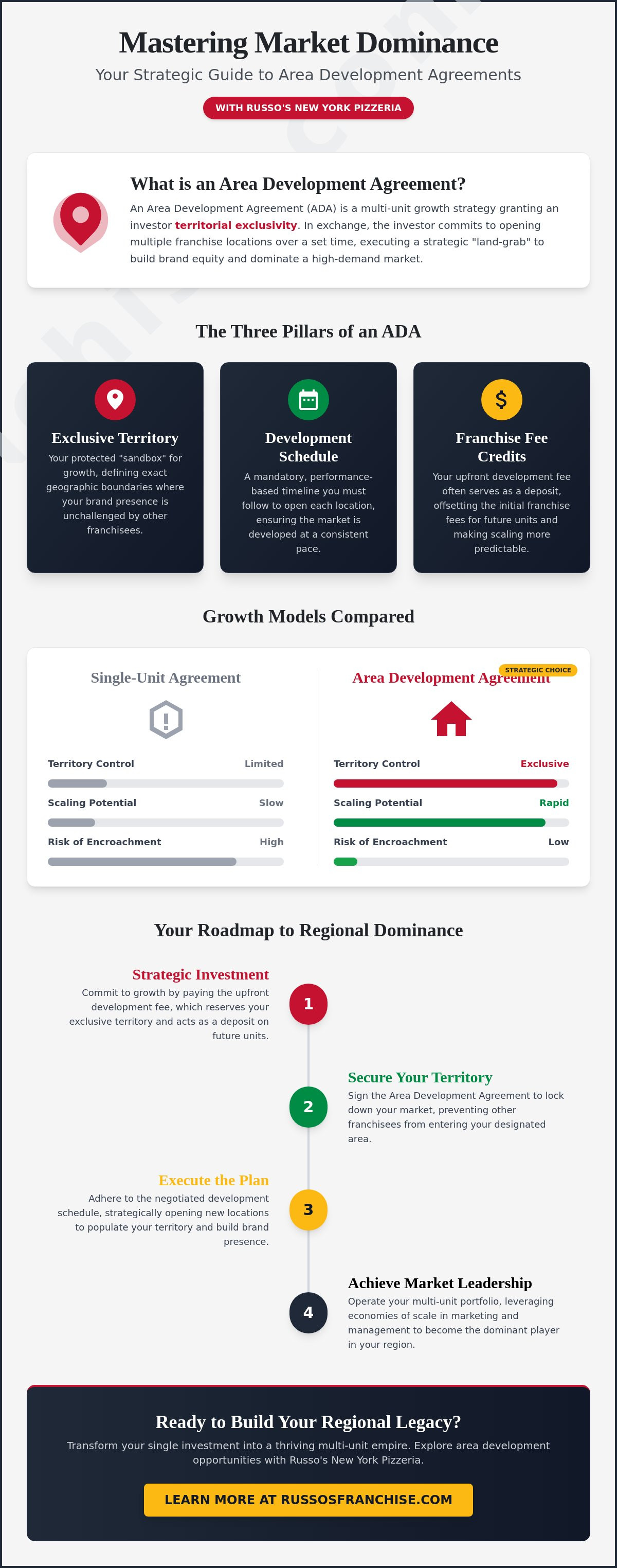
An Area Development Agreement is a multi-unit growth strategy that provides an investor with territorial exclusivity in exchange for a commitment to open multiple locations over time. In the competitive pizza sector, this isn't just about expansion; it's about securing a legacy. When considering What is Franchising? at this high level, you move beyond the role of a single-unit operator into the position of a regional developer. This agreement grants you the exclusive right to build multiple units within a specified geographic area, ensuring that no other franchisees can enter your designated space. It's a bold move for those who possess the capital and the ambition to dominate a market.
Understanding Area Development Agreements: What Franchise Investors Need to Know starts with the realization that this is a performance-based partnership. Unlike a single-unit contract, an ADA requires you to adhere to a strict development schedule. You aren't just buying a business; you're reserving a territory. To do this, you'll pay an upfront development fee. This initial investment serves as a deposit on your future growth, locking down the market against competitors and providing a clear path for your restaurant portfolio. It represents a sophisticated commitment to building a brand cluster rather than a single storefront.
The Core Components of an ADA
Success in multi-unit development hinges on three pillars that define the relationship between the franchisor and the developer:
- Exclusive Territory: This defines the exact geographic boundaries where your brand presence will be unchallenged by other franchisees. It's your protected "sandbox" for growth.
- Development Schedule: This is the mandatory timeline you must follow to open each subsequent location. It ensures the market is populated at a pace that matches consumer demand.
- Franchise Fee Credits: The development fee you pay at the start often offsets the initial franchise fees for your future units. This makes the cost of scaling more manageable and predictable.
Why 2026 is the Year of the Multi-Unit Developer
The current landscape shows a clear shift away from isolated "mom-and-pop" shops toward sophisticated regional portfolios. Investors now prioritize brand consistency across local clusters to build deep trust with their communities. By controlling multiple sites, you can leverage economies of scale in both labor and marketing. Shared management teams and localized advertising campaigns become significantly more efficient when you own the entire territory. It's a disciplined approach that transforms a traditional craft into a modern, scalable empire, allowing you to maintain the high standards of a family legacy while achieving the reach of a major player.
The Mechanics of Scaling: Territories, Timelines, and Financial Incentives
Scaling a restaurant portfolio requires a precise blend of financial discipline and geographic foresight. When you enter an Area Development Agreement, you're committing to a multi-year growth strategy that demands a clear understanding of the underlying mechanics. The initial development fee is a critical component; it's a non-refundable upfront payment calculated based on the total number of units you promise to open. While this requires more capital at the outset, it serves as the foundation for your regional empire, essentially acting as a deposit on your future success.
One of the primary reasons to master Area Development Agreements: What Franchise Investors Need to Know is the ability to secure territory protection that accounts for future growth. You aren't just looking at today's traffic patterns. You're analyzing where the market will be in five or ten years. A sophisticated agreement ensures your "protected area" is large enough to support your entire development schedule without internal competition. If you're ready to explore these regional opportunities, a pizza franchise with a proven multi-unit model can provide the necessary framework for your expansion.
Negotiating Your Development Schedule
A realistic development schedule is the heartbeat of your agreement. You must balance the desire for aggressive growth with the practical realities of local real estate acquisition. In 2026, modern agreements often include grace periods or specific "force majeure" clauses to protect investors from unforeseen construction or permitting delays. Negotiating these milestones is vital to avoid agreement default. Relying on a franchisor with robust site selection support can make the difference between meeting your timeline and falling behind.
Financial Advantages of the ADA Model
The financial allure of the ADA model lies in its ability to lower your average "cost of entry." By committing to multiple units, you often unlock specific incentives that reward your loyalty and risk-taking. These typically include:
- Volume Discounts: Lowered upfront fees for units four, five, and beyond.
- Royalty Plateaus: Tiered royalty rates that decrease as your total regional sales hit specific milestones.
- Shared Operational Costs: The ability to use a single marketing budget or regional manager across your entire cluster.
Centralized management doesn't just save money; it creates a cohesive brand experience that resonates with your customers. Ultimately, a multi-unit enterprise holds a significantly higher exit value than a collection of independent stores. This makes the ADA a powerful vehicle for building a family legacy, as you're creating a turnkey regional business that is highly attractive to future buyers or institutional investors.
Strategic Comparison: ADA vs. Single-Unit vs. Master Franchise
Choosing the right investment path is a matter of matching your professional identity with the appropriate financial vehicle. While the pizza industry reached a staggering $50.1 billion in 2024, the way you capture that market depends on your desired level of involvement and risk. A single-unit agreement is the cornerstone of the industry, ideal for the hands-on operator who wants to focus on perfecting one high-performing Italian kitchen. It's a role defined by craft and community connection, where success is measured by the quality of every slice served. However, for those looking to move beyond the kitchen, understanding Area Development Agreements: What Franchise Investors Need to Know is essential for regional growth.
An Area Development Agreement serves as the middle ground between a single storefront and the vast complexity of a Master Franchise. It allows you to build a regional cluster of restaurants without the added burden of sub-franchising rights. You remain the owner of every unit in your territory, maintaining total control over brand consistency and operational standards. In contrast, an International Master Franchise is the highest tier of investment. This model transforms you into a mini-franchisor, granting you the power to sell franchises to others within a specific country or region. It's a sophisticated leap that involves training and supporting other owners, requiring a robust corporate infrastructure.
Risk and Responsibility Tiers
Each model carries a distinct profile of risk and operational focus. Identifying where you fit is the first step toward a secure investment:
- Single-Unit: Low risk and limited scalability. Your focus is entirely on daily operations and local customer service.
- Area Development: Moderate to high capital requirements with high scalability. You control the regional market and benefit from shared resources across your locations.
- Master Franchise: High complexity and high reward. You act as a partner to the brand, managing a network of independent franchisees.
Which Path to Choose?
Evaluating your long-term goals is vital. Ask yourself if you're a restaurateur who loves the hospitality of a single shop or a developer who enjoys the chess game of market expansion. If your goal is to build a scalable family legacy, the ADA model offers the most balanced path to regional dominance. It allows you to leverage established pizza franchise opportunities to diversify your portfolio while keeping your operations streamlined. By matching your capital to the brand's support infrastructure, you ensure that your growth is both disciplined and sustainable. Whether you choose a single unit or a multi-unit territory, the key is to follow a proven blueprint that respects the heritage of the craft.
Due Diligence: Crucial Factors to Evaluate Before Signing
Signing a multi-unit contract is a significant commitment that requires more than just capital; it demands a deep dive into the operational reality of the brand. When examining Area Development Agreements: What Franchise Investors Need to Know, the first document you must scrutinize is the Franchise Disclosure Document (FDD). Specifically, pay close attention to Item 12. This section outlines your territorial rights, defining whether your exclusivity is absolute or if the franchisor retains the right to sell through alternative channels like airports or stadiums. A secure investment is one where your boundaries are clear and your growth path is protected from internal competition.
Operational stability is the next pillar of due diligence. You must evaluate the franchisor’s supply chain logistics to ensure they can maintain quality across every regional site you open. If the brand's meticulous standards rely on specific ingredients or traditional methods, you need to be certain those resources are accessible throughout your territory. Scaling a cluster of restaurants is only possible if the foundation is as authentic as the first store. Before committing to a long-term development schedule, verify that the brand has the training capacity to support your rapid growth. You're looking for a partner with the heart of a mentor who has successfully guided others through regional expansion.
Assessing Market Depth
Validating a five-year development plan requires objective demographic data. Is the region truly capable of supporting the number of units you've promised? You should analyze the specific demand for New York Style pizza in your target area, as consumer preferences can vary wildly between zip codes. Look at the local competition in the premium Italian kitchen segment. If the market is already crowded with high-end pizzerias, your strategy must focus on how the brand's heritage and quality will carve out a dominant share. Market depth isn't just about population size; it's about the appetite for a premium experience.
Operational Support and Training
A founder-led brand often provides more stable guidance for developers because the vision remains consistent from the top down. This is why a robust pizza franchise training program is non-negotiable. You need to ensure that the craftsmanship which defines the brand can be replicated by your managers across multiple locations. Training isn't a one-time event; it's a continuous process of maintaining standards as you scale. If you're ready to partner with a brand that values excellence as much as you do, you can view our available territories to learn about our specific support systems and how we help developers thrive.
Building a Regional Legacy with Russo’s New York Pizzeria
Building a regional legacy is the ultimate goal for any serious developer who values both prestige and profitability. As you finalize your research into Area Development Agreements: What Franchise Investors Need to Know , remember that the strongest portfolios are built on unwavering consistency. Russo’s New York Pizzeria offers a unique ADA model that marries 1992-era family recipes with a sophisticated, modern scaling system. It’s a path that transforms you from a single-unit owner into a regional power player in the Italian dining sector. By focusing on scratch-made quality and authentic heritage, you create a business that isn't just a financial transaction; it's a destination for the community.
Long-term profitability in the multi-unit space is driven by the ability to stand out in a crowded market. While the U.S. pizza industry reached $50.1 billion in 2024, consumers are increasingly moving away from "one-size-fits-all" chains. They're looking for the authenticity and craftsmanship that only a heritage-based brand can provide. When you master Area Development Agreements: What Franchise Investors Need to Know , you're positioning yourself to capture this demand by offering a premium experience across every storefront in your territory. This disciplined approach ensures that your growth is as stable as it is ambitious.
The Heritage Advantage in Multi-Unit Growth
Customers today are weary of ghost kitchens and sterile, automated concepts. They crave the warmth of a premium Italian experience that feels rooted in tradition. Maintaining this feel across multiple brick-and-mortar locations requires a founder-led organization that understands the nuances of the craft. Anthony Russo’s vision provides the stability needed during regional expansion, ensuring that the meticulous standards of the first kitchen are mirrored in the tenth. This stability is vital for investors who want to build a scalable family legacy without sacrificing the "scratch-made" quality that drives customer loyalty.
Global and Specialized Opportunities
This commitment to authenticity extends to specialized markets, providing a unique edge for developers in diverse regions. Scaling the halal pizza franchise model allows you to tap into a rapidly growing global demand for authentic, Islamic-compliant dining. It’s a specialized opportunity that combines the universal appeal of New York style pizza with the strict standards of the Halal market. Whether you're targeting domestic clusters or international territories, our blueprint is designed to help you dominate your specific region. If you're ready to secure your exclusive territory and begin your journey, you can Request information on Russo’s franchise opportunities to see how our family legacy can become yours.
Securing Your Regional Future in the Pizza Industry
Scaling a restaurant portfolio is a journey that requires both the heart of a craftsman and the mind of a developer. By mastering Area Development Agreements: What Franchise Investors Need to Know , you've moved beyond the scope of a single storefront toward a regional legacy defined by exclusivity and strategic growth. You now understand how to leverage development schedules and financial incentives to build a cluster of high-performing locations that respect the tradition of the craft.
The key to long-term profitability lies in choosing a partner that values excellence as much as you do. Russo’s has been founder-led since 1992, providing a stable foundation for our proven multi-unit scaling model. Whether you're looking for domestic growth or exploring global halal-certified options, our blueprint is designed to turn your ambition into a thriving regional empire. We're here to guide you through every milestone as you build a business that stands the test of time. It's time to take the next step in your entrepreneurial story.
Frequently Asked Questions
What is the main difference between an Area Development Agreement and a Master Franchise?
The primary distinction lies in ownership and the right to sub-franchise. In an Area Development Agreement, you are the sole owner and operator of every unit within your territory, maintaining direct control over brand standards and daily operations. Conversely, a Master Franchisee acts as a mini-franchisor, possessing the authority to sell franchise rights to third-party operators while providing them with local training and support. This model involves higher complexity and a different management structure.
How much is a typical development fee for a multi-unit pizza franchise?
Development fees are typically calculated as a non-refundable upfront payment based on the total number of units you commit to developing. This fee often acts as a deposit, where a portion is credited toward the initial franchise fee for each subsequent location opened under the agreement. This structure ensures the developer has the capital and commitment necessary to secure and hold an exclusive territory against competitors while providing a clear financial roadmap for expansion.
What happens if I miss a deadline in my development schedule?
Missing a milestone in your development schedule can lead to a default of the agreement, potentially resulting in the loss of your exclusive territory rights. While franchisors may offer grace periods or specific clauses for unforeseen real estate or permitting delays, persistent failure to meet the timeline allows the brand to open the market to other investors. It's vital to negotiate realistic milestones that account for local construction and licensing realities before you sign the final contract.
Can I sell my rights under an Area Development Agreement to another investor?
Selling your rights under an Area Development Agreement generally requires formal approval from the franchisor and is subject to specific transfer conditions. Most agreements mandate that the new investor meets the same financial and operational standards as the original developer. Because these rights are tied to a regional growth strategy, the franchisor must ensure the incoming partner is capable of fulfilling the remaining development schedule and maintaining the brand's meticulous standards across the territory.
Is an Area Development Agreement better for international expansion?
An Area Development Agreement is a powerful tool for international expansion because it allows an investor to establish a dominant regional cluster quickly. It provides the scale necessary to build a local supply chain and marketing presence, which is essential when introducing a brand to a new global market. For those seeking even broader reach, an International Master Franchise might be the preferred choice, as it empowers the developer to scale through sub-franchisees across an entire country.
Do Area Development Agreements include sub-franchising rights?
No, Area Development Agreements do not include sub-franchising rights. This is a fundamental point regarding Area Development Agreements: What Franchise Investors Need to Know. As a developer, you own and operate all the stores yourself rather than selling the rights to other individuals. This model is ideal for investors who want to maintain total control over their restaurant portfolio and brand consistency without the added responsibility of managing and supporting third-party franchise owners.
What should I look for in the "Territory" section of my ADA?
You should look for clearly defined geographic boundaries and the specific nature of your exclusivity. Ensure the agreement details any "carve-outs," which are locations like airports, stadiums, or universities where the franchisor may reserve the right to open units regardless of your territory. A well-structured territory section accounts for population density and future growth, ensuring the region can support your entire development schedule without internal cannibalization or encroachment from other operators.
Are there discounted royalty fees for area developers?
While discounted royalty fees are less common, some franchisors offer tiered royalty structures or reduced initial franchise fees for multi-unit developers. These incentives are designed to reward the significant capital risk and commitment involved in regional expansion. Understanding Area Development Agreements: What Franchise Investors Need to Know includes recognizing that these financial benefits often kick in after the first few units are successfully operational, helping to lower the average per-unit investment cost over the long term.