Franchise with Family Recipes: Why Heritage-Driven Pizzerias Outperform in 2026
Your greatest competitive threat in 2026 isn't the pizzeria down the street; it's the growing consumer exhaustion with generic, soul-less food brands. While 83% of Americans eat pizza at least once a month, they're increasingly trading "commodity" slices for authentic, heritage-driven experiences. Choosing to partner with a franchise with family recipes provides the ultimate operational moat, shielding your investment from the volatility of a crowded market. You likely worry that scratch-made quality requires impossible complexity, yet the most successful models prove that tradition and modern efficiency can coexist beautifully.
We'll show you how these time-honored methods ensure long-term customer loyalty and protect your pricing power against rising industry costs. You'll discover the precise balance between maintaining a family legacy and scaling a high-growth pizza & Italian kitchen franchise. We're going to explore why these heritage-driven businesses aren't just surviving the new FDA food safety standards but are actually thriving because of them.
Key Takeaways
- Learn why a franchise with family recipes provides a superior business moat by prioritizing operational authenticity over mere marketing fluff.
- Understand how proprietary heritage recipes protect your supply chain from commodity substitutions while ensuring product consistency across every location.
- Discover the financial advantage of a premium price point model that leverages high-quality ingredients to outperform high-volume, low-margin corporate franchises.
- Master the process of auditing a brand's culinary integrity by reviewing the Franchise Disclosure Document for specific proprietary ingredient requirements.
- Explore how the Russo’s legacy successfully translates New York-style family traditions into a scalable international master franchise opportunity.
Table of Contents
- Beyond the Menu: Why a Franchise with Family Recipes is a Strategic Asset
- The Operational Power of Proprietary Heritage Recipes
- Comparing Heritage-Led Models vs. Corporate Fast-Food Franchises
- How to Audit a Franchise’s Culinary Integrity Before You Invest
- The Russo’s Legacy: Scaling Authentic Italian Kitchens Internationally
Beyond the Menu: Why a Franchise with Family Recipes is a Strategic Asset
The 2026 restaurant market has reached a tipping point where consumers can easily distinguish between a brand that merely tells a story and one that lives it. A heritage-driven model represents more than just a marketing angle; it's a sophisticated business strategy designed for long-term resilience. While corporate fast-food entities prioritize high-volume processing, a franchise with family recipes centers its value proposition on craftsmanship. This shift is fueled by a growing public rejection of ultra-processed menus. Today's diners prioritize proteins and healthy fats while limiting refined carbohydrates, as encouraged by the 2025-2030 Dietary Guidelines for Americans. By rooting a business in time-honored methods, owners secure a unique position that generic competitors simply cannot duplicate.
Trust is the most valuable currency when entering a new territory. When a legacy-driven brand arrives, it carries the weight of generations, offering a sense of reliability that corporate startups lack. Understanding family business dynamics allows investors to see how these values translate into operational stability and consistent quality. It isn't just about the food; it's about the professional momentum that comes from a proven, refined path. This creates an immediate bond with local communities, transforming a new restaurant into a neighborhood staple from day one.
The "Commodity Trap" in Modern Pizzerias
Generic pizzerias often fall into a "commodity trap" where their only lever for growth is lowering prices. This race to the bottom destroys margins and erodes brand value over time. With ghost kitchens expected to comprise half of the market share in drive-thru and takeaway sectors by 2030, the market is saturated with anonymous, non-heritage brands. These entities lack a distinct identity and a specific flavor profile. A franchise with family recipes serves as a powerful business moat, ensuring that your product remains a distinct, premium choice rather than a replaceable commodity.
Authenticity as a Customer Retention Engine
The psychology of "homemade" dining creates a powerful emotional bond with the guest that digital-only brands can't replicate. In a fast-casual environment, proprietary flavors build "craveability" that drives repeat business and steady growth. Research indicates that 83% of American consumers eat pizza at least once per month, but their loyalty is shifting toward brands offering transparency and quality. Scratch-made dough and fresh ingredients aren't just culinary choices; they're financial drivers that increase customer lifetime value. When a recipe is proprietary, the customer can only satisfy that specific craving at your location, securing a legacy-driven business for the franchise owner.
The Operational Power of Proprietary Heritage Recipes
Proprietary recipes are the legal and operational heartbeat of a successful franchise with family recipes. They transform a guarded culinary secret into a scalable business system that protects your investment from the inside out. In a market where many chains rely on generic, pre-made sauces and frozen dough, having a "secret sauce" acts as a formidable barrier to entry. It prevents competitors from mimicking your product and ensures that your brand remains a destination rather than a convenience. This consistency is a hallmark of successful franchise practices, where following a time-tested blueprint leads to predictable, high-quality results across every location.
The franchisor plays a critical role in maintaining this integrity across hundreds of units. By centralizing the production of key proprietary ingredients, the brand ensures that the flavor profile remains identical whether a guest is in Houston or Dubai. This centralized control also shields your supply chain from generic substitutions. If a recipe requires a specific variety of vine-ripened tomato or a unique cold-pressed olive oil, the system is designed to provide those exact components. With the FDA's national phase-out plan for "The Big Six" food dyes set for completion by December 31, 2026, heritage brands that rely on natural, traditional ingredients are already ahead of the regulatory curve. You don't need a five-star chef in every kitchen when the excellence is already baked into the ingredients and the process.
Standardising Tradition for Global Scale
Scaling scratch-made quality requires a meticulous documentation of history. The Russo’s method involves translating 100-year-old family secrets into precise, repeatable steps that modern kitchen staff can execute with perfection. Modern technology supports these traditional brick-oven techniques through automated temperature controls and digital inventory tracking. This balance ensures that while the food tastes "made from scratch," the kitchen runs with the efficiency of a high-growth business. Exploring a pizza & Italian kitchen franchise allows you to step into a model where the operational heavy lifting is already solved.
Protecting the Franchise Moat
A heritage-driven moat is built on more than just taste; it's built on exclusivity. Proprietary ingredients prevent competitors from reverse-engineering your menu items. Founder-led training in culinary heritage ensures that every franchise owner understands the "why" behind the "how," fostering a culture of excellence. These recipes also simplify inventory management. By focusing on a core set of high-quality, versatile ingredients used across multiple family recipes, owners can reduce waste and streamline their ordering processes without sacrificing the premium experience guests expect.
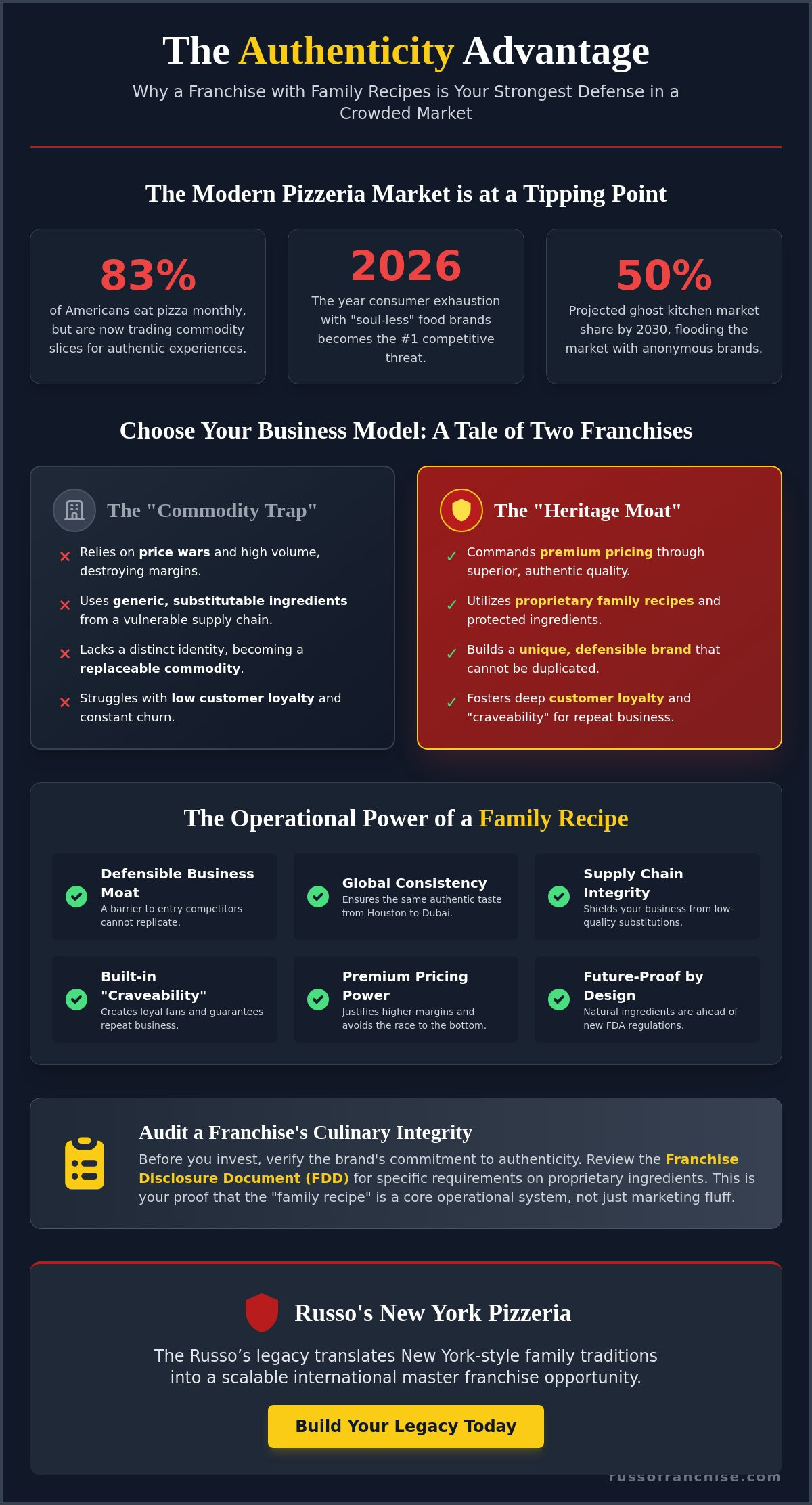
Comparing Heritage-Led Models vs. Corporate Fast-Food Franchises
Entering the pizza industry often presents a choice between becoming a high-volume commodity or a premium destination. Corporate fast-food franchises rely on ultra-processed ingredients and massive advertising budgets to drive traffic through deep discounting. In contrast, a franchise with family recipes builds its success on pricing power. When your product is unique, you aren't forced to compete in "two-for-one" price wars that erode your profit margins. This distinction is vital in 2026, as consumers increasingly seek out "real food" experiences over generic slices that lack a distinct culinary identity.
Staffing and operational culture also differ significantly between these two models. Fast-food assembly lines often suffer from high turnover because the work is repetitive and disconnected from the final product. Heritage kitchens, however, foster a sense of pride. Employees are taught to hand-toss dough and simmer sauces from scratch, turning a job into a craft. This engagement leads to higher retention rates and a more stable labor cost, which is essential given the current economic climate. Understanding the broader franchise model benefits helps owners see how a strong brand culture contributes to both local economic stability and long-term business health.
The Economics of Scratch-Made Dough
Making dough in-house is a financial masterstroke that many investors overlook. While pre-frozen dough pucks offer convenience, they come with higher shipping costs and lower quality. Preparing dough on-site using flour, water, and yeast drastically reduces the cost of goods sold while delivering a superior texture and flavor that justifies a higher menu price. This approach allows owners to maintain healthy margins without resorting to aggressive discounting. For those analyzing the market, this guide to premium Italian investments in 2026 provides a deeper look at how quality ingredients translate into financial performance.
Brand Equity and Exit Strategy
The long-term value of a franchise with family recipes lies in its resale potential. Heritage brands command higher resale values because they possess a "moat" that generic chains lack. When it's time to exit the business, a buyer isn't just purchasing equipment; they're acquiring a legacy-driven brand with a loyal customer base. The Italian kitchen segment remains one of the most stable categories in the global market, providing a level of security that "trendy" or "cheap" brands cannot match. High franchisee turnover is often the hallmark of brands that compete solely on price, whereas heritage-led models offer a refined path toward a lasting legacy.
How to Audit a Franchise’s Culinary Integrity Before You Invest
Due diligence for a premium investment requires looking past the glossy marketing brochures to verify the brand's operational soul. Before you commit to a franchise with family recipes , you must perform a rigorous audit of its culinary integrity. This process ensures that the "heritage" being sold is a functional business asset rather than a superficial slogan. A truly heritage-driven brand provides a refined, time-tested path that relies on specific, proprietary methods that generic competitors cannot replicate. Your goal is to identify a model where excellence is a disciplined standard, not an occasional accident.
Start your investigation with the Franchise Disclosure Document (FDD), specifically focusing on Item 8. This section outlines the restrictions on sources of products and services. A legitimate heritage brand will mandate the use of proprietary ingredients, such as specific spice blends or house-made sauces, to ensure consistency across the network. If the FDD allows for generic, broadline substitutions for key flavor components, the brand's culinary moat is likely thin. Professional investors look for a system that protects the "Gold Standard" of the kitchen through strict quality controls and a clear refusal to use frozen, pre-processed shortcuts.
The Founder-Led Difference
A founder who is also a trained chef, such as Anthony Russo, brings a level of meticulous craftsmanship that a purely corporate executive cannot replicate. When evaluating a franchise with family recipes , ask the founder about the specific origins of their signature dishes. Real heritage has a timeline, such as the 1992 founding of the Russo’s brand, and a geographical root in traditional Italian regions. "Fake heritage" often lacks these concrete details, relying instead on vague stories of "old-world style" without any proprietary substance. A chef-led blueprint ensures the training program teaches the "why" behind every technique, from the chemistry of the dough to the slow-simmering of the marinara.
Supply Chain and Quality Control
Verifying the source of key ingredients is a non-negotiable step in your audit. In 2026, transparency is a requirement, especially with the FDA's national phase-out of "The Big Six" food dyes by December 31. You should investigate whether the franchisor uses vine-ripened tomatoes, unbleached flour, and real mozzarella. These choices aren't just about taste; they're about long-term profitability and meeting the dietary preferences of modern consumers. A robust franchisor will have a system for auditing unit-level quality to prevent the "quality drift" that often plagues fast-food chains. If you're ready to lead a brand that prioritizes these standards, consider exploring a franchise opportunity that values authenticity as much as you do.
The Russo’s Legacy: Scaling Authentic Italian Kitchens Internationally
The story of Chef Anthony Russo didn't begin in a corporate boardroom; it started in a family kitchen where every ingredient told a story. Since the official founding in 1992, the brand has focused on a singular mission: bringing the sophistication of New York-style Italian cuisine to the world. This franchise with family recipes has successfully transitioned from a local favorite to a global powerhouse by refusing to compromise on its culinary soul. Scaling an international master franchise requires more than just logistics. It demands a deep respect for the original blueprint while possessing the entrepreneurial confidence to enter diverse new markets.
Translating these heritage-driven recipes for global audiences involves a meticulous attention to detail. We ensure that the proprietary spice blends and slow-simmered sauces remain consistent, whether the kitchen is in Houston or Riyadh. This reliability is why our partners trust the model. We've proven that the "Italian Kitchen" feel is a universal language that resonates with guests across every continent. By providing a stable and refined path, we allow franchise owners to focus on hospitality and growth rather than reinventing the wheel in the kitchen.
Authenticity Without Borders
One of the most significant strategic advantages of our model is the halal pizza franchise adaptation. This specialized approach allows us to bring our family legacy to diverse cultures while strictly adhering to local dietary requirements. It’s a game-changer for expansion in the Middle East and Southeast Asia, where transparency and quality are paramount. The International Master Developer acts as a guardian of this integrity. They work closely with the corporate team to ensure that the "Gold Standard" of every Russo's dish is maintained without shortcuts. This partnership preserves the brand's prestige while allowing for rapid, disciplined growth.
Your Future with Russo’s New York Pizzeria
The support system for our developers is built on the heart of a family-oriented guide. We provide a thorough blueprint for both single-unit and multi-unit expansion, covering everything from site selection to advanced kitchen technology. You don't have to navigate the complexities of the industry alone. We've already perfected the traditional craft and the business model, making this a safe and exciting opportunity for ambitious investors. It’s time to secure a legacy-driven business that values craftsmanship over convenience. We encourage you to explore the pizza franchise opportunities available today and discover how tradition drives profitability in 2026.
Secure Your Legacy in the Future of Authentic Dining
The 2026 market demands a return to substance over speed. You've discovered how authentic traditions serve as a powerful business moat, protecting your margins from the commodity trap of generic pizzerias. By prioritizing culinary integrity and proprietary ingredients, you build a brand that commands loyalty and resists economic volatility. Investing in a franchise with family recipes isn't just about buying a restaurant; it's about acquiring a time-tested blueprint for operational excellence and long-term profitability.
Since 1992, Chef Anthony Russo has led our brand with a commitment to craftsmanship that corporate assembly lines simply cannot replicate. Whether you're interested in a local unit or a global international master franchise with our halal-certified models, the path to success is already refined and ready for your leadership. Don't settle for a generic business when you can lead a brand with a soul. Your journey toward a prestigious, legacy-driven business begins with a single, authentic step.
Frequently Asked Questions
What qualifies as a "family recipe" in a franchise model?
A family recipe is a proprietary culinary formula passed down through generations and codified into a scalable business system. These aren't just simple instructions; they're the intellectual property that defines the brand's unique flavor profile. In our model, this includes everything from the specific hydration levels of the dough to the slow-simmering techniques used for our signature marinara sauce.
Is it harder to manage a franchise that cooks from scratch?
While scratch-made kitchens require disciplined standards, modern operational systems make them highly manageable for dedicated owners. We provide a refined, time-tested path that simplifies complex culinary tasks into repeatable, documented steps. This ensures that a franchise with family recipes can maintain high quality without needing a master chef in every kitchen, as the system itself acts as the expert guide.
Do family recipes actually improve the ROI of a pizza franchise?
Proprietary recipes improve ROI by creating pricing power and protecting your margins from commodity price wars. When you offer a unique flavor profile that guests can't find elsewhere, you reduce the need for aggressive discounting to drive traffic. Additionally, making dough and sauces in-house using raw ingredients is often more cost-effective than purchasing pre-processed, frozen alternatives that carry high shipping markups. Using a franchise with family recipes as your foundation ensures you aren't just selling food; you're selling an exclusive experience.
How does Russo’s protect its proprietary recipes from being copied?
We protect our culinary IP through a combination of legal safeguards and centralized supply chain control. Our signature spice blends and key flavor components are produced centrally and distributed only to authorized partners. This prevents competitors from reverse-engineering our menu while ensuring that the "Gold Standard" of our kitchen remains consistent across all international territories, from New York to the Middle East.
Can family recipes be adapted for Halal or other dietary standards?
Our heritage-driven model is intentionally designed to be inclusive, offering a successful Halal pizza franchise framework for global markets. We maintain the integrity of our original family flavors while sourcing certified ingredients that meet specific cultural and religious requirements. This flexibility allows the brand to scale into diverse territories without losing the authentic Italian kitchen feel that has defined our legacy for decades.
What kind of culinary training does Russo’s provide to new franchisees?
We provide intensive, founder-led training that covers the philosophy behind every traditional technique. New partners spend significant time in our kitchens learning the art of hand-tossing dough and simmering sauces to perfection. This hands-on guidance ensures you have the entrepreneurial confidence to lead your team and maintain the meticulous standards required for a premium dining experience from day one.
Why is a founder-led franchise better than one owned by a private equity firm?
A founder-led brand prioritizes quality and craftsmanship over short-term financial engineering. Chef Anthony Russo remains deeply involved in culinary development, ensuring the brand stays true to the standards established at our founding. Private equity firms often prioritize aggressive cost-cutting and commodity scaling, which can erode the unique brand trust and heritage that drive long-term profitability and customer loyalty.
Does a heritage brand require more expensive equipment, like brick ovens?
Authenticity does require specific tools, such as our signature brick ovens, but these are strategic investments in product quality. These ovens are essential for achieving the specific crust texture and flavor profile that guests expect from a premium Italian kitchen. While the initial setup is professional and polished, these assets provide a distinct competitive advantage that generic fast-food equipment simply cannot match.